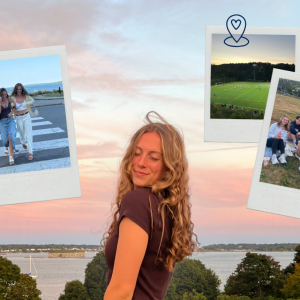

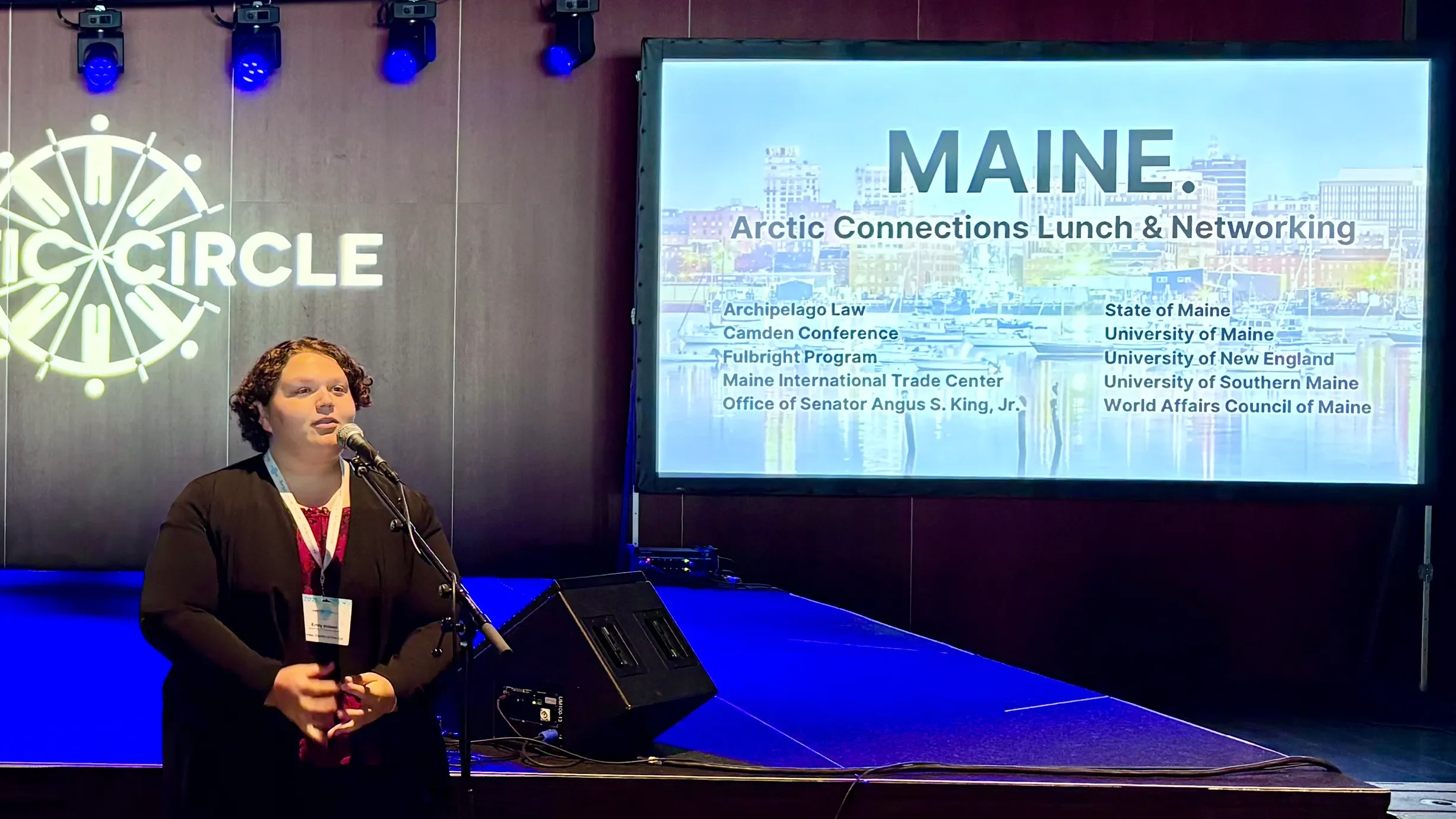
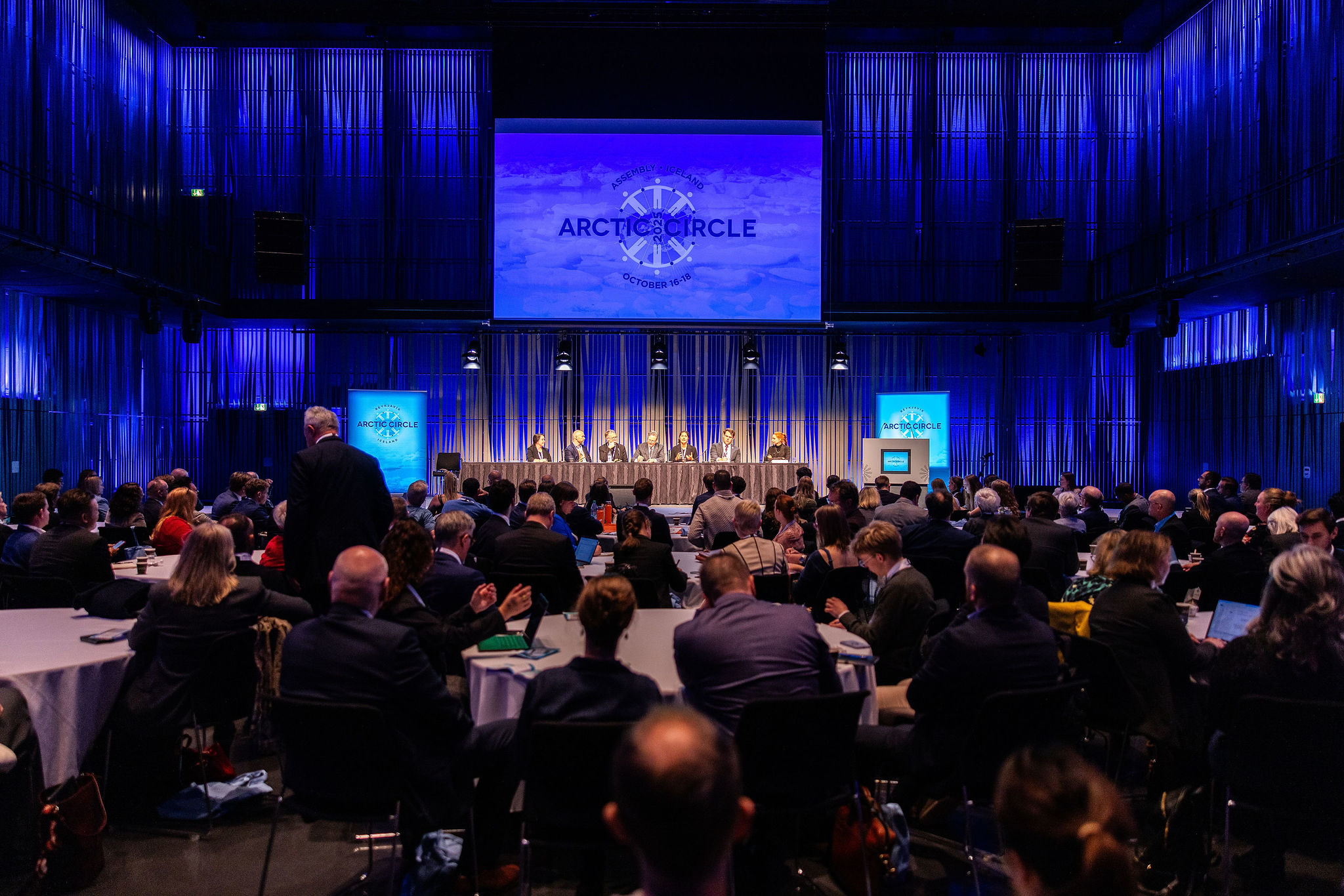
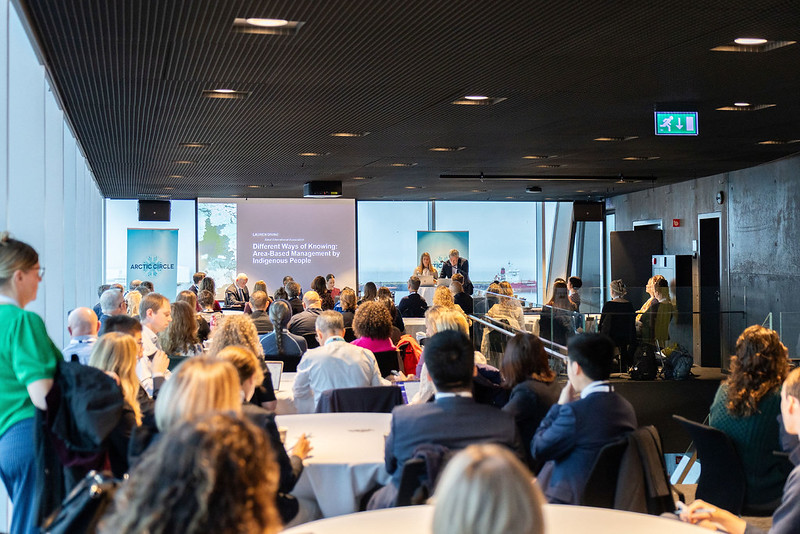
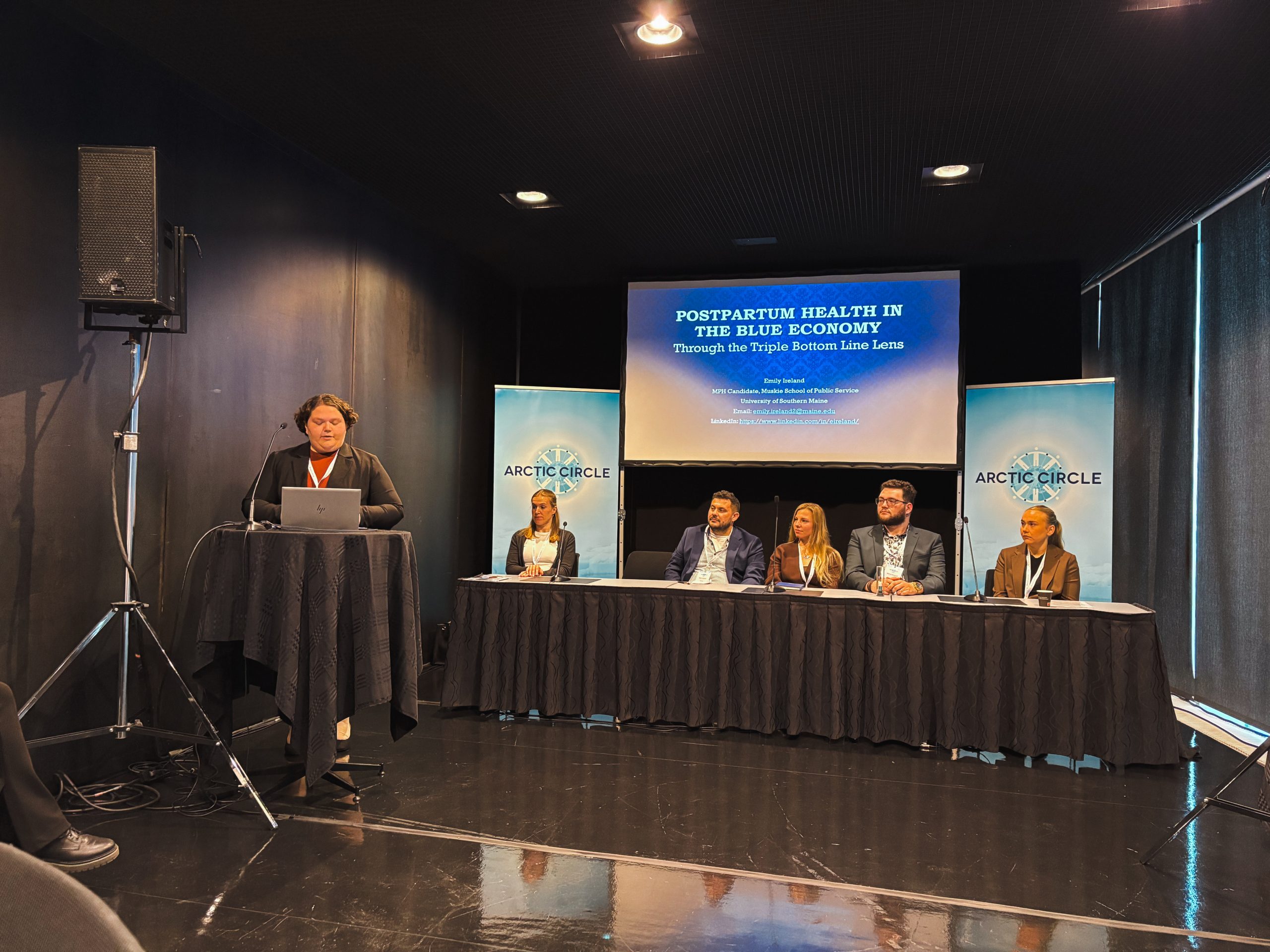
Emily Ireland felt her nerves kicking in as she stood at the podium and looked out into the conference room in Reykjavik. The Arctic Circle Assembly had drawn scientists, diplomats and engineers from all over the world, and the room was filling up quickly. All morning, presenters had discussed everything from deep-sea mining and solar power to international internet laws. Now Emily, a graduate student pursuing her master’s in public health, was up.
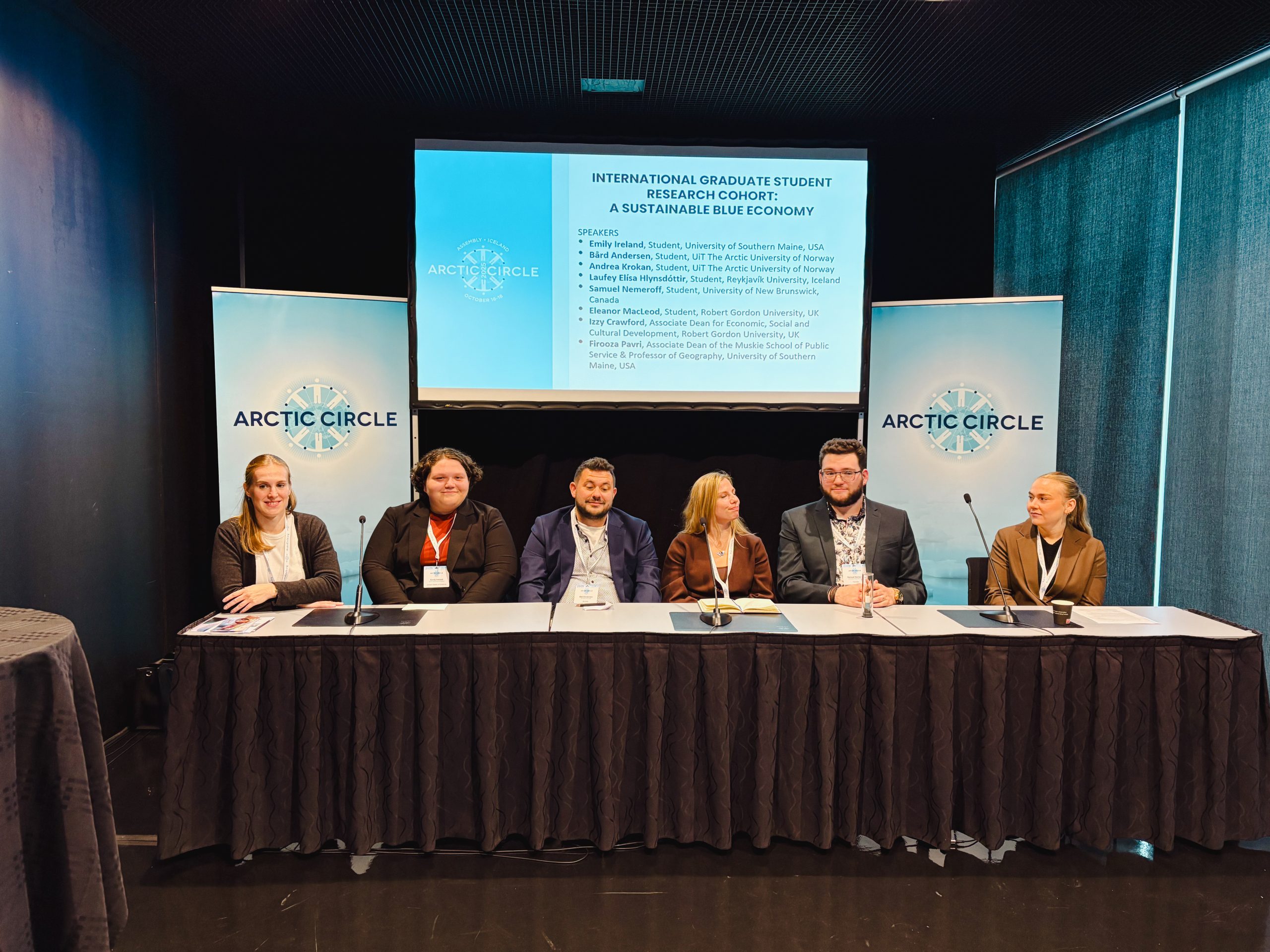
She was presenting as part of an international student cohort focused on the “blue economy” — the sustainable use of ocean resources for economic growth — but her research was unexpected. While her fellow student presenters discussed technology and infrastructure, Emily’s focus was on maternal death rates. Her argument was simple: you can’t achieve economic development if you haven’t addressed the basic health of the people driving it.
Where it all began: how Emily discovered maternal health
Born an hour outside of Portland, Emily’s journey to this moment started long before she ever knew she would go to Iceland. As an undergraduate at USM studying social and behavioral science, she still wasn’t sure what she wanted to do.
It all clicked for her during an internship at MaineHealth, where she helped people navigate the complexities of health insurance as a case manager. USM had just launched an accelerated Master’s in Public Health program where she could start grad courses senior year — so she decided to go for it.
“I wanted to stay here,” she said. “And here we are.”
A dream deferred, then realized: how Emily finally got to Iceland
Now in her second year of the MPH program at the Muskie School and set to graduate in May, Emily’s road to Reykjavik began with a missed opportunity from her undergrad years.
“I was enrolled in the Honors Abroad in Iceland class, and unfortunately, the year that I qualified for the class, it didn’t run. Then I couldn’t fit it into my schedule the following year. So I never got to go on that trip,” she said. “It was kind of upsetting, because I was looking forward to going to Iceland for a long time.”
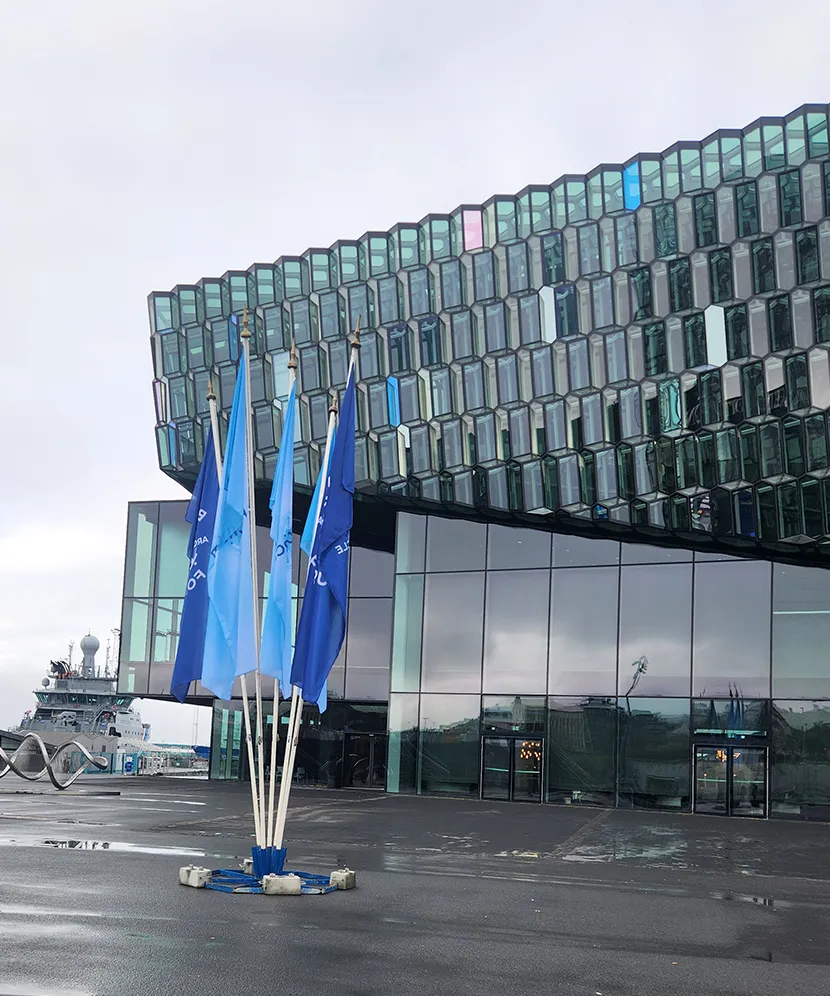
Then, during her first year of grad school, an email landed in her inbox about a research opportunity in Iceland — a chance to travel to Reykjavik and present at the ACA. She was ready to go.
“I like research, I like Iceland, let’s make it happen,” she said.
Emily had always been drawn to Iceland. She loves winter — an admittedly uncommon trait — and had always wanted to see the northern lights, which she’d somehow never caught in Maine.
Not only was this a chance to finally visit Iceland, but also an opportunity to join an international cohort and present at a global conference — a chance to meet world leaders and share research that could actually influence policy.
“I like research, I like Iceland, let’s make it happen.”
Emily Ireland ’24, MA ’26
Master’s in Public Health
The challenge: making maternal health fit into the blue economy
The cohort’s research had to center on the blue economy, with each student applying the ‘triple bottom line’ framework — people, planet, profit — to their work.
“I decided to focus mostly on the people part of it,” Emily said. “I kept thinking, ‘I’m interested in maternal health, so I’m going to make it fit somehow.’ And if I was going to talk about people, I wanted to talk about mothers.”
Emily quickly realized she was the only student coming from a social science background. The others were, as she put it, ‘very science-y.’ As they continued their bi-monthly Zoom meetings, she grew to appreciate how interconnected all the topics were.
“Even though we all had very different topics, we all influenced each other,” she said.
Her own research — guided by faculty support from Tracy Meagher, who coordinates the graduate cohort, and Dean Firooza Pavri — compared maternal death rates across the U.S., Canada, Iceland and Norway. The numbers were stark: the U.S. maternal death rate sat at 24 per 100,000, while Norway’s was statistically zero.
Emily initially hypothesized that different postpartum care practices drove the gap, but the medical protocols were nearly identical. For her, the red flag wasn’t the differences themselves — it was the surprising lack of research explaining them.
“You can’t think about the blue economy without thinking about healthcare and the people impacted by it, particularly maternal and child health. It’s such an overlooked area that you can barely find any information on it,” said Emily.
You can’t think about the blue economy without thinking about healthcare and the people impacted by it, particularly maternal and child health.
Emily Ireland ’24, MA ’26
Master’s in Public Health
Five minutes to make an impact: presenting on an international stage
After months of research and preparation, the moment arrived. With just minutes to speak, Emily distilled nearly a years-worth of work into a presentation meant to challenge assumptions and spark conversation.
Her closing statement was a call to action: “In 2023, based on this rate, over 800 women died from giving birth. Let’s figure out why.”
The audience had been thinking about technical systems and infrastructure all morning. Emily’s presentation reframed the conversation around the people those systems are meant to serve.
“I think it was almost an eye opener for a lot of people,” Emily said. “The conference was very technical — people sitting in rooms all day talking about technology. And then having five whole minutes to talk about something completely different. Afterwards, I ended up having really good conversations about maternal and child health in the Arctic region and what that could look like moving forward.”
The presentation opened doors Emily hadn’t anticipated.
You can get there from here: building professional and international connections
Since presenting in Reykjavik, Emily has built connections that extend far beyond the conference. She was put in touch with directors at the University of New England, expanding her network in Maine’s maternal and child health community. She also connected with professionals at MaineHealth who work directly in the field.
Beyond these professional connections, the experience brought her closer to her cohort in ways she hadn’t expected.
“I didn’t know if we would be able to stay in touch afterwards because the research process itself was very solitary,” she said. “But after meeting everyone, I was like, ‘Oh, we’re staying in touch.’”
As she nears graduation, Emily is balancing her studies with a full-time position at Partners for World Health, a Portland-based nonprofit focused on redistributing unused medical supplies globally. She is now applying to PhD programs in maternal and child health, looking forward to the next chapter of her work.
Embracing curiosity: advice for students interested in USM’s North Atlantic Cohort
Emily’s advice for students considering joining the cohort is simple:
“Even if you’re not sure, go for it,” she said. “My main reason when I started was, ‘Yeah, I want to go to Iceland — I’ll figure it out along the way.’ If you have something you’re passionate about, you will find a way to connect it.”
She took that approach all the way to Reykjavik, presenting her research to an international audience. She didn’t have a perfectly mapped-out plan. But she did have curiosity, support, and a willingness to make unexpected connections. Plus, she finally saw the northern lights — dancing across the Arctic sky, reflecting on the water during a late-night cruise.
Want to go to Iceland like Emily? Learn more about USM’s Honors Abroad in Iceland program and how you can join future trips.

Curious about Public Health at USM?
Through USM’s accelerated pathway, Emily started her graduate coursework during undergrad—giving her a head start on her Master’s degree.