

The University of Southern Maine CubeSat Design Challenge (UCDC 2026), in collaboration with NASA, the Maine Space Grant Consortium, and the UMaine High-Altitude Ballooning Club, is pleased to accept registrations from grade 6-12 students across Maine to design, build and operate a CubeSat capable of meeting one of our five mission challenges. Unlike previous USM CubeSat programs, this year’s challenge is not a head-to-head competition; instead, this year’s program challenges teams to achieve specific technological goals specified within five unique and exciting challenge categories. Teams that successfully achieve the challenge goal will be awarded a trophy and distinction on our website’s hall of fame.
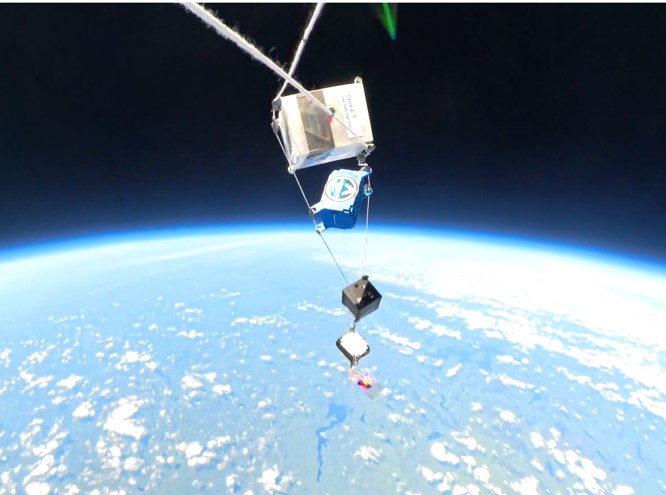
The challenges are designed to push student teams to collaboratively perform complex engineering tasks, spur creativity, and gain valuable experience needed to be a successful engineer. The UCDC 2026 program aims to reach ALL Maine students in grades 6-12 at any level of educational preparedness.
The challenges will:
- Engage students in STEM experiential learning and consider future careers within the space industry
- Increase student confidence in STEM through problem solving within a real space mission experience
- Allow students to develop and practice soft career skills, such as teamwork, leadership and project management
- Help build interest and technological skills in Maine’s future space industry workforce
>>>>Click Here for Free Team Registration<<<<
CHALLENGE DETAILS
UCDC 2026 challenges are designed to require students to perform a science or technology mission in areas common to space exploration demands. The challenges are distributed across five mission categories. Teams must choose a single category to compete in. Teams will need to meet or exceed the success criteria specified under the challenge category while also meeting the specific engineering constraints detailed below.
Engineering Constraints
Each CubeSat, regardless of challenge category, must be designed to meet the following basic mission requirements.
- Must meet 1U CubeSat form factor (10cm X 10cm X 10cm outside dimensions)
- Must weigh less than 300 grams (0.66 lbs.)
- Must have on-board battery power
- Must survive a vibration frequency sweep on USM’s shaker table
- Must be constructed for less than $150 (challenge required hardware not included)
- Must have 4 external anchors points on the CubeSat (for ballooning flight)
The competition registrants are judged on the overall quality of submitted designs, creativity and uniqueness of approach within the chosen missions. Student teams are also assessed on anticipated benefits to the scientific and engineering communities based on their designs.
Challenge Categories
Registration and Team Specifications
Registration
Entry into the CubeSat Challenge is free to all participants. Each team must register following the instructions and forms outlined. Registration is open until February 20, 2026. The challenge will be limited to a total of 24 teams due to high-altitude ballooning ride share restrictions. Teams will be enrolled on a first-come, first-served basis. Additional registrations will be accepted, but overflow teams will be waitlisted as alternates for the balloon flight in May.
Each registering team will receive the following:
- Enrollment into a USM CubeSat development virtual course providing instructions into the design and operation of CubeSats. The course will cover topics such as computer-aided design, Arduino programming, wiring basics and mission planning.
- An assigned USM mentor to provide technical resources and guidance on the project.
- A commemorative USM CubeSat challenge tee-shirt.
To register and receive your CubeSat starter kit: Complete the online registration form at the top of this page.
Team Specifications
Teams must consist of at least one student and one teacher (or parent) from their respective educational institutions. The teacher (or parent) must have the support of the educational institution for organizing in-school / afterschool activities and in-State travel. There are no limits on maximum team size. Each school can have more than one team. Teams may work with external consultants on any aspects of their design. All contributing team members should be credited on the team roster, which is submitted with the project.
Challenge Process
Beginning the Challenge
Teams may begin working on their CubeSat designs directly after registration in the program. Teams will be provided required hardware specified in their challenge category as soon as registration is completed. Teams will submit purchase requests for additional CubeSat hardware and components to the program via email. The University of Southern Maine will purchase all hardware and components and mail the components to the registration address provided. All costs will be tracked and verify that overall CubeSat costs are within $150/CubeSat.
Pre-Flight Qualifications
All CubeSats must be pre-qualified for flight on the high-altitude balloon to complete the challenge. Qualifications will be completed on the fully-assembled CubeSats by the University of Southern Maine faculty and staff during the week of May 18th. Teams may travel to USM to complete the qualification testing, or request a visit at your school location in advance. Pre-flight qualifications include visual inspections, form factor verifications, vibration testing qualifications, weight verifications and CubeSat operation verifications according to challenge guidelines detailed at the top of the page.
Challenge Flight Details
The CubeSat Challenge high-altitude balloon flight is scheduled for Saturday, May 23rd with a rain date of Sunday, May 24th. The flight location will be determined based on weather conditions. At least one team representative is required to attend the flight to handle the CubeSat startup and participate in balloon payload and launch operations. The University of Southern Maine staff will track the payloads during flight and recover flight hardware.
Challenge Assessment
The recovery team will assess the state of the hardware and take pictures of the CubeSats as recovered after launch. Depending on the nature of the challenge, the USM team may also remove data storage cards and review flight data. Based on the evidence, the USM judges will determine each team’s achievement within their respective challenge. Teams deemed successful in the challenge will be provided a trophy and place on the USM CubeSat challenge “Wall of Fame”.
Our Sponsors
Generous support of our program & mission provided by: