


The University of Southern Maine’s first comprehensive Economic Contribution Study finds the University generated $384.5 million in statewide economic activity in the last fiscal year. That activity supported 2,582 jobs across Maine and contributed $56.4 million in tax revenues to local, state, and federal governments. Together, those figures illustrate USM’s position as a major economic engine for Southern Maine and the state as a whole – creating jobs, driving research, and developing the skilled workforce Maine depends on.
Preparing graduates who power Maine’s workforce

The study highlights one of USM’s most significant contributions: the number of graduates who choose to stay and work in Maine. Sixty-three percent of alumni remain in the state after earning their degrees, including 36 percent of out-of-state students. These graduates often move directly into high-need industries such as healthcare, education, public service and business management – areas that align closely with the state’s workforce priorities.
The report also points to the University’s growing emphasis on applied learning and career preparation. In the last year alone, USM students completed 3,248 placements through the Career Hub, working with 183 Maine businesses and 148 public and nonprofit organizations. More than 57 percent of students reported completing at least one or two internships during their studies, giving them both professional experience and a pathway to full-time employment after graduation.
Measuring USM’s statewide contribution
Prepared by Dr. Rachel Bouvier, Associate Professor of Economics, and Caroline Paras, the study measured the ripple effects of University operations, construction projects, student spending, and visitor activity across Maine’s economy. Using the IMPLAN modeling system, the analysis found that USM generated $263.8 million in value added, a measure comparable to the state’s gross domestic product. It also supported $197 million in wages distributed across multiple sectors, from construction and retail to professional services and the arts.
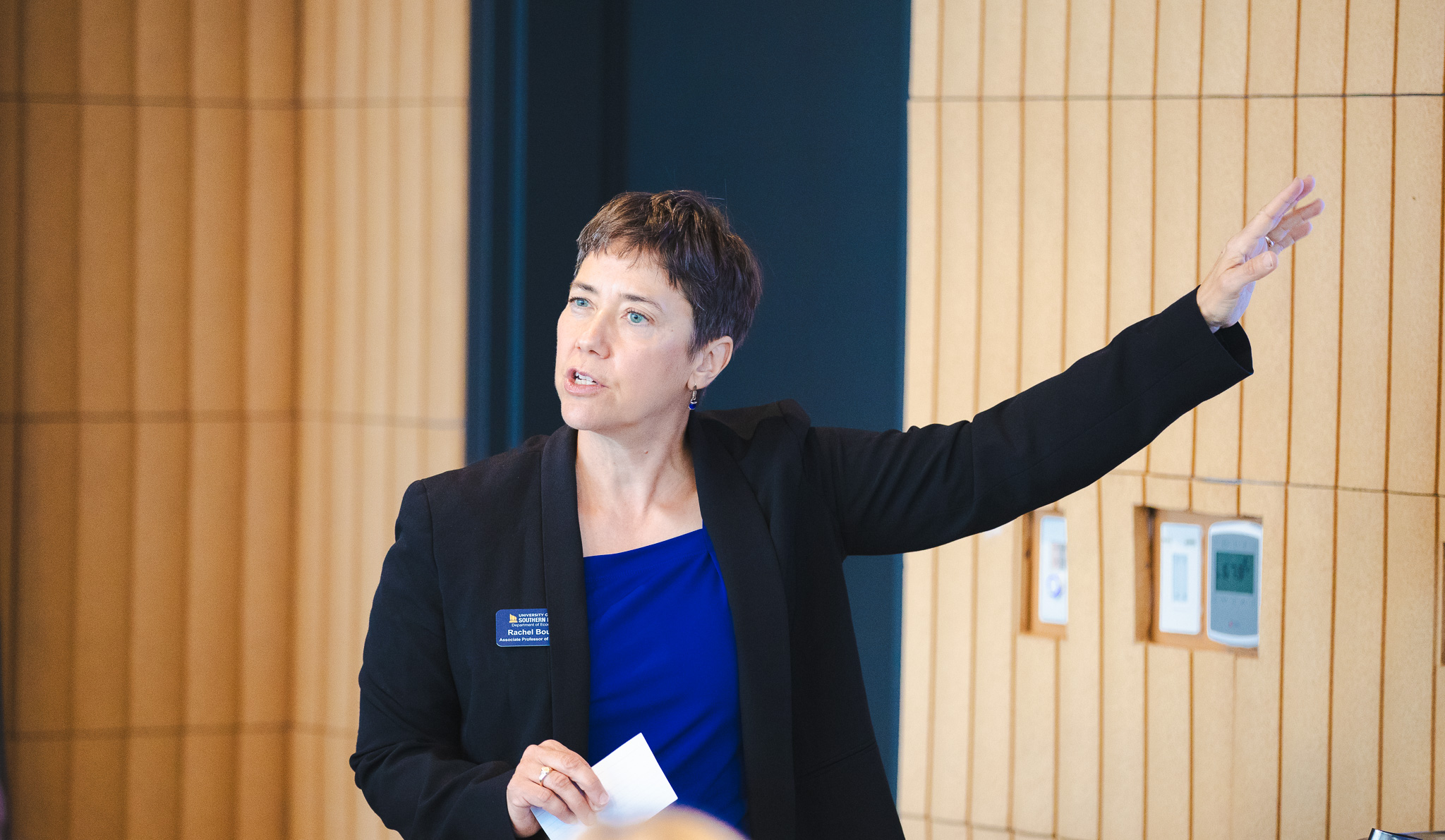
“The total economic contribution of USM, including the direct, indirect and induced effects, is over $380 million.” said Bouvier.
The report estimates that for every $1 in state appropriation to USM, the University returns nearly $6 in overall statewide output and about $4 in direct economic value. That return reflects both the University’s fiscal impact and its broader influence on Maine’s workforce pipeline and community well-being.
“We also support about $56 million in taxes,” said Bouvier. “A lot of that is federal, but about $6 million of that is in local taxes, and $11 million from state taxes.”
Connecting education to Maine’s economy
The report shows USM as a hub of innovation and support for Maine’s business community. Programs such as the Maine Small Business Development Centers, headquartered at USM, provided advising and training to 1,092 businesses last year, including 155 startups and seven publicly traded companies. Other University initiatives, like the QC² Lab for quality control in craft brewing and the Composites Engineering Research Lab, extend technical and scientific resources to Maine manufacturers, entrepreneurs, and startups. USM is investing further in strategic opportunities to connect the university’s resources and Maine’s economy with the newly formed Office of Commercialization.
Research and public service through the Catherine Cutler Institute contributed nearly $25 million in grants and contracts last fiscal year, accounting for about 75 percent of USM’s total research activity. Much of that work informs public policy, health outcomes, and community development across the state.
“We say ‘contribution’ rather than impact, because impact implies what would happen if the university did not exist. And a contribution, on the other hand, is that we are supporting economic activity throughout the state.” Bouvier explained.
Extending learning and innovation across Maine
Beyond degree programs, USM fosters lifelong learning and community engagement on a broad scale. The Osher Lifelong Learning Institute enrolled 1,845 learners aged 50 and older, offering opportunities for continued study and connection.

“On the K-12 side, we bring almost 15,000 students to campus every year for early college, as well as summer camps in athletics, in STEM, and in music. And these are really important because they serve as a recruitment tool for the University of Maine system, while also engaging students in multi-day itineraries that expose them to campus life so they can begin to see themselves going to college someday.” said Caroline Paras, Research Analyst for Maine Center for Business & Economic Research.
Visitor and cultural engagement also generate measurable economic benefits. The University hosted more than 63,000 attendees for ticketed arts performances, lectures, and athletic events, generating local spending on food, lodging, and entertainment. Together, these experiences reinforce USM’s role as both a cultural destination and a public resource for southern Maine.
Sustainability remains an integral part of that outreach. The University’s campuses feature LEED-certified and Passive House buildings, 58 Level-2 electric vehicle chargers, and free regional transit for students and employees – initiatives that reduce costs and emissions while supporting Maine’s environmental goals.
Building a baseline for Maine’s future
The Economic Contribution Study provides USM and the state with a clear baseline for understanding how higher education drives economic growth, workforce stability, and community well-being. By quantifying not only spending but also the University’s social and educational reach, the report provides data to guide future investment, planning, and partnerships among USM, policymakers, and Maine employers.
Dr. Bouvier and Paras recommend updating the study every few years to capture the evolving effects of USM’s programs, new facilities, and workforce initiatives. Tracking those changes over time, they note, will help both the University and the state measure the long-term value of investing in higher education and the people it serves.
Learn more
The USM Economic Contribution Study 2025 is available here.