

“Imagine being at home and you just replaced your old cathode ray tube television with an 8K digital screen,” said Tom Bickford, director of STEM outreach at the University of Southern Maine. “It’s going to be like, ‘Wow, we used to watch that?'”
That’s the kind of transformation visitors will see this January at USM’s Southworth Planetarium as it undergoes its first major upgrade in over a decade. The 55-year-old facility will debut a brand-new projector system expected to transform the space-traveling experience for its 15,000 annual visitors.
The planetarium is the only one in Southern Maine, making it a rare educational resource in a state that lacks a major science museum, zoo or aquarium.
“If you were either an adult or a child that was really interested in science, where would you go?” Bickford asks. “Other than here, you would have to go a long way to find a good option.”
What’s new and improved
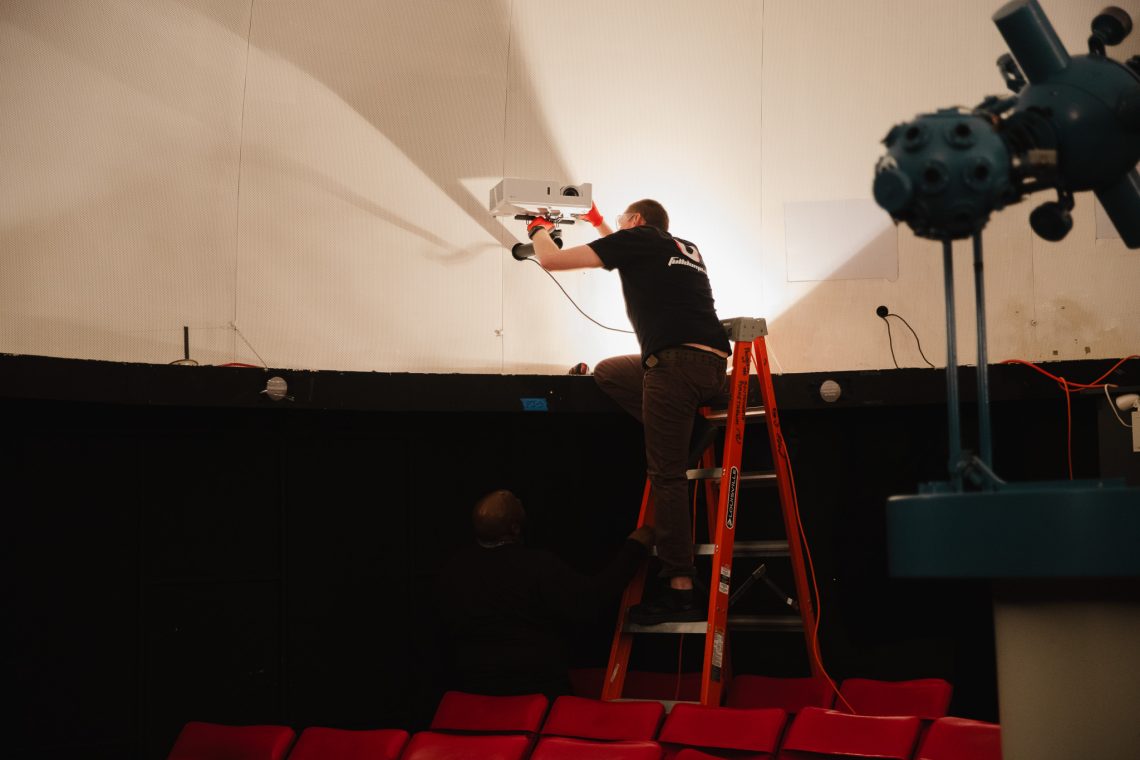
For the last decade, the planetarium has relied on a single 2K projector that bounces light off a mirror to cover the dome. The upgrade replaces it with eight projectors positioned around the space, projecting directly onto the dome for a brighter, sharper viewing experience.
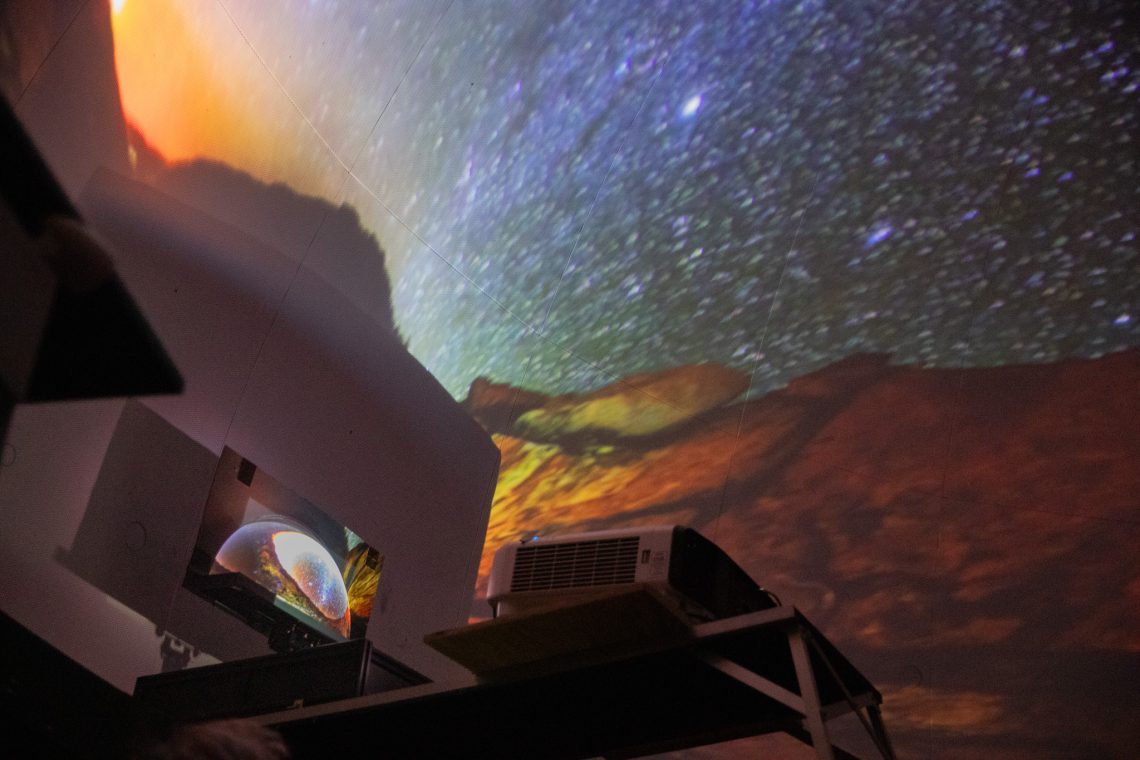
“If you look closely now, you’ll see the pixels,” said Bickford. “The new system has eight times as many pixels – you won’t notice that you’re looking at pixels anymore. You’ll see a real theater experience.”
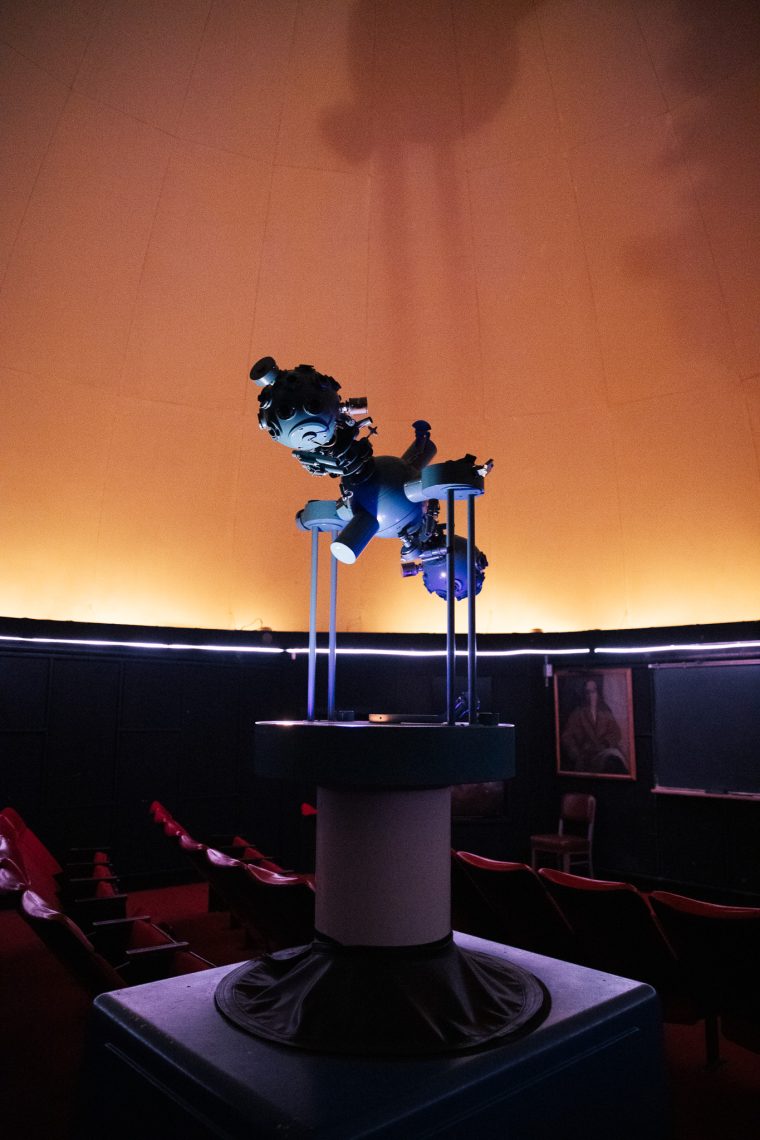
The upgrade will also enhance the planetarium’s star tour capabilities, which currently depend on the facility’s 1970s Zeiss star projector – a remarkable feat of mechanical engineering that requires highly specialized, ongoing maintenance. The digital projectors will offer far more flexibility, allowing staff to zoom in on celestial objects, overlay constellation patterns, and create interactive presentations that weren’t possible before.
In addition to the new projector system, the planetarium will replace its current two-speaker stereo setup with a six-speaker surround sound system, allowing audio to move through the space in sync with on-screen action.
“Say you’re watching a dinosaur walk around the screen,” said Bickford. “You would hear the audio walk around with the dinosaur.”
The visual and audio upgrades total $105,000. The university is funding the majority with a $100,000 investment from one-time savings in the previous fiscal year. The remaining costs will be supported by donations from individuals and charitable foundations, which have been steadily increasing and will also support future improvements such as new seating, a modernized dome, and a redesigned entryway.
Serving the Southern Maine community
With roughly 15,000 visitors and 700 shows annually, the planetarium attracts a wide range of visitors. About half of its visitors are school groups, ranging from elementary through high school students, while the rest attend the frequent public shows that run throughout the week and on weekends.
“We have also had live musical performances here,” said John Haley, the planetarium’s manager. “In the past, it’s been hard to get the brightness needed to have those shows going on and show off the amazing visuals that come with the full dome projection. With the new projectors, it will be much easier to create more dynamic, engaging shows – and I’m really excited for that.”
Beyond serving as an educational and cultural hub, the planetarium fills a critical gap in a region without a major science or wildlife center. The upgrades will strengthen its role, expand programming, and attract more visitors.
“We are expecting to see attendance increase,” said Bickford. “It’ll be the new thing in town.”
Beyond sight and sound: Southworth’s long-term vision
The projector and sound upgrades are just the beginning of a five- to 10-year modernization plan. While this marks the most dramatic shift for visitors, other planned improvements will further strengthen the planetarium’s role as an educational resource and regional destination.
After the technology upgrades, new seating is the priority. The current seats are about 30 years old, and the planetarium is aiming to replace them by fiscal year 2027. Beyond that, the planetarium’s 55-year-old dome is ready for some well-earned attention – either by refurbishing its original perforated metal panels or by installing a modern inflated fabric dome designed for a seamless projection surface. Plans also include redesigning the entryway and transforming the wrap-around gallery into a space for hands-on science experiences.
Growing donor support, facilitated by the planetarium’s partnership with the USM Foundation, will help fund these future improvements.
“We’ve been trying to fix things up piecemeal here and there,” Haley said. “But the opportunity to take that experience – from when you walk in the door all the way into the planetarium – to the next level is exciting.”
In February, campus radio station WMPG will debut “Fridaze” – Friday evening shows from 5 to 7 p.m., pairing music with space imagery and testing out the system’s new capabilities. The collaboration will be the first of many, according to Haley and Bickford.
“The MIST Lab has talked about projecting VR experiences onto the dome, so instead of just one person with a headset seeing it, the whole audience could share that experience,” Haley said. “Biology faculty have floated ideas too. I think those conversations are just going to ramp up as word gets out.”
More than just a show: five decades of curiosity and discovery
For more than five decades, the planetarium has offered Mainers a unique window into the cosmos. Bickford estimates that over a million people have walked through these doors since its establishment, each experiencing something that can’t be replicated online.
“There’s a difference between going someplace and having an experience where you get all of your senses active than it is to just do it online,” Bickford said. “Until you’ve sat in a dome production watching a full dome theater presentation or the star show, it’s a much more immersive experience. And that’s what we can give them.”
As immersive experiences increasingly move online, Haley and Bickford see enduring value in live shows like those at the planetarium – the spark ignited when someone learns something new in person.
“Every once in a while you hear people give that ‘Oh wow’ at the end of a show,” Haley said. “You come to the planetarium and sit through a tour of the night sky, and that sparks something in people they don’t often get elsewhere. You can sit at home and watch YouTube, but to be immersed in something, to see it all around you and come away thinking about the world differently – there’s a lot of possibility there.”
The new projectors will debut Jan. 27 with the Audio Universe: Tour of the Solar System show series. The timing is ideal, with upgrades scheduled to be completed just ahead of February school vacation, one of the planetarium’s busiest periods of the year. Plan your visit and view the full show schedule to see the transformation for yourself.
“I want folks to leave here saying, ‘Wow,'” Haley said. “Thinking about new possibilities, inspired by curiosity. And with these upgrades, we’re only going to create more of those moments.”
Those moments are made possible through community support. To contribute to the planetarium’s continued improvements, visit the USM Foundation giving page.