

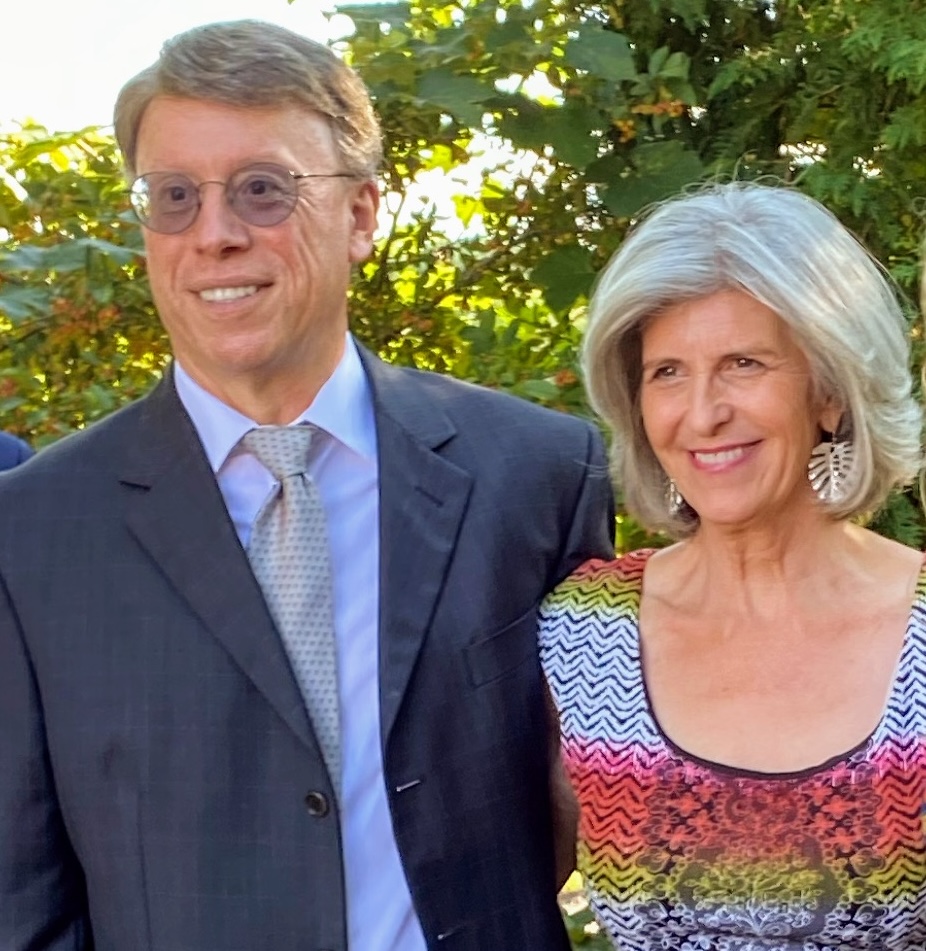
A 1977 graduate of the University of Southern Maine, Don Dodge, shown here with his wife and fellow Husky grad, Holly (Harper) Dodge ’79, was raised in Hollis Center, Maine, and graduated from Bonny Eagle High School before enrolling at USM (then UMPG). He began his career with McDonald Page and then Wishcamper Companies, later earning his MBA from Southern New Hampshire University. Don would go on to help shape some of the most transformative moments in modern tech—serving in leadership roles at AltaVista, Napster, Microsoft, and Google Ventures. Today, he is a General Partner at New North Ventures, as well as the Founder and Chairman of Chain Accel and a Board Member and Investor at Cyfrin. He lives in Maine and Florida with his wife and fellow USM alumna, Holly. Their two sons, Derek and Darren, both work in tech and have launched several ventures alongside their father.
USMF: How did a kid from Hollis, Maine find the confidence to build a career at the leading edge of the tech world? What gave you the sense that you could reach that high—and did USM contribute to that?
Don: I didn’t have a plan—and I couldn’t have. None of this existed when I started. There were no personal computers, no internet, no smartphones, no search engines. So even if I had made a plan, it would’ve been irrelevant. A lot of people climb the ladder so hard they miss opportunities that didn’t even exist when they started. I was open to those opportunities—and willing to take big risks.
USM – it was UMPG then – absolutely played a part. I met my wife here—we were paired on a business consulting project—and I got my business fundamentals there too. I actually started in the two-year business program because they didn’t think I could handle the four-year track. So, I earned my associate’s degree first, then proved to myself I could keep going.
I came from very humble beginnings. I tell people I come from a long line of underachievers. There weren’t role models or mentors where I grew up. But my first job was at McDonald Page—same as my dad—and from there, I moved to Wishcamper Companies. Working with Joe Wishcamper really changed my trajectory. He opened my eyes to bigger possibilities. Then I took a job in New Hampshire with Digital Equipment Corporation—at the time the second largest computer company in the world—and that launched me into tech.
USM gave me the discipline and understanding of business that helped me navigate what turned out to be a very unconventional, exciting career path.
USMF: A lot of USM alums weren’t straight-A students, but they’ve gone on to do incredible things. Where did your tenacity come from? Was there a defining moment?
Don: Working with Joe Wishcamper was one of those defining moments. He was the most disciplined, visionary person I’d ever met, and he became—and still is—a mentor.
But here’s another one: I had to take electives outside of business, and I ended up in a political science course. A professor told us there were internships available with Maine’s congressional delegation. I got one with Senator Muskie in Portland, which led to working on Senator Hathaway’s re-election campaign. Through that, I met Jimmy Carter, John Glenn, Ted Kennedy, John McCain. Later, I worked with Joe Brennan after he was elected governor.
That all came from a single elective—and a professor who opened a door. I always tell people: don’t over-plan your life. Stay open. The best opportunities are often the ones you didn’t see coming.
USMF: Looking back, how has your career shaped your view of Maine?
Don: I know a lot of successful people who come back to Maine because of the values here. It’s a great place to live. In tech, you see this a lot—David Roux (who helped create Android), Bob Metcalfe (inventor of Ethernet)—they all return to Maine. And people like Joe Wishcamper didn’t grow up here but came to love it. That says a lot about the pull of this state.
You can be successful from anywhere—especially now. You can live in Maine and work for Google. That’s the best of both worlds. I have a home in Hills Beach, close to where I grew up. It’s a grounding, comforting place.
USMF: What’s an achievement you’re particularly proud of?
Don: I’ve had the chance to be part of changing the world a few times. At AltaVista, we invented multimedia search—being able to search for images, video, music. Today it’s standard, but 27 years ago, it was impossible. Then it was Napster—which completely revolutionized the music industry.
Plus, simply coming from Hollis, Maine and ending up at the top levels of Microsoft and Google… that still feels unbelievable. But it happened. And now, I’ve started two tech companies, and a venture capital firm focused on defense and intelligence. I’ve been to the Pentagon and the CIA. That’s not a path anyone from my hometown could have imagined.
USMF: What advice would you give students trying to future-proof their education?
Don: Most people don’t end up working in the field of their college major. Sometimes that’s a good thing! What matters more than your major is how you learn.
The most important skill? Writing. If you can’t write, can’t express yourself clearly, you can’t lead. I wish I’d learned that sooner. And be adaptable. Keep learning. Don’t get locked into one plan—because that plan could be obsolete by the time you’re ready to act on it.
USMF: What’s your take on AI—like ChatGPT—and how it’s changing things?
Don: I’m not afraid of it. All software is about making things more efficient. That changes work, yes—but it creates new possibilities too. Look at stockbrokers, travel agents, admin assistants. Those roles changed or disappeared—but new ones emerged. If you don’t adjust, you’ll get left behind. That’s the throughline. Adjust, grow, stay curious.
USMF: What are you passionate about, outside of work?
Don: I live on a golf course in Florida and by the ocean in Maine, but I don’t golf, and I don’t boat. I just love the ambiance! What I really love is solving hard problems. If there aren’t any, I’ll go looking for them. I’ve invested in 65 companies trying to do just that—build better, faster, cheaper solutions. And I don’t think I’ll ever stop. It’s not about the money. It’s about winning. I want to win at things that seem impossible.
USMF: What’s the biggest challenge you’ve faced?
Don: In tech, the biggest challenge is solving problems that don’t have clear answers. And sometimes the timing just isn’t right. You can be too early. You can be right—but the market’s not ready. The smartest people revisit first principles and ask: what’s changed? Because what didn’t work five years ago might work now. It comes down to curiosity. Reimagining problems. Recombining old ideas in new ways. That’s the work I love.
USMF: Sounds like you might never retire.
Don: Oh, you’re totally right. Figuring out innovative solutions to problems that just haven’t been done before? That’s what excites me.