

As the lights dimmed in Maddy’s Theatre, a historic moment began to unfold in front of an audience of eager children. The theater’s production of “Stellaluna” would be the first American Sign Language-integrated production in the Children’s Museum & Theatre of Maine’s nearly 100-year existence – a milestone made possible with the participation of six University of Southern Maine students, alumni and faculty members.
A beloved story, reimagined for every audience
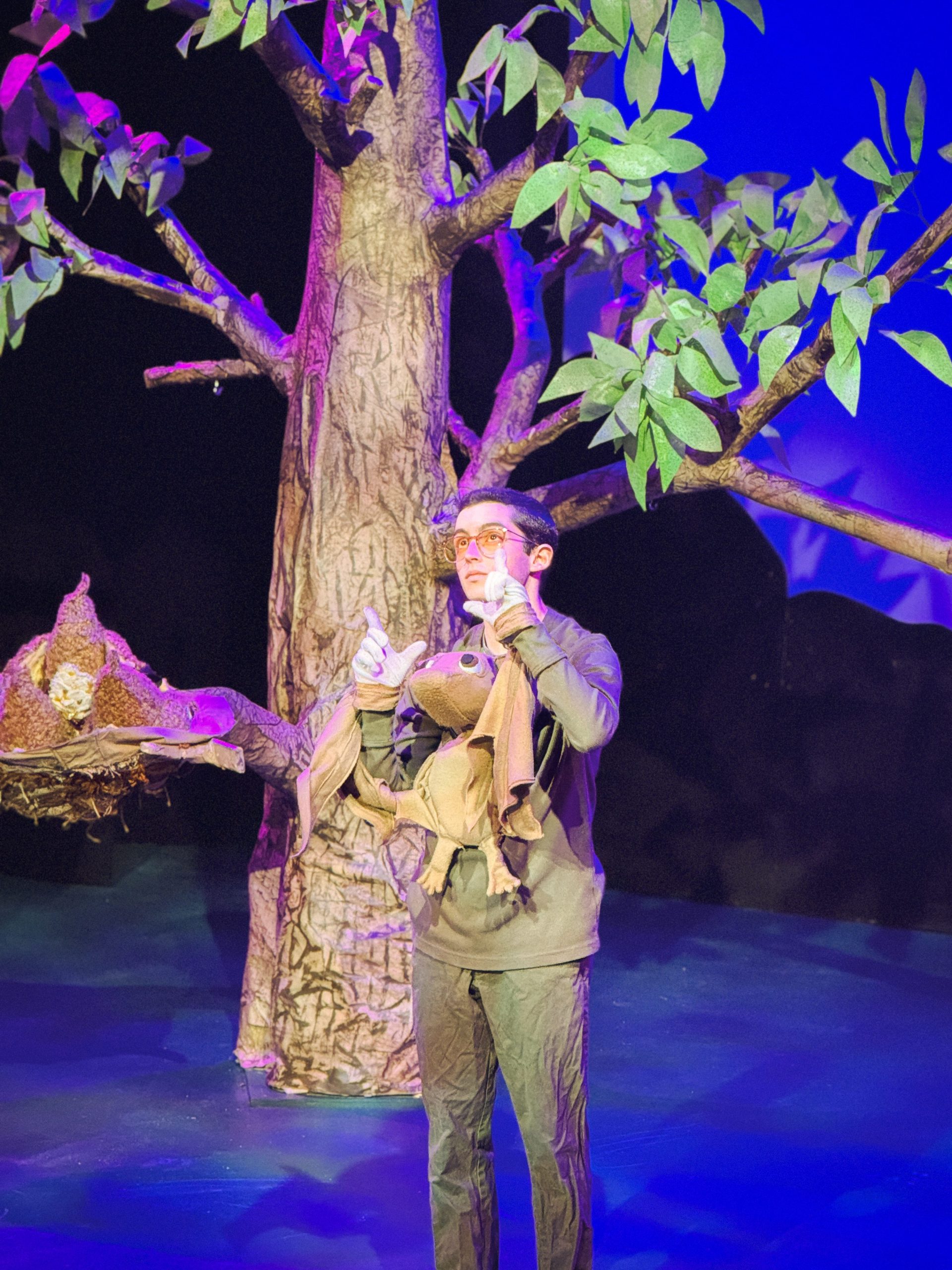
“Stellaluna,” adapted from the beloved children’s book, follows a young bat separated from her mother who finds temporary refuge with a family of birds. The story explores themes of belonging and acceptance as Stellaluna learns that being different – having ‘bat manners,’ not bad manners – is something to celebrate.
For over a century, the Children’s Museum & Theatre of Maine has staged productions for young audiences, making it the nation’s longest-running children’s theater. “Stellaluna” broke new ground as the first ASL-integrated performance in the theater’s history.
“It’s truly an honor to be part of a production that so beautifully reflects its own message – building connection across difference,” said Regan Thibodeau, a USM alumna and professor of ASL and interpreting who served as the Director of Artistic Sign Language for the show. “I hope Deaf families see themselves reflected on stage, and that parents of Deaf children see what’s possible when communication is centered at home.”
Beyond integrated ASL, the production also features open captioning on stage projections. Bringing this inclusive vision and joyful show to life has required a specialized, dedicated team.
A story of collaboration: Six USM community members make history
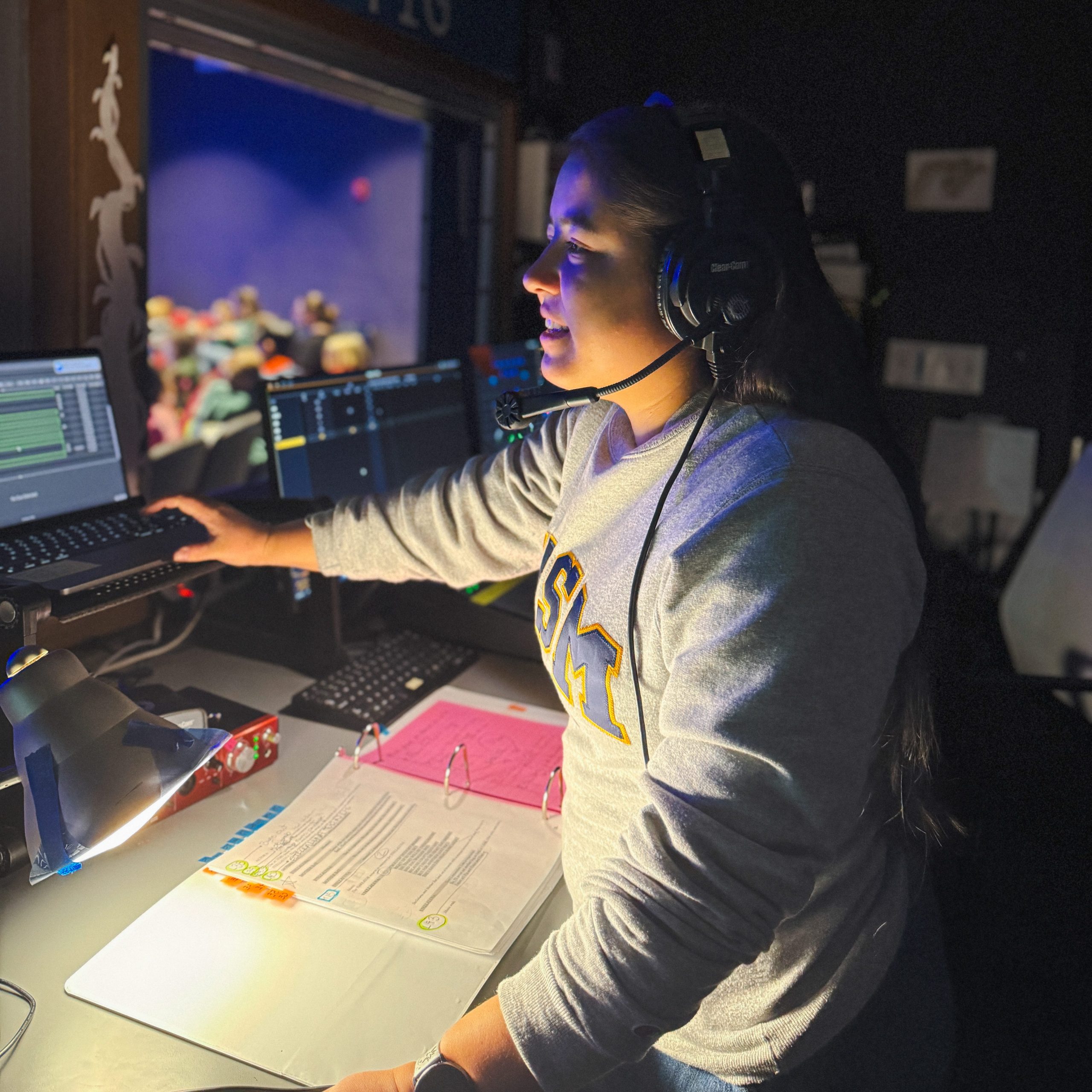
Six members of the USM community are helping to bring “Stellaluna” to life. Joining Thibodeau are: Professor Amy Richardson, training in artistic ASL direction under Thibodeau, Professor SeifAllah Salotto-Cristobal as lighting designer, alumna Juliet Moniz as rehearsal stage manager, senior Marissa Morgans as performance stage manager and sophomore Luca Enriquez Capalbo – a theater major and Deaf Studies minor – as Stellaluna understudy.
“It was really a full circle moment to work with so many USM folks on this production,” said Moniz. “Our USM crew is really aligned on how we make art and what it means to collaborate – that’s what has allowed the process to go so smoothly.”
Students, alumni and faculty found themselves in unexpected mentorship roles. Moniz, who once learned from Professor Salotto-Cristobal in the classroom, now collaborated with him as a peer, while guiding Morgans and Capalbo through their first professional production.
Taking the lead role
Capalbo had about two weeks to prepare before he was asked to step into the role of Stellaluna, but he did have certain advantages: He grew up signing with his family, and his major in theater and minor in Deaf studies prepared him for the challenge.
“ASL comes naturally to me, but the hardest part was learning to use the puppet’s face instead of my own while still keeping the performance grounded,” Capalbo said. “Fighting years of muscle memory on every other word, especially with an audience’s eyes on you, was definitely a challenge.”
Capalbo’s first full performance in front of an audience went off without a hitch – a testament to both his preparation and the support from the full cast and crew.
“USM’s theater faculty was instrumental,” he said. “And as a theater major and Deaf Studies minor, I felt confidently prepared to step into a role perfectly conjoining my two areas of study.”
Bringing the animals to life: The power of artistic ASL
Integrating artistic ASL seamlessly into the production required a different approach to both storytelling and sign language interpretation. Unlike standard interpretation, artistic ASL is a creative, theatrical form that, in “Stellaluna’s” case, blends visual storytelling with animal-like gestures and expressions.
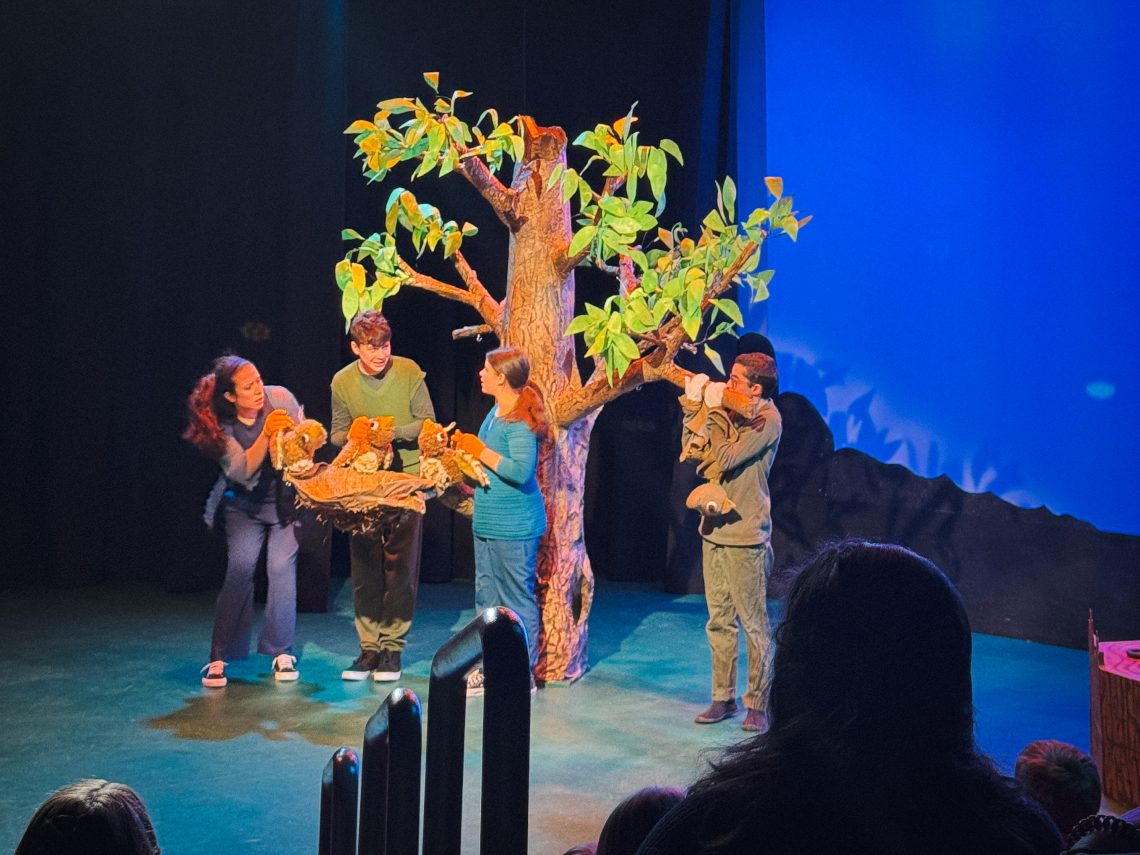
“Artistic ASL invites imagination,” said Thibodeau. “We explored how animals might communicate – using wings, feet, movement and gesture alongside sign. It allows expression to be playful and embodied.”
Every design choice reflected that creativity. The puppets were made so each animal could sign fluidly: Stellaluna through her articulated wings and the birds through orange-gloved feet. Bringing this vision to the stage required technical precision to serve all audiences – hearing, deaf and hard of hearing.
“This production definitely kept me on my toes because at any given moment actors were always doing at least three things at once,” said Moniz. “Including but not limited to speaking in ASL, singing, dancing, playing violin/flute, tap dancing, puppeteering and doing acrobatics.”
The hard work paid off. The result is a production that is accessible to all and captivating to watch. Throughout performances, children sign along with characters, gasp when Stellaluna struggles to fly, and erupt in laughter when Pip – one of the birds – crashes through the audience.
“Working on a production that prioritizes inclusion is everything I’ve ever wanted,” said Moniz. “The young audience members who come and see this show will either learn how to include others, or see a version of themselves being included.”
A more inclusive stage starts here
For the USM students, alumni and faculty involved, “Stellaluna” represents more than a single production – it’s a model for what the future of theater could be. Moniz is already directing the theater’s next show, and graduating senior Morgans says the experience has shaped how she’ll approach future productions.
“Seeing how easy it is to make theater accessible and the impact it has on our community has reinforced my desire to be mindful of the ways we can make theater inclusive to all,” said Morgans.
“Stellaluna” will continue its run through February 22 at the Children’s Museum & Theatre of Maine. The theater’s next production, “Shrek the Musical: Theatre for Young Audiences Version”, directed by Moniz, will close out the 2025-26 season this spring. USM’s Department of Theatre and Deaf Studies program continue to empower students to prioritize accessibility and inclusion – in the classroom and on stage.