
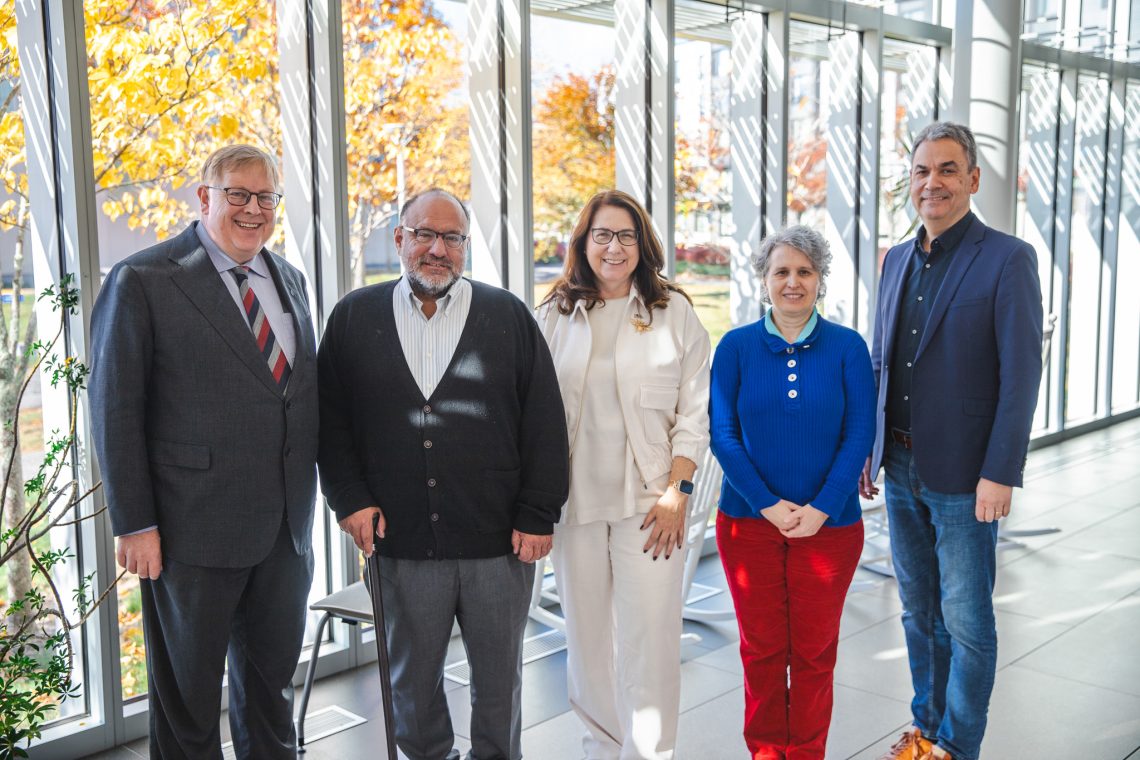
With Maine’s U.S. Senate race drawing international interest, a delegation of German political and academic leaders visited the University of Southern Maine on Oct. 30 ahead of the midterm elections to learn more about the state’s political landscape and its implications for U.S.-German relations.
The delegation turned to USM’s political science faculty for insight into Maine’s closely watched Senate race, the state’s ranked-choice voting system, and how voters make their decisions.
Francesca Vassallo, associate professor of political science, said the delegation viewed Maine as a key battleground in the midterm elections, as the state’s Senate race could help determine which party controls the chamber. Vassallo said the outcome also carries implications for Germany, whose export-driven economy is sensitive to U.S. trade and tariff policy.
Ron Schmidt, professor of political science, said Maine’s political landscape has generated more interest from international media, particularly the state’s history of supporting candidates from different parties.
“The question everybody seems to want to know is, why is Susan Collins so popular in Maine when Maine is not a heavily Republican state?” Schmidt said. “It’s Maine’s willingness to split voting tickets, to vote for different parties in the same election, and Collins’ skill at cultivating her political base.”
The discussions also highlighted shared concerns among voters in Maine and Germany, including health care, affordability, and inflation.
“The German delegation presented many similarities between what Maine voters want and what German voters also expect at this time. For instance, the importance of a fully funded health care system, an affordable cost of living, low inflation, and the budget struggles of a society with low demographic growth,” Vassallo said.
Vassallo organized the visit after the Hanns Seidel Foundation, a German political foundation, contacted her. During their time on USM’s Portland campus, delegation members toured the Osher Map Library and met with faculty and university leaders.
Looking ahead, Vassallo hopes to host international delegations annually, welcoming representatives from different countries and opening future discussions to students and the broader community.