
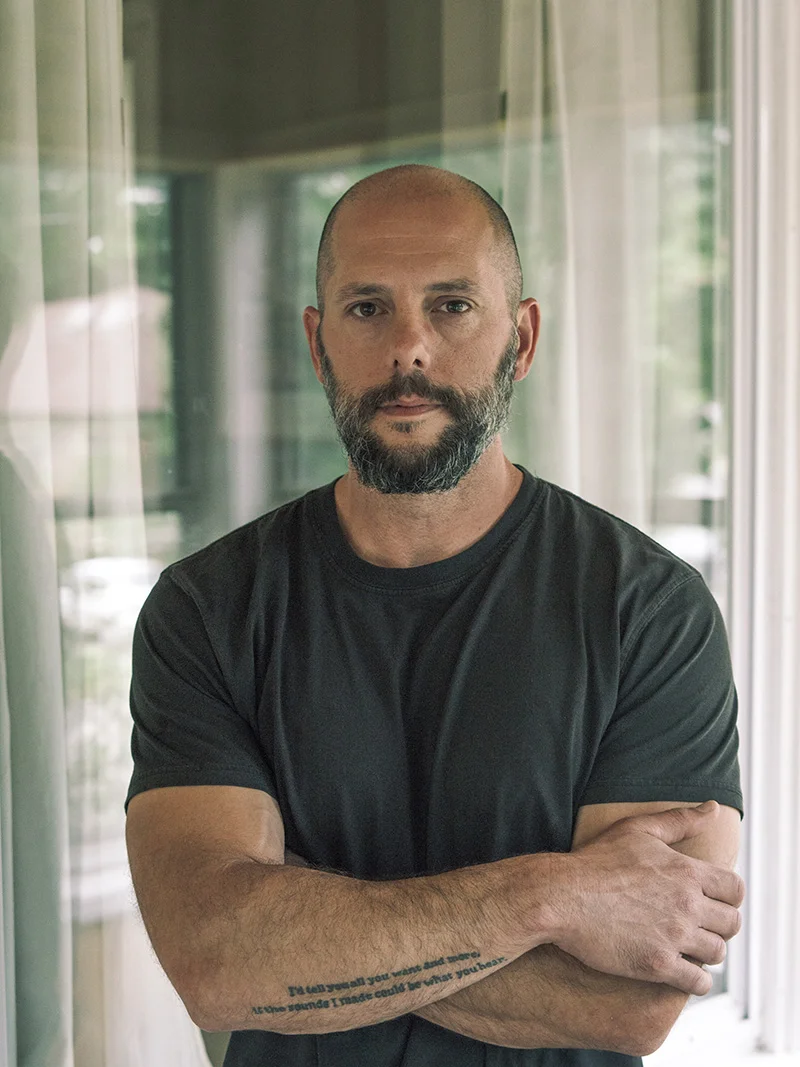
Ron Currie Jr. has had a busy summer: His sixth book was published in July, and he spent much of the season developing one of his novels into a Netflix series.
This fall, the Waterville native and Stonecoast MFA faculty member returns to familiar ground for a public talk at the University of Southern Maine’s Lewiston-Auburn Campus (LAC).
Currie has spent much of his career writing about the hardscrabble Franco-American community he grew up in. His two most recent novels center on Babs Dionne, a Maine matriarch inspired in part by his paternal grandmother.
“She was tough as nails and in a way that was very matter of fact. It wasn’t performative. This was how you had to be as a woman in that world in order to get by,” Currie said.
Babs first appeared in Currie’s 2025 novel “The Savage, Noble Death of Babs Dionne.” He had wanted to write about his upbringing for years, but said the story didn’t come together until he found its central character.
“Stories don’t start properly with wishes and they don’t start with premise. They usually start properly with character. I didn’t have the character that I needed until I found Babs,” Currie said. “I understood the whole world instantly once I knew who she was.”
Currie returns to Babs in “We Will See You Bleed,” a prequel published July 7. The novel takes her back to a Waterville on the brink, with its paper mill strike dragging on and its Franco-American neighborhood coming apart.
Currie’s path to becoming an award-winning novelist wasn’t a conventional one.
“I’m an autodidact. I’m self-taught. I don’t have a degree. I have a high school diploma,” Currie said.
The experience informs both how he thinks about writing and how he teaches it.
“Ultimately writing is properly an egalitarian pursuit. It’s a job. It’s an important one, and it’s very exacting, but it’s available to anybody who’s willing to submit to its rigors,” he said.
At Stonecoast, USM’s low-residency MFA program, Currie mentors students one on throughout the semester. “My job is not to impose my own artistic and aesthetic prejudices on my students. It’s to ask myself, what kind of writer is this person trying to become? And how can I help?” Currie said.
Currie’s own writing is taking a new form.
The adaptation of The Savage, Noble Death of Babs Dionne is in development as a Netflix series, though Currie is limited on what he can share about the project.
“I spent the summer developing the project with a team in Los Angeles. It went exceptionally well, and we’re expecting to hear really good news about where the project stands any time now,” Currie said.
He draws a sharp contrast between writing a novel and writing for television.
“As a novelist, you’re everything. You’re the director, you’re the sole writer, you’re the set designer, you do the costumes, you do all the acting. It’s all you. And when you’re doing a TV show, boy, is it not all you,” Currie said.
As someone who usually works alone, Currie was surprised by just how much he’s enjoyed the collaboration.
“It turns out that I like being on a team,” Currie said. “I like being part of a club, as long as I establish the club.”
On Sept. 29, Currie will host a free public talk on “We Will See You Bleed” at LAC, hosted by the Franco-American Collection.
The novel focuses on a paper mill strike dragging on, which Currie drew in part from the 1987 strike at International Paper in Jay, a labor fight still remembered across Maine.
“It’s not ancient history, and for a lot of us, it might as well have happened last week,” Currie said.