

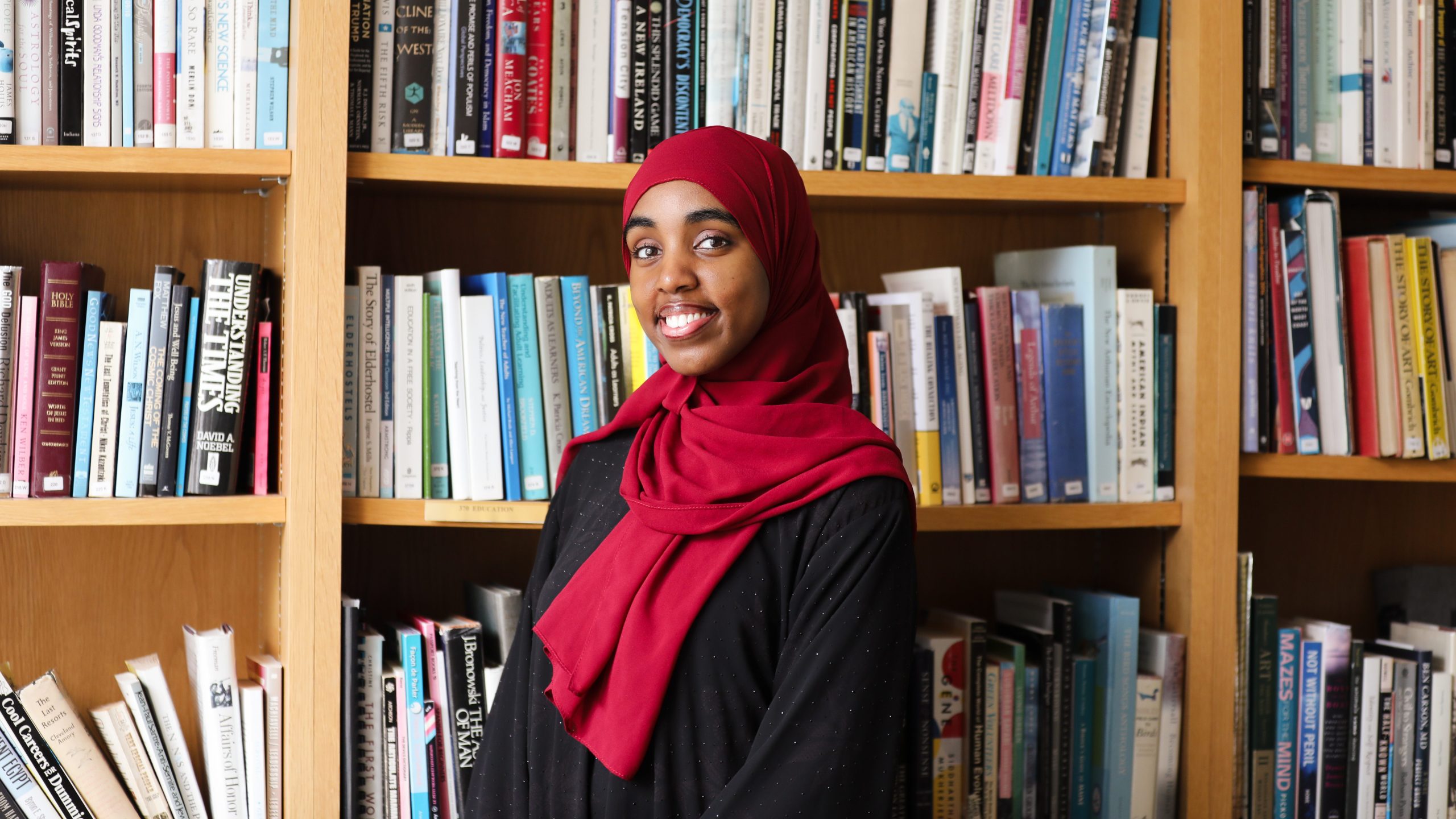
Najmo Ahmed will deliver the student address at the University of Southern Maine’s 2026 Commencement celebration, graduating as a first-generation college student with a bachelor’s degree in social and behavioral sciences.
Born in Kenya, Ahmed grew up in Lewiston after her family settled there when she was barely a year old. She transferred to USM with a clear plan: political science, followed by law school, and a career in immigration law. That plan quickly changed.
“My friend pulled me aside and said, ‘I think you’d be really good at social work — you already know how to connect with children, and you’re really good with them,’” Ahmed said. “Once I started the internship, everything clicked. I could see myself doing this work and actually making a difference.”
That conversation with her friend, followed by the internship with the Maine Department of Health and Human Services, pointed her somewhere she hadn’t expected: child protective services, and a growing conviction that vulnerable children and families needed more advocates in their corner.
She shifted her major from political science to social and behavioral sciences — a broader lens, she figured, for the kind of work she wanted to do. For her capstone project, Ahmed researched Black maternal health mortality rates, a topic that pushed her toward public health and, eventually, toward policy.
“The rates were significantly higher for Black women,” she said. “It really motivated me to want to do something within policy, and to advocate for change.”
That research helped chart her next steps. She’s currently enrolled in a master’s program in public health through USM’s Muskie School of Public Service, which she expects to complete in spring 2027, with plans to continue her work in social services and, eventually, healthcare administration.
Ahmed’s path has not been a straight one, but every turn has pointed her toward the same kind of work: showing up for communities that are too often left without support. At commencement, she plans to speak about belonging — what it means to find your place and use it to show up for others.
“Everyone has their own journey, their own struggles,” she said. “Before making assumptions about someone, take the time to understand them — and try to be kind.”