

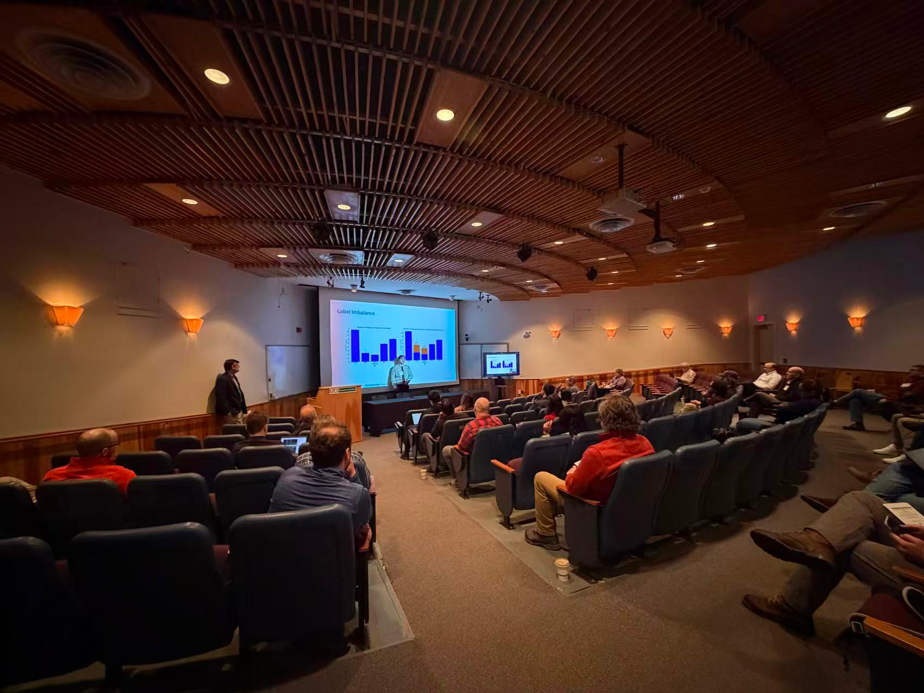
Dr. Xin Zhang and Dr. Yuqi Song from the Department of Computer Science recently presented their collaborative research at the Maine IDeA Data Science Conference, delivering a talk titled “Attention-Based CNN for Enhanced Detection of Arsenic Exposure.” Their work addresses a significant public health concern: chronic arsenic exposure, particularly in communities that rely on private wells. Long-term exposure has been linked to serious health risks, including neurotoxic effects in children and broader developmental complications across affected populations.
To investigate these effects at the cellular level, Zhang and Song collaborated with Douglas Currie in the Biology Department at the University of Southern Maine. Currie’s lab generated the experimental dataset, consisting of phase-contrast microscopy images of PC12 cells exposed in vitro to varying concentrations of sodium arsenite. These experiments simulate the impact of arsenic on neuronal-like cells, providing a controlled setting to study cellular responses and quantify structural and morphological changes.
Building on this dataset, Zhang and Song developed an advanced deep learning framework based on the ResNet-50 architecture, enhanced with a Convolutional Block Attention Module. This approach improves the model’s ability to identify subtle morphological changes associated with arsenic exposure, advancing detection capabilities beyond traditional methods and enabling more precise classification and interpretation of cellular features.
As part of their commitment to open research, the team has made both the dataset and the trained model publicly available. Their work offers a valuable resource for researchers studying arsenic-related health effects and establishes a strong foundation for future investigations into diseases that alter neuronal morphology.