

Bridging classical methods and modern computing, the new text emphasizes performance, clarity, and hands-on exploration.
The Department of Computer Science at the University of Southern Maine is pleased to announce the publication of “Explorations in Numerical Analysis and Machine Learning with Julia,” a new textbook co-authored by Professor James Quinlan. Released by World Scientific Publishing, this comprehensive and innovative book integrates foundational topics in numerical analysis with contemporary applications in machine learning, using the high-performance Julia programming language as a unifying platform.
Designed for advanced undergraduates, graduate students, and practitioners, the text presents a unified approach to algorithmic thinking, numerical methods, and data-driven modeling. The book covers essential topics such as interpolation, matrix factorization, and differential equations, while also introducing students to optimization, neural networks, and the numerical underpinnings of machine learning. The text also provides an in-depth treatment of numerical linear algebra, including both direct methods, such as LU decomposition, and indirect methods, like the conjugate gradient method, which are essential for efficiently solving large systems.
“Julia is uniquely suited for this kind of integration,” Quinlan explained. “It combines the performance of low-level languages like C with the ease of use and expressiveness of Python or MATLAB. That makes it ideal for students who want to understand both how algorithms work and how to apply them to real-world problems involving data.”
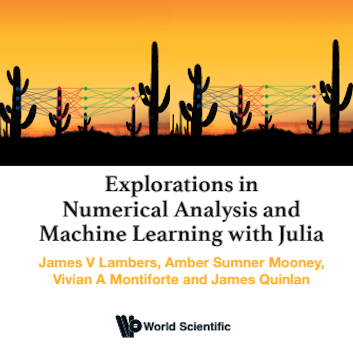
What sets Numerical Analysis and Machine Learning in Julia apart is its emphasis on readable code, exploratory examples, and numerical transparency. Readers gain a deep understanding of how algorithms behave in practice, not just in theory. From solving linear systems to training neural networks, each concept is reinforced with Julia code that runs efficiently and mirrors the workflow of professionals in research and industry.
The book also includes extensive exercises, concept checks, and code examples that encourage active learning and exploration. It is already being considered for adoption in courses on numerical computing, applied machine learning, and scientific computing in Julia.
Professor Quinlan, who teaches in the Department of Computer Science at USM, developed the text in response to a growing need for modern computational tools that don’t sacrifice mathematical rigor. “We’re at a point where students need to understand the numerical backbone of machine learning—how optimization works, how data is represented, and how to avoid common pitfalls like instability or overfitting. This book tries to make those connections clear and practical.”
The publication reinforces USM’s leadership in forward-looking, accessible computing education and reflects Quinlan’s commitment to blending theoretical depth with hands-on, high-performance computing.
Faculty interested in adopting the book for coursework or research can learn more through the publisher’s website, which includes a detailed table of contents and sample chapters.
Book Details
Explorations in Numerical Analysis and Machine Learning with Julia
World Scientific Publishing, 2025
https://www.worldscientific.com/worldscibooks/10.1142/14443