
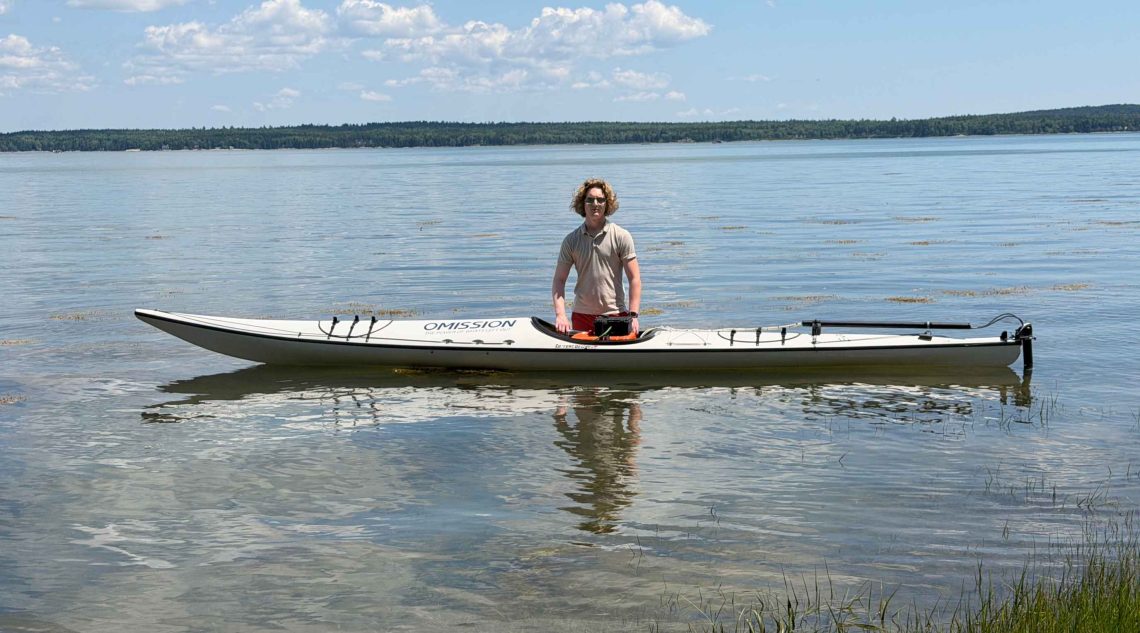
Christian Taylor finds his best ideas a few miles off Camp Ellis, beyond Ram Island in Saco Bay. On calm evenings, he paddles his sea kayak out and watches the water turn gold, then fade to dark.
A couple of years ago on one of those paddles, Taylor thought about a problem he’d faced while working at a drone company as a student. The challenge was to build a self-running boat that could collect data without a crew — but issues like fuel, cost, and maintenance kept getting in the way. He kept mulling it over until he looked down at the narrow hull beneath him.
“I’m sitting out there in my kayak, and I’m like, kayak, that’s the answer,” he said.
At the time, Taylor was finishing his engineering degree at the University of Southern Maine, where his senior capstone project had sparked an interest in collecting ocean data. The kayak gave him a better way to go after it. Today, he manages the engineering department’s machine shop, and that kayak is at the heart of the company he’s building.
The guidance his father gave him
Taylor, 26, grew up surrounded by flying machines. His dad, an aerospace engineer and Air Force veteran, was building drones before most people even knew the word. The shop became Taylor’s second home as a kid, where he learned to fly, fix, and build things.
When it came to his own future, his dad steered him toward an engineering degree. But he didn’t need much convincing.
Taylor enrolled in a high school vocational program, then apprenticed at Pratt & Whitney while working third shift on the production floor and earning an associate degree in precision manufacturing and machining at Southern Maine Community College.
When he was ready to pursue an engineering degree, Taylor chose USM, where he had long planned to study. He began working toward degrees in both electrical and mechanical engineering. He’s now also taking classes toward an MBA at the University of Maine.
“I have so many degrees because I want to be able to play in the sandbox and do whatever I want,” he said.
A capstone project that became his mission
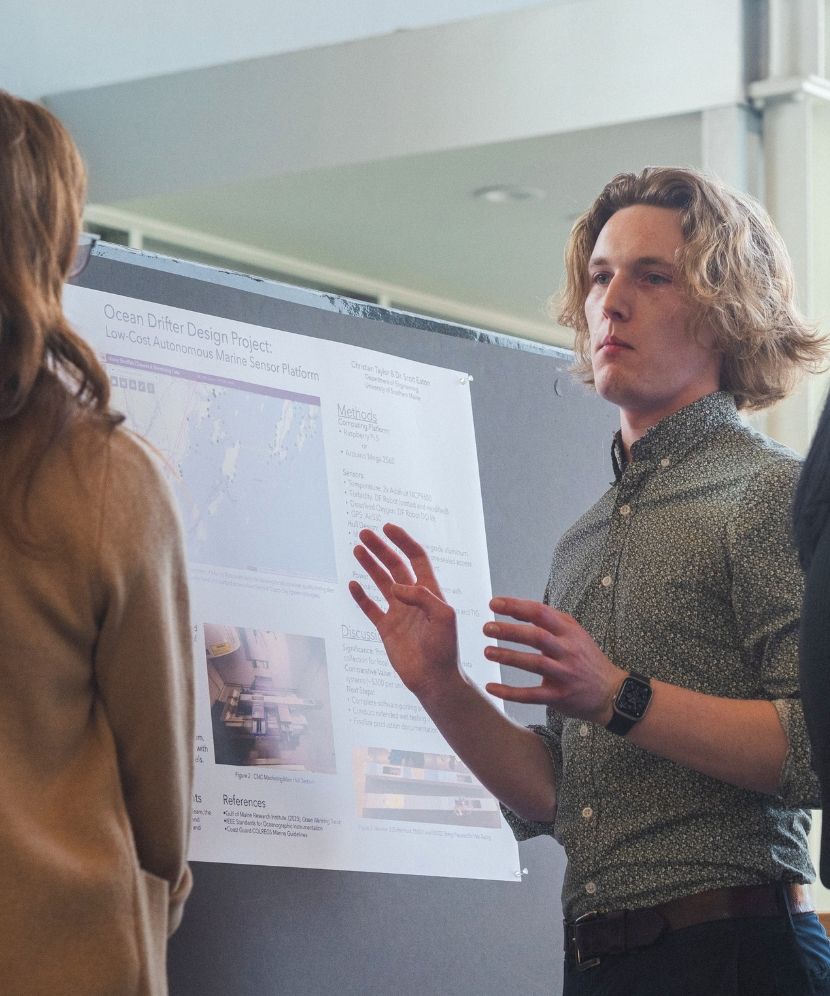
For his senior engineering capstone at USM in 2024-25, Taylor developed the Drifter Project, a set of floating monitors designed to collect data on the open water. The project deepened his interest in gathering ocean data, a problem he would later approach from a different angle.
The Gulf of Maine Research Institute says the Gulf is warming faster than almost any other ocean surface on the planet, causing more algae blooms and shellfish bed closures, as well as lobsters moving north to find colder water.
“We’re not collecting nearly enough data to have any sort of educated decision making around our water,” Taylor said.
Tracking these changes up close is slow and expensive, so Taylor said it doesn’t happen as often as it should.
“We know less about our oceans than we do Mars,” he said.
That was still on his mind the night he drifted past Ram Island.
Omission finds its focus
Taylor had already started a company, though its direction was still taking shape. While working at a drone company during the pandemic, supply delays prompted him to buy CNC machines and manufacture parts himself. In 2022, he turned that work into a side business called Omission.
“Omission’s really two businesses wearing a trench coat,” he said. “The machine shop generates the cash flow while I develop the unmanned systems.”
The company’s direction became clearer in 2024, as Taylor neared graduation. Building floating monitors for the Drifter Project had shown him how little data Maine collects about its waters. That evening paddle sparked an idea: Turn a sea kayak into an unmanned research vessel that could carry different sensors wherever data was needed. It would be affordable, portable, and able to reach places larger boats couldn’t.
That concept became Omission’s first product, the Nautical System One (NS-1), now in development with early pilot work underway. The modular electric kit fits into a standard kayak without modification, converting it into an unmanned research vessel in about 30 minutes.
Why he chose the harbor over the contract
Taylor says there was a quicker way to make money with a boat like this, but he chose not to take it. Unmanned surface vessels have become popular in defense in recent years, and he knows that field well. While he says his competitors go after Pentagon contracts, he wants to focus on research labs and the working waterfront instead.
“That technology gets wrapped up in classification and never makes it to the civilian market,” he said. “And frankly, that’s where the need is.”
Taylor says much of Maine’s water data still comes from someone leaning over the side of a chartered boat, collecting samples by hand, and sending them to a lab. Each trip means paying for a captain, fuel, and insurance, then waiting for good weather. Most researchers can’t afford to spend six figures on a new vessel, so Omission focuses on offering the service instead of just selling the hardware: book a day, the kayak goes out, collects the data, and returns.
“There’s an immediate need for civilian research and civilian systems that can support our local economy and our local ecosystem,” he said. “And that’s where I see the biggest need across the board.”
Teaching at USM and charting Omission’s next course
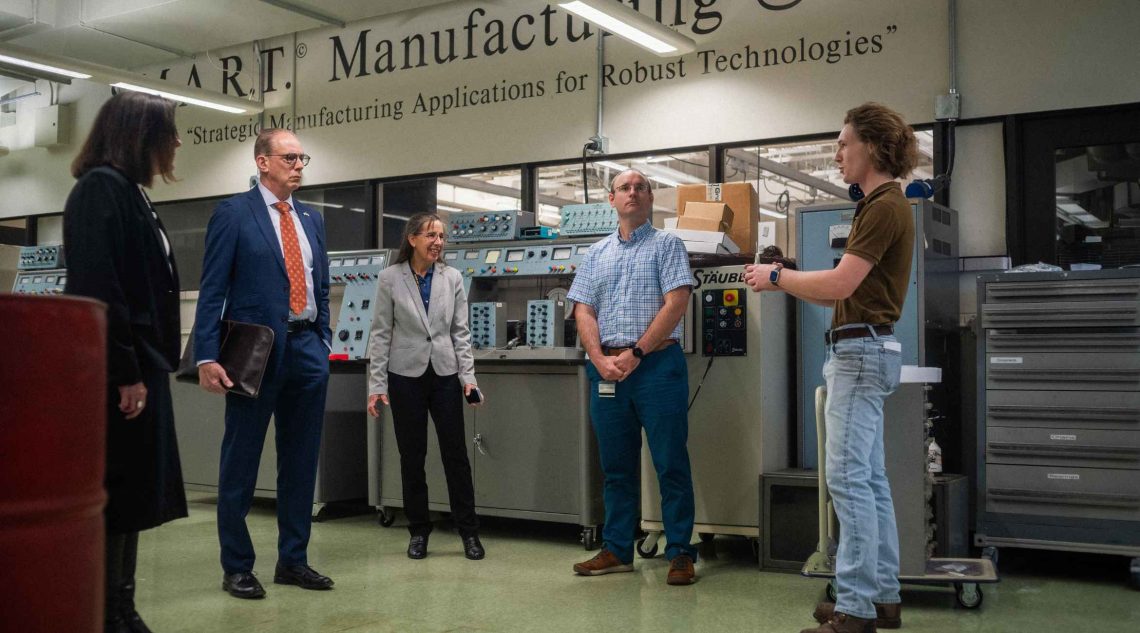
Taylor started working as manager of USM’s engineering machine shop just a few months before graduating in spring 2025. He earned a bachelor’s degree in mechanical engineering, but set aside the electrical engineering degree so he could teach.
Today he teaches the engineering department’s machine tools course, where students learn to design parts for manufacturing and to spot risks and work safely in the shop.
“It’s a really fun lab class that gets the students into the shop making things with their own hands,” he said.
Omission made its first real public appearance at the 2026 Maine Blue Economy Week. For now, it’s just one person and one boat at a time, but he envisions a future where one operator manages a whole fleet, turning a single afternoon on the bay into a complete picture of it. Looking ahead, he sees Omission working across water, air, and land, living up to its catch-all name. Through it all, he plans to stay in Maine.
“I love Maine, and I don’t plan on leaving,” he said. “I live minutes from the ocean. It really doesn’t get much better for what I want to do.”
He’s started to notice a pattern in his life.
“All of this started as a hobby, as my recreational thing,” he said. “I have a bad habit of turning hobbies into businesses, which is bad and good, depending on how you look at it.”
Bonus: What song have you had on repeat lately?

HARDX
Yaego