
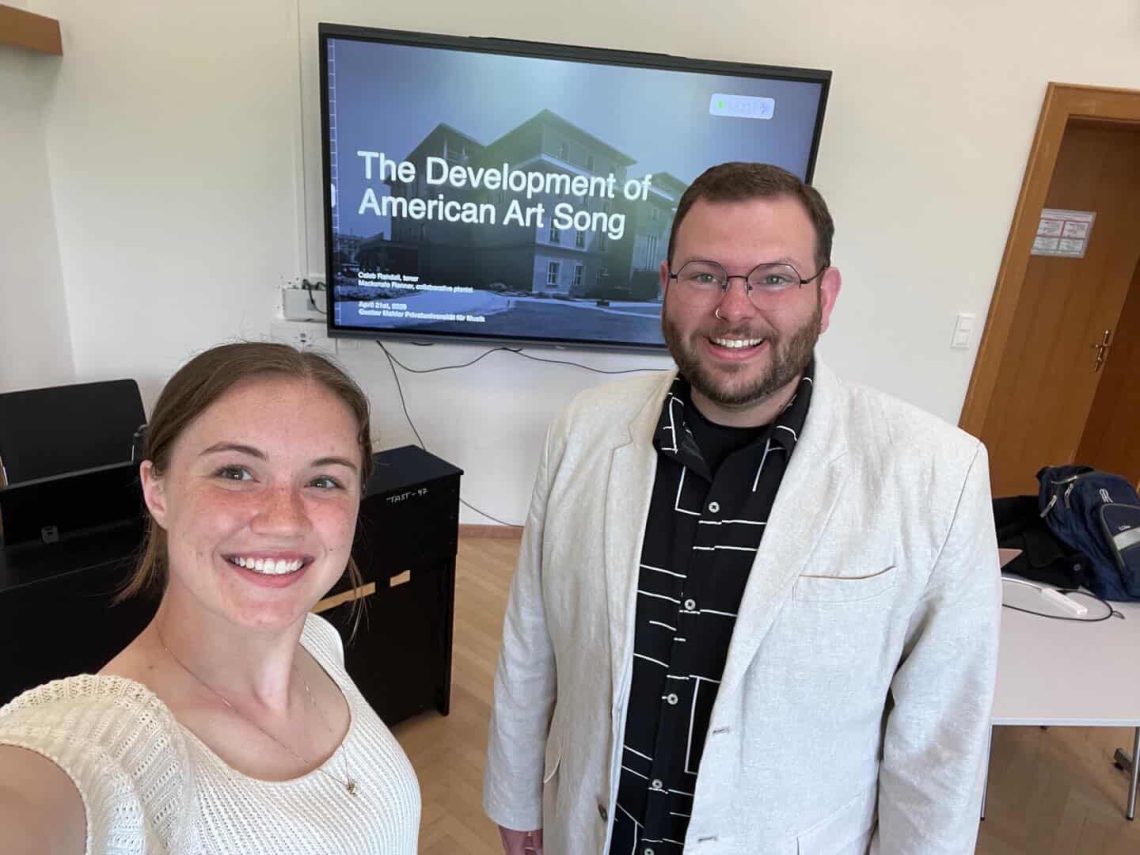
Makenzie Renner ’26 and Caleb Randall ’23 ’26G were among the more than 1,000 University of Southern Maine students who crossed the stage at commencement in May — but unlike most of their peers, the pair had just returned from Austria, where they were invited to present on the history and culture of American music at one of Europe’s leading conservatories.
Keep reading to find out how two students from USM’s Osher School of Music took American Art Song to European stages, what it took to get there, and how the experience is now shaping their next steps.
American art song meets Europe
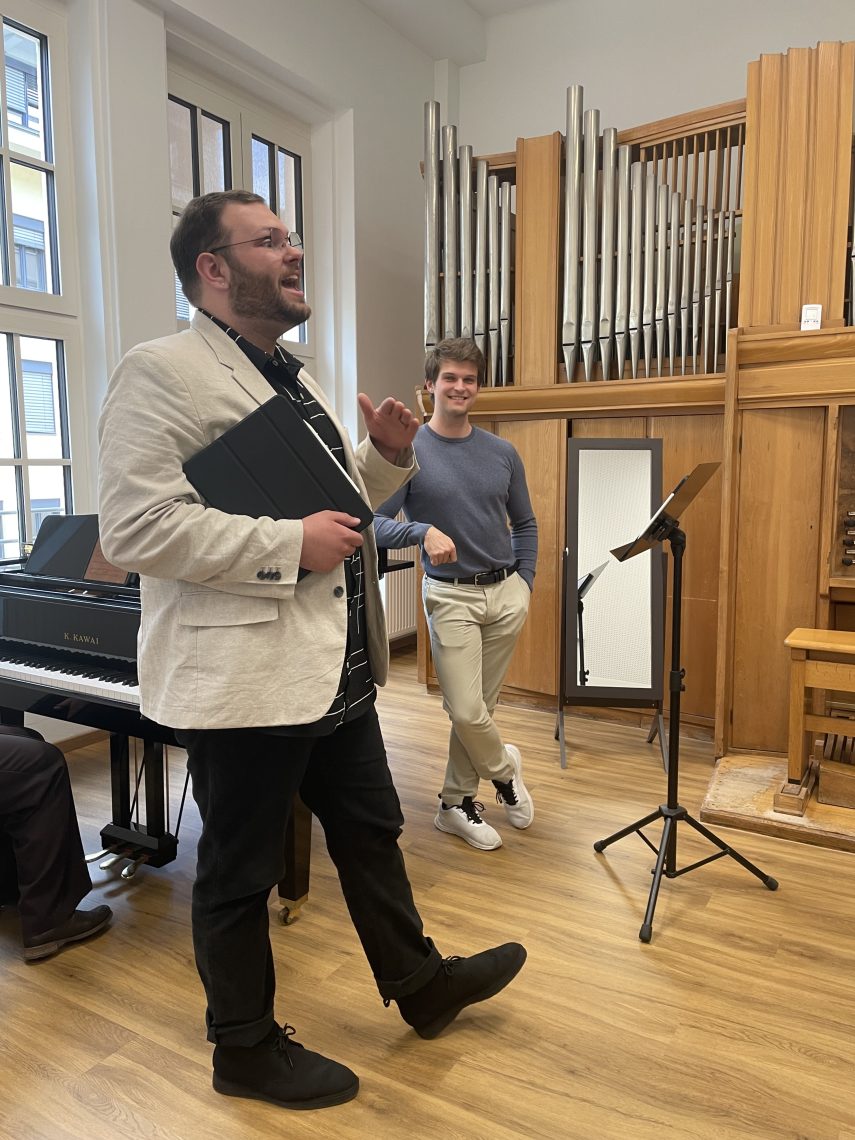
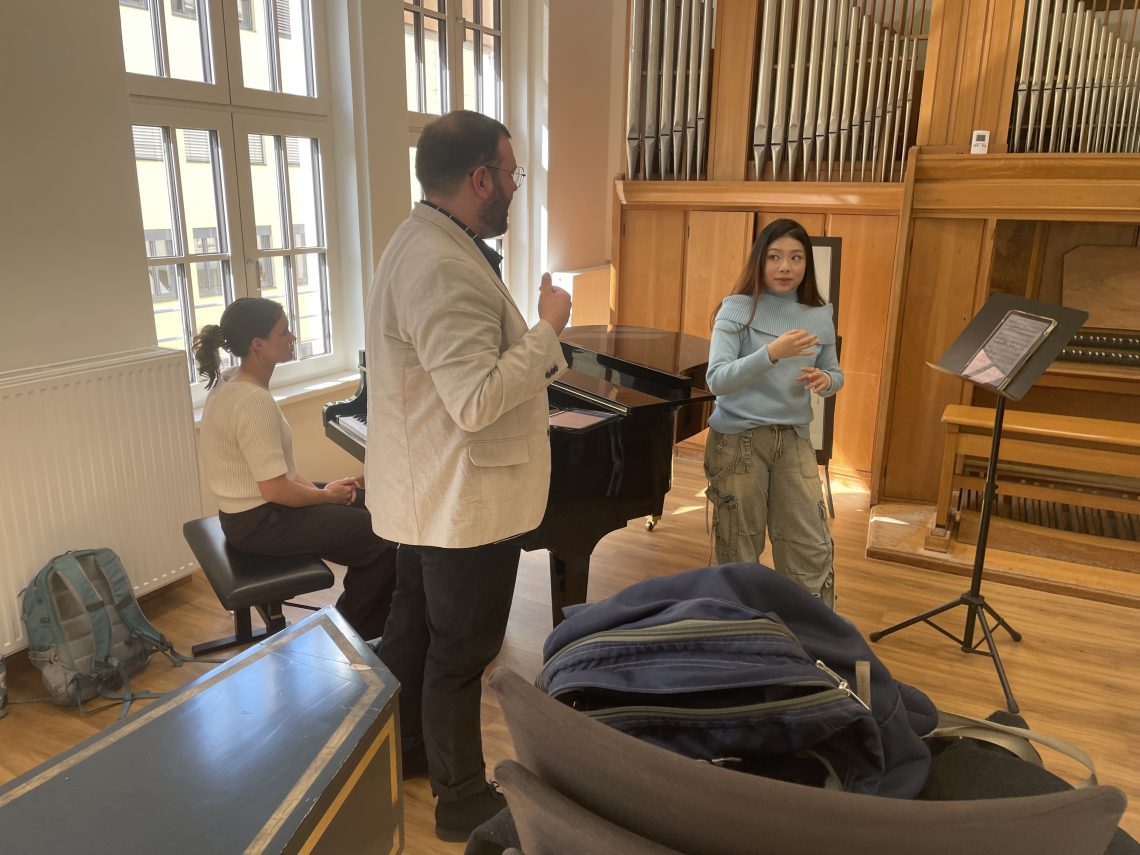
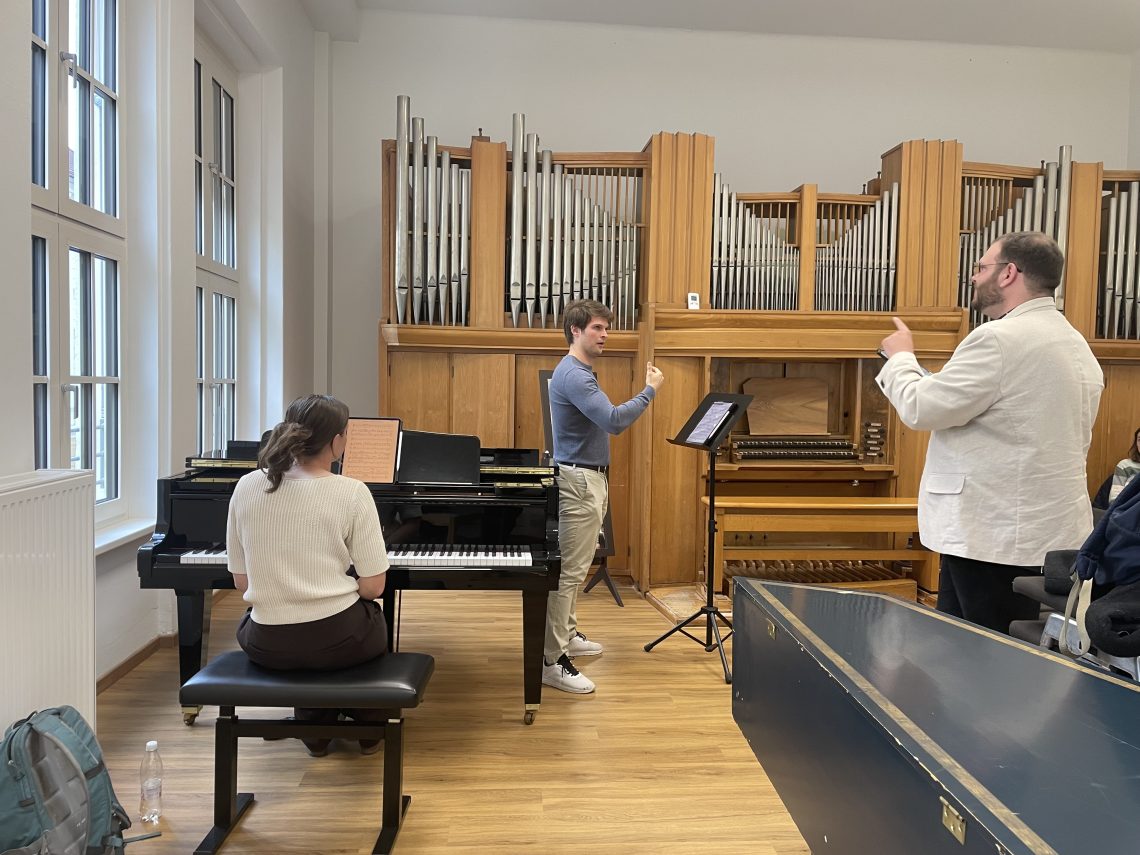
In April, Randall and Renner traveled to Klagenfurt, Austria, where they spent four days at Gustav Mahler Privatuniversität für Musik, one of Europe’s leading conservatories. Over the course of the visit, Randall delivered lectures on the history and culture of American music alongside masterclasses, intensive one-on-one coaching sessions where student performers work through repertoire in front of an audience of their peers. Renner was the collaborative pianist for all of it.
Inside the masterclasses, one challenge kept coming up. Singer after singer took the stage, polished and prepared, their technique largely beyond reproach. The one thing left to work on was something none of them had ever been taught: how to sound American.
“Teaching Europeans how to say an American ‘r,’ turns out, is one of the biggest challenges in American art song diction,” Renner said. “It’s not a consonant and it’s not really a vowel. No other language really has a sound like it. Every time Caleb would address it, the performer on stage would be trying to replicate it, then look into the audience, and all of them would just be under their breath, too, quietly trying it. I remember being surprised, learning things about American English and how it’s pronounced that I’d never even thought of.”
Randall said that moment captured what made these singers remarkable.
“These collegiate vocalists are at a point where the only thing they’re working on in a piece of music, because all of the other things are so spectacular, is just these small diction changes,” Randall said.
To understand how two musicians from USM ended up in that room, it helps to start with the music itself.
What is American art song?
Art song is a classical performance of music written for voice and piano. In Europe, the tradition runs in a single thread per country: German lieder, French mélodie, Italian song cycles — each with its own lineage, its own unbroken line of influence. American art song is different.
“In America, we have such a diverse population that our art song has not followed one single trend, but has flowed through many different avenues of musical experience, of cultural experience,” Randall said. “This lecture series really explores how finances have played a part in developing art song, how power structures have been involved, who is in control of what is performed and what is not in the concert hall, and ultimately how America shaped its own voice.”
From the rhythms enslaved Africans brought to America to jazz musicians who traveled the world on government-funded tours after World War II, American music evolved by absorbing influences from every direction. As pianos became affordable for middle-class families, composers began writing music for audiences beyond the elite, helping to shape a distinctly American sound. For many audiences at European conservatories, it was a musical history they had rarely encountered.
The graduate student behind the lecture series
Caleb Randall came to USM with a passion for teaching — the question was what to focus on. About two and a half years into his undergraduate degree, American Art Song and African American spirituals answered that for him, and it quietly became the defining thread of his academic career.
By the time he completed his undergraduate degree in 2023, Randall had a private studio of his own. Today it has around 50 students. His master’s thesis, completed this spring, focused on the use of African American spirituals as a pedagogical tool. The research and the repertoire had become inseparable from who he was.
“When you hear something in a performance and you really feel the music, don’t put it off,” said Randall. “Find the music, study the music, perform the music.”
The path to Europe began with Melinda Haslett, associate professor and director of vocal studies at the Osher School of Music. Haslett has spent years building relationships with music institutions across Europe, opening doors for her students that few universities at USM’s size can offer.
Haslett invited Randall to travel with her last fall to the Conservatorio Arrigo Boito in Parma, Italy, where the two presented at a conference connected to the Erasmus+ program — a European Union initiative that funds student and faculty exchange across the continent. The response opened doors Randall had not anticipated, leading to an invitation to lecture and run masterclasses at the Akademija za glasbo at the University of Ljubljana in Slovenia.
That first trip to Ljubljana involved four hours of speaking and singing across two days, individual feedback sessions with students — all starting the morning after a transatlantic flight.
“You get off of a plane — which is already difficult because you’re dehydrated and your vocal folds are swelling and you’re uncomfortable and you’re jet lagged — and then you turn around the next morning and you have to sing at 8 a.m., which is when your body feels like it’s 3 a.m.,” Randall said.
He delivered, and Ljubljana opened the door to Austria.
Six weeks, 14 pieces, and a flight to Austria
“You can’t run a masterclass without a great pianist,” Randall said. “You’re sight reading incredibly difficult music alongside a singer who’s probably been working on it for months.”
Makenzie Renner was that pianist. She committed to play softball at USM before she had even taken her first lesson with the music department. As both an athlete and a pianist, she spent four years fully present in both worlds. She made the most of every collaborative opportunity she could find — accompanying student recitals, picking up gigs, and taking voice lessons to better understand the singers she was working with. Her department made room for all of it. The music faculty came to her games. Her softball team came to recitals.
“I don’t think I could have gone anywhere else and gotten the same quality of education and development for the piano specifically, while also being at like 99% of games and practices and lifts and team events and everything.”
Mackenzie Renner ’26
By her senior year, Renner was someone faculty trusted when the stakes were high. Scott Wheatley, lecturer in voice at USM, had been mentoring Renner’s collaborative work throughout her time in the department. When a scheduling conflict made it impossible for him to join Randall for the Austria trip, he knew exactly where to turn.
“His first recommendation was reaching out to me,” said Renner. “Putting that faith in an undergrad to represent the university, rather than outsourcing to someone who has more experience, meant a lot.”
It was spring break when Renner received the message from Randall — and she couldn’t quite believe it.
“How often do you get asked to play piano in Europe?” Renner said. “Being on the softball team, I knew I’d have to miss some games and I actually had my senior recital scheduled for the same timeframe. My schedule was reeling through my mind, wondering how I could possibly make it work.”
She waited five days before deciding that it would all fall into place, one way or another.
With roughly six weeks until departure, she worked through the lecture repertoire with Wheatley, running pieces during her voice lessons — he sang, while she played to get the material in her ears.
The masterclass repertoire, 14 pieces the Austrian students would be performing, arrived a week before she left. Some were easy, others not so much.
The problem was time. That week included three away softball games, a home game, and a travel weekend. A doubleheader alone consumed seven hours of the day. When she mapped her schedule, she found one window: three hours on a Thursday afternoon before the bus left.
“That’s what I did,” she said. “I took those three hours and just focused in and got enough. I made a lot of notes on my music, reminding myself of certain intervals, certain tricks, patterns, anything that helped trigger my memory before I was actually there.”
And just like that, it was time to get on the plane.
Renner’s senior recital, originally scheduled for that spring, has been moved to the fall with the full support of the music department. The Osher School of Music did not ask her to choose — it made room.
Building a music career beyond the classroom
Renner says the trip arrived at exactly the right moment. With graduate school auditions coming up this fall and applications to collaborative piano programs in the works, she now has experience abroad that stands out on an undergraduate resume. The vocal director at Gustav Mahler Privatuniversität für Musik put it plainly during the trip.
“She mentioned I should come back, that I could study there,” Renner said. “Studying in Europe is fantastic and significantly less expensive. So there’s that kind of validation. And if I can put on my application that I have worked as a collaborative pianist internationally, that looks really, really great.”
Renner is also returning to the softball field — the head coach asked her to join the staff as an assistant coach next year.
“I can’t leave softball no matter how hard I try,” she said. “I said yes. So I’ll be teaching piano part time, the rest of my time will be gigs, and then whenever I can, I’ll go to ball practice.”
As for Randall, he performed a full concert of African American spirituals in Portland this May and is working toward bringing the lecture series to Croatia in the fall.
He says USM and the Osher School of Music not only opened the door to opportunities, but prepared him to make the most of them.
“USM is an incredibly valuable place for musicians to study music,” Randall said. “It’s put me in a place where I’m working with world-class singers around the world, and engaging with music on a deeper level than I ever thought possible, because of the direction and the support that comes from the faculty at USM.”