

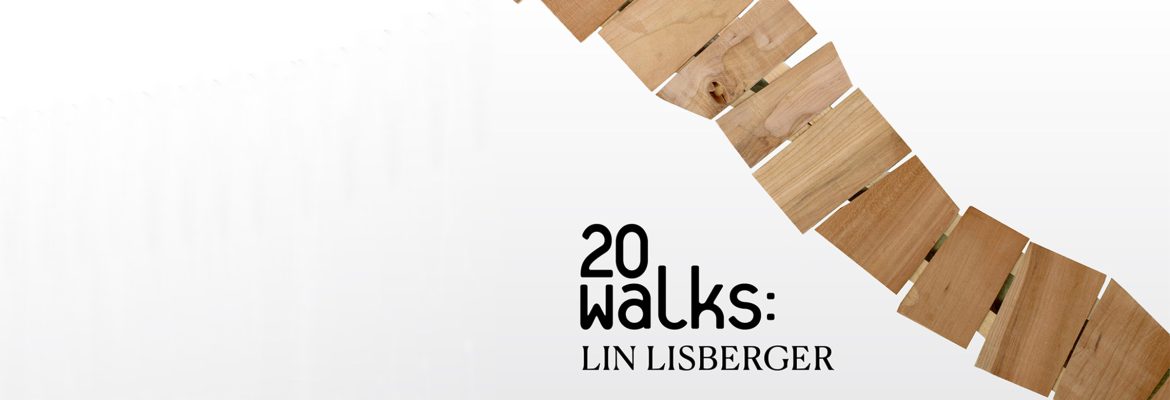
September 18 – December 10
20 Walks is a meditation on the somatic journeys that keep us grounded. Featuring sculptural contemplations in artist Lin Lisberger’s primary medium, wood, this exhibition considers how our memory of place is tied to the physical, and what details our minds rely on to recall embodied experiences.
From the artist:
My sculptures reinforce the beauty and spirituality of walking, and the places people walk.
As a sculptor, I have always been interested in combining abstraction and narrative in my work. 20 Walks references the physical memory of my own walks in places at home and around the world. Each piece captures a sense of place along with the memory of a particular personal moment or sight. The goal of these pieces is to evoke a recollection, not tell all the details. This form of abstraction keeps the pieces simpler, more elegant, and hopefully visceral, while always keeping form essential.
My sculptures are carved directly from whole or laminated healthy native wood (as locally harvested as possible) or are constructed from carved parts. I carve with gouges and a drawshave, as well as with a chain saw, depending on the desired surface and quality of image.
I walk for physical and social reasons. I walk for emotional reasons. I walk because I like how it feels to move through space, and I like the spaces that I move through. This immersion in nature and everyday lives serves as solace and nourishment to me. I have walked around numerous European and a few Asian countries, several US states, and of course, regularly walk in Portland and New England. In many ways walking has the quality of pilgrimage. Pilgrimages frequently involve a journey or search of moral or spiritual significance or can be a metaphorical journey, and often offer broad geographical and sociological experiences.
Curatorial Essay
In 1960, artist La Monte Young created a work titled Composition 1960 #10. Seven simple words comprise the piece: “Draw a straight line and follow it.”[1] Such straightforward instructions give way to a cacophony of potential interpretations. Does one draw a line with sidewalk chalk? With a string? For how long? What of the nature of the line? We tend to imagine a line as straight, but can it not curve as well? What of its axis? While we might conceptualize a line as horizontal, a consideration of the line as occupying vertical space instead creates an action about the limitations and binding nature of gravity. If we extend a line into a bisecting Z-axis, does it cease to be two-dimensional? Is its two-dimensionality its chief characteristic? Can we walk between planes? These questions are to say nothing of walking itself: shall we tiptoe? Stomp? Skip sideways? Through the line, Young draws attention to the seemingly simple act of walking and how its mundanity obscures its complexity. Walking is a quotidian action whose performance is cloaked by its well-trodden groove in our motion memory.
I think of Composition 1960 #10 when I encounter the works in Lin Lisberger’s 20 Walks. While any claim to the encapsulation of walking is futile — as Composition 1960 #10 attests — directing our attention to the act itself is not. Both Lisberger and Young have a way of manifesting the potential creativity inherent in somatic experience.
The link between sculpture and place is articulated through proprioceptual thinking, or how an understanding of the body’s positioning in space gives rise to knowledge. [2] Moving is a way of connecting, of thinking through the embodiment of experience. The constant between sculpture, place, and wood is the kinesthetic understanding that can only be arrived at via presence. 20 Walks unites various aspects of memory and place-based experience through the artist’s arboreal medium. Lisberger shapes memories of somatic unwinding and abstracted understanding, rooted in and radicalized by place.
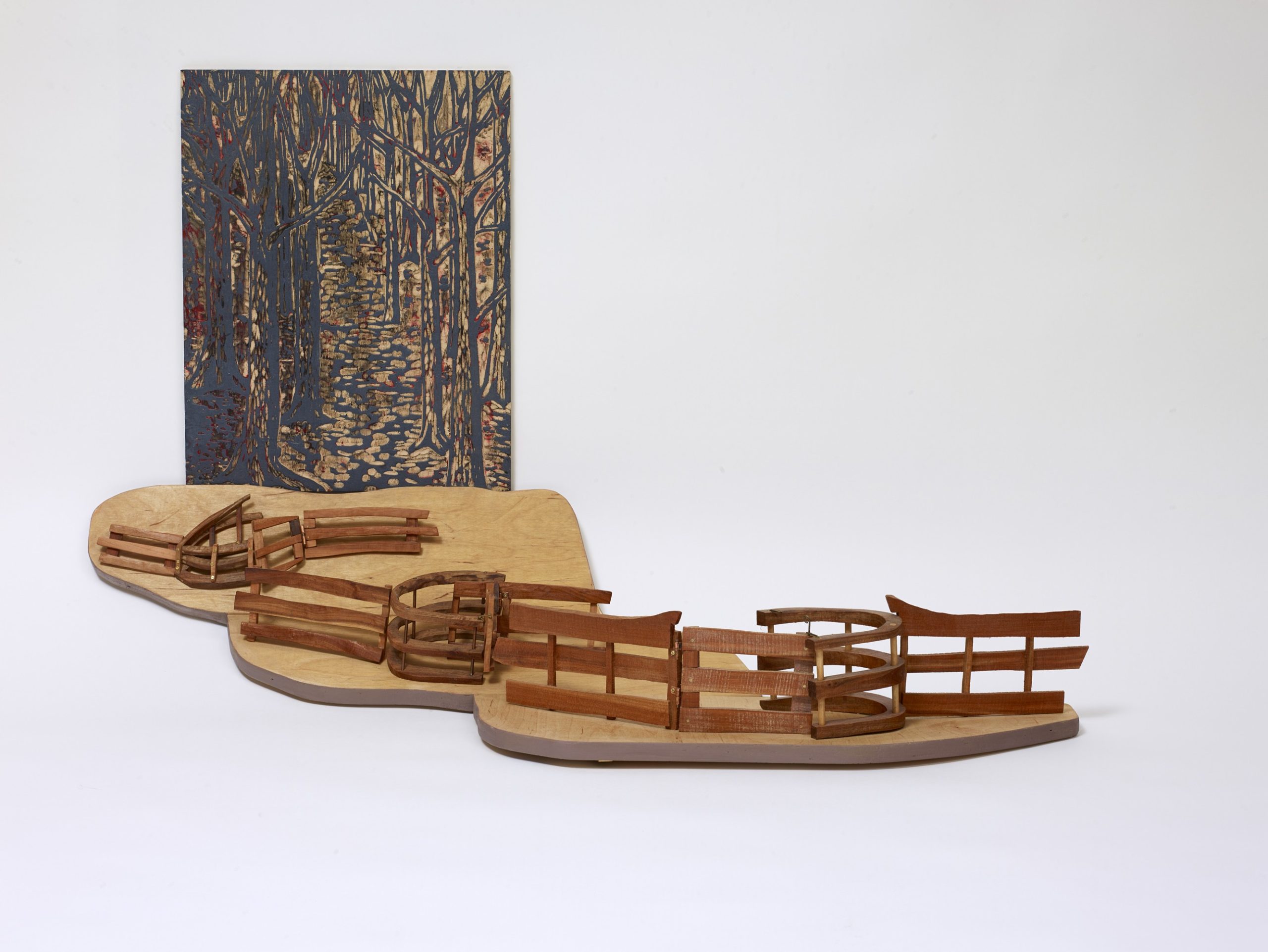
Walking carves places in our memories. Footfalls over decaying foliage, stumbles over rocks, sojourns to locales whose cultural understanding can only be arrived at through the body’s somatic memory: these constitute Lisberger’s domain. Contemplation and reflection give way to indexical activity: chiseling, gouging, sawing, sanding, incising, envisioning. Through these methods, she arrives at abstracted approximations of bodily navigation.
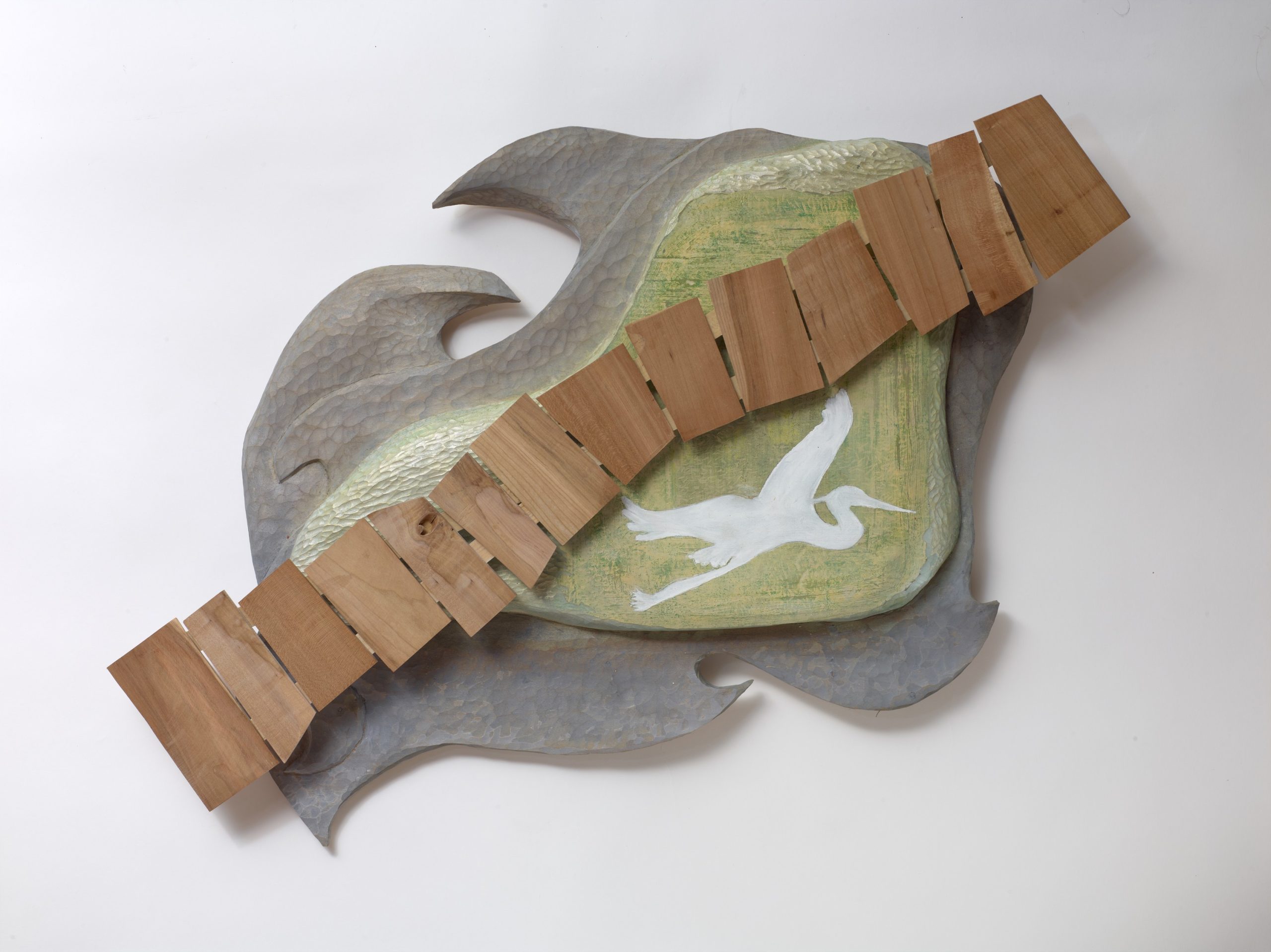
Fore River Sanctuary (2019) speaks to the repetition in a stride. Wooden planks of varying sizes abut one another against a grey wave and green backdrop. The boards bisect their base on a diagonal from the lower left area of the piece to its upper right. A great blue heron soars in the bottom right corner, complicating our perspective. The rhythm of the wooden rectangles is evocative: a tempo of a rubber sole hitting board gives way to a soothing beat, a metronome against which to compose thought. The meandering line of the differently sized planks speaks to chance encounters, to the body’s tendency to undermine the mind’s orderly predilection as wandering takes shape.
Lisberger’s works often evoke a natural backdrop. In doing so, she eschews Charles Baudelaire’s flâneur, an urban dilettante ushered into existence through industrialization who would, in philosopher Walter Benjamin’s words, “botanize the asphalt” with the seeds stuck in his soles.[3] While not against urban life, the city is not Lisberger’s focus. Instead, the artist’s walks take place in a world synergistic with the man-made, in spaces in which environmental-anthropic harmony is possible.
The all-encompassing nature of somatic experience gives rise to creative action. The lines of Lisberger’s walks rise up, becoming spatial renderings of memory. They are records of a kind, a mental archive made tangible. Each work in 20 Walks is tied to a personal, ambulatory experience of place by the artist. Through wood and the sculptural form, Lisberger gestures, purposefully, at memory. She leaves its final manifestation slightly abstracted. It is the audience’s experiences of these vivid distillations, visible in the undefined space of abstraction, that breed new understandings of the body in place.
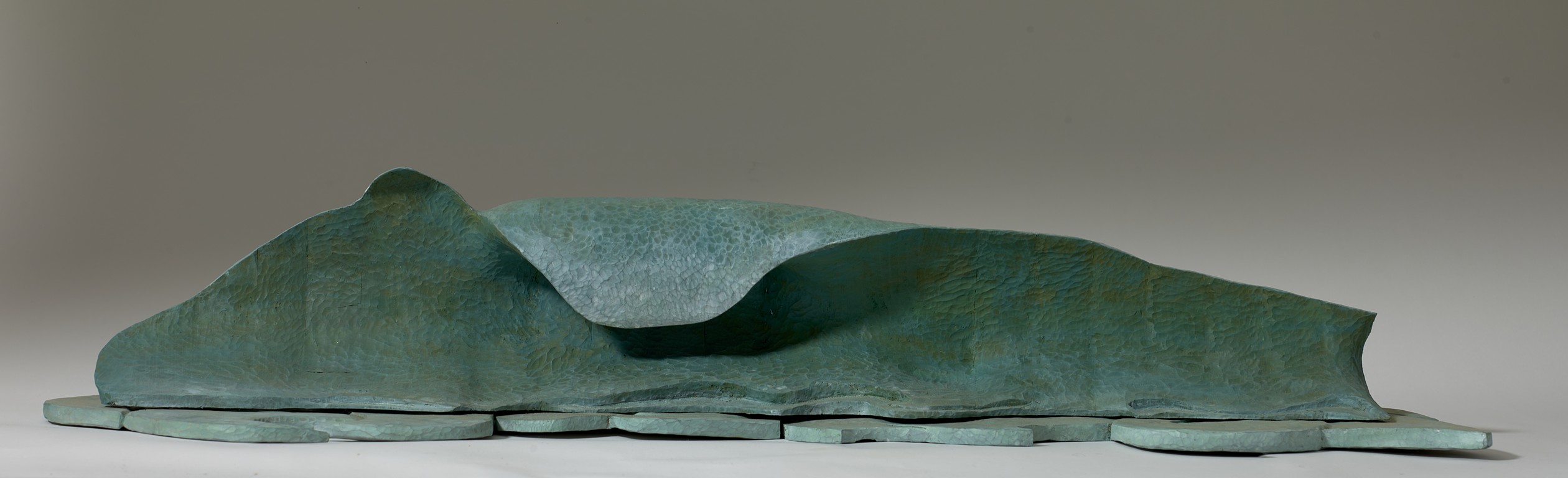
Elemental material construction heightens the ways in which sculpture harkens to experience. Wood, in particular, eases viewing with its familiar tension of durability and porosity. It constructs the spaces that enclose us in architecture and envelope us with perforated openings in the wilderness. Poplar’s elemental gravity is transformed in Lisberger’s Two Lights (2022). An elongated form measuring 47 inches, the piece starts relatively flat, then rises up and curls over itself. Hand-chiseled marks repeat across its breadth. The work is painted a grey-ish aquamarine. Divets left by Lisberger’s indexical tracing of mallet and gouge have a light-capturing effect akin to dappled sunrays playing on the water’s surface. The piece captures the moment of the wave in a state of natural tension. In Lisberger’s hands, wood morphs into an elemental sibling, its elements turn in a tidal shift.
Place is tied to experience. Writer Lucy Lippard defines place as “the intersections of nature, culture, history, and ideology [that] form the ground on which we stand…a portion of land/town/cityscape seen from the inside, the resonance of a specific location that is known and familiar.”[4] Lisberger heightens the peculiar quality of place through her works, bringing viewers into the artist’s understanding of local by way of vignettes. The interiority of the artist’s experience in these spaces contrasts with the audience’s circumambulation. Attentive to cultural histories and the terrain’s underfoot topography, Lisberger’s articulations are specific but accessible, engendering a sense of place even as we see her work from a removed vantage point, not quite occupying its center.
Sculpture is uniquely positioned as a medium that can approximate a somatic understanding of place. Viewed in the round, the form relates to the space it occupies but is not so embedded in it as to cause its architecture to lose its meaning, as can so often be the case with painting. Instead, sculpture causes the three-dimensional to take on new meaning, heightening our conception of in-situ placement and giving way to proprioceptual memory. Its three-dimensionality allows audiences to navigate the complexities inherent to objecthood while remaining situated within the specificity of embodied place-based experience.
We condense encounters with place into memories, shrinking the clamor of sensorial input into one navigable film in the mind’s eye. Our minds transform unwieldy information into a catalog of what matters most to reconstruct experience. Throughout 20 Walks, Lisberger makes tangible a memory with just enough information for audiences to comprehend each discreet walk.
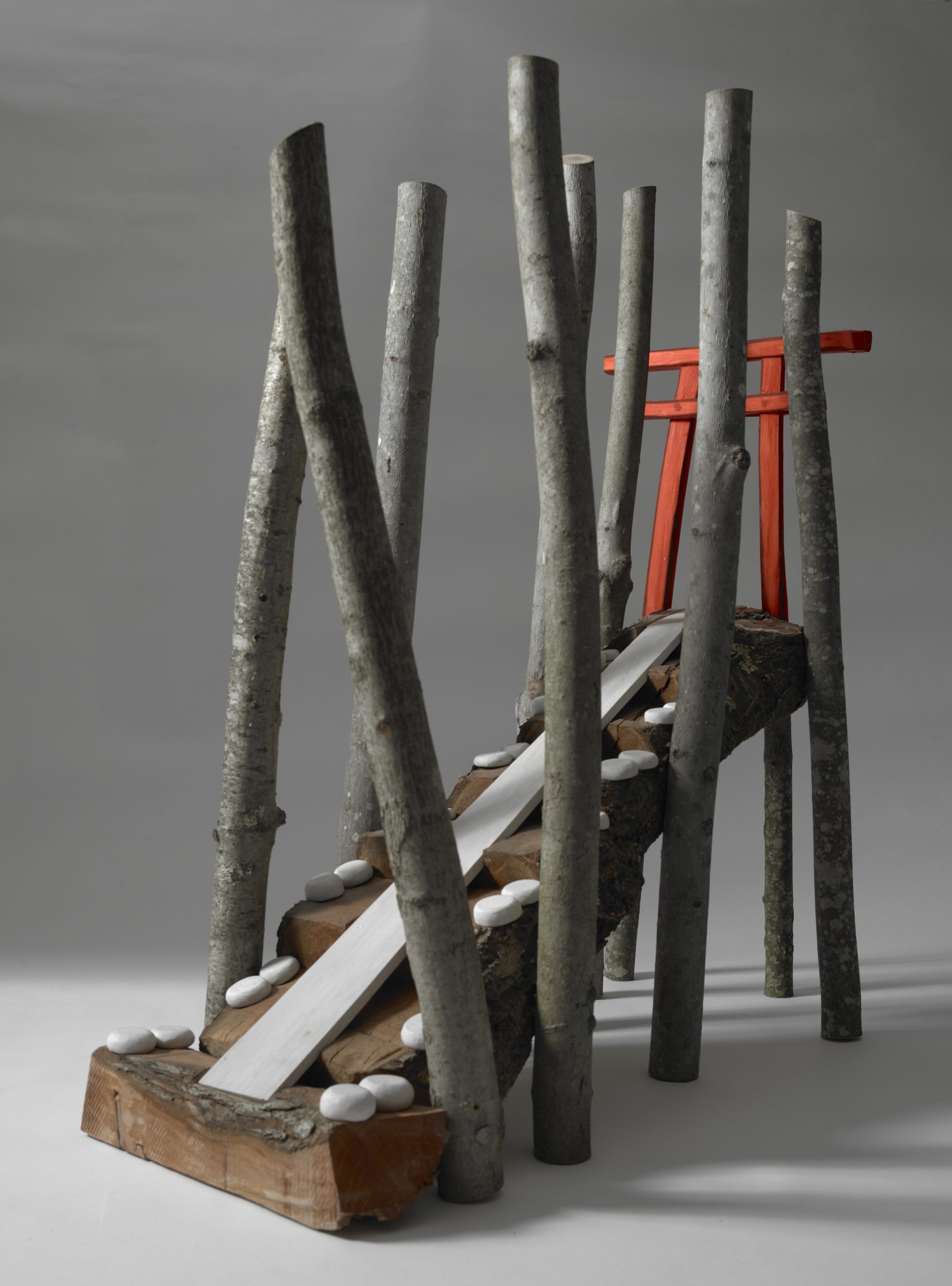
Kamakura (2020) recalls the artist’s walk up a steep mountain in the Japanese city of the same name. Its steps approach a traditional red torii, the arch that marks the transition between the mundane and sacred, where spirits comingle in the passage. Lisberger surrounds the summit with saplings, planting a dense forest on its periphery (a tactic she also employs in The Grey Woods). The sculpture is considerably scaled down from life’s experience, standing just 39 inches tall. Articulated entirely through humble cherry, chestnut, and paint, Lisberger’s place-based resonance transcends the everyday, recalling a moment best imagined through the burn of a calf, the breaking of a twig, the rustle of a red maple. The embodied memories Kamakura conjures foster reverence for the ordinary extraordinary. Lisberger pays attention to how we are always in communion with the natural, with the unknown.
Lisberger shapes place, but she is keenly aware of how it shapes her: the careful navigation of brambles, the mounting of summits molds our proprioceptual understanding, kneading our synaptic folds into a mirror of landscape’s undulations. A doppelganger of each hill and valley resides in our mind, just as the ground gives way to mold our footprints. Lisberger’s work reminds us of how that which we have witnessed witnesses us.
— Kat Zagaria Buckley, Director of Art Exhibitions and Outreach, University of Southern Maine
[1] Waxman, Lori. Keep Walking Intently. Sternberg Press, 2017. 207.
[2] Thinkers such as Donna Haraway hold that our positionality constitutes knowledge; that knowledge itself is fragmentary and occurs across a spectrum of individual subjectivities. Although Haraway writes of the role of positionality in sight with sight as akin to knowing, I assert that positionality plays into proprioception and its respective capacity to generate knowledge. See Haraway, Donna. “Situated Knowledges: The Science Question in Feminism and the Privilege of Partial Perspective.” Feminist Studies 14, no. 3 (1988): 575–99. https://doi.org/10.2307/3178066.
[3] Benjamin, Walter. The Arcades Project. Translated by Howard Eiland and Kevin McLaughlin. Revised edition. Cambridge, Mass.: Belknap Press, 2002. 372. I have written elsewhere on how this phrase portends nature’s ability to reclaim manmade structures, such as in the case of the picturesque and “ruins.” Such a reading of the phrase heightens its corollary to Lisberger’s work. See Buckley, Kat. “We Hope for Better Things; It Will Arise from the Ashes: Exploring the Aesthetics of Post Modern Ruin Photography in Detroit.” Kritikos Intertheory, Winter, 2016. https://intertheory.org/buckley.htm
I use “him” in the sentence this notation accompanies, as, for Baudelaire, the flâneur was emphatically male.
[4] Lippard, Lucy R. “All Over the Place.” In The Lure of the Local: Senses of Place in a Multicentered Society, New edition. New Press, 1998. 7.