

The University of Southern Maine has launched Polymath Pathways, a new multidisciplinary undergraduate program that allows students to earn two fully developed majors within a single degree — without adding time to graduation.
Thinking like a polymath
Unlike a traditional double major, which typically leaves students to piece together their own path, USM’s Polymath Pathways are built from the ground up as structured, advisor-supported programs designed to be completed in four years. Each pathway pairs two distinct, intentionally matched majors, allowing students to graduate with two full majors at the cost of one degree.
The name is deliberate: a polymath, historically, is someone fluent across multiple disciplines — and that’s precisely what the program sets out to develop. Each pairing was designed to ensure the two fields reinforce rather than simply coexist with each other.

“The Polymath Pathway is designed for students who are intellectually curious across majors,” said Jane Kuenz, dean of USM’s College of Arts, Humanities, and Social Sciences. “It prepares students to move among disciplines and approach problems — and their solutions — from more than one vantage point.”
A 2024 National Bureau of Economic Research study found that double majors experience roughly 56% greater protection from income volatility than single-major graduates — and the less related the two fields, the stronger that protection. USM’s five Polymath Pathways are built on exactly that premise: pairing fields that are distinct enough to diversify a student’s skills, but connected enough to deepen them.
Unexpected pairings, intentional design
The five available Polymath Pathways connect fields that don’t share a classroom, yet each combination is grounded in a deliberate logic that strengthens both perspectives.
“The Philosophy and Finance pair was everyone’s fantasy football choice,” Kuenz said. “It seems counterintuitive until it’s not. Both fields require analytical thinking, focus, and precision — one with numbers, the other with words and ideas.”
Faculty in both departments see the connection clearly.
“Logic trains students to analyze arguments, evaluate evidence, and reason carefully about complex systems,” said Dr. Yishai Cohen, associate professor of philosophy. “When paired with finance, those same skills help students make clearer, more responsible decisions about risk and markets.”

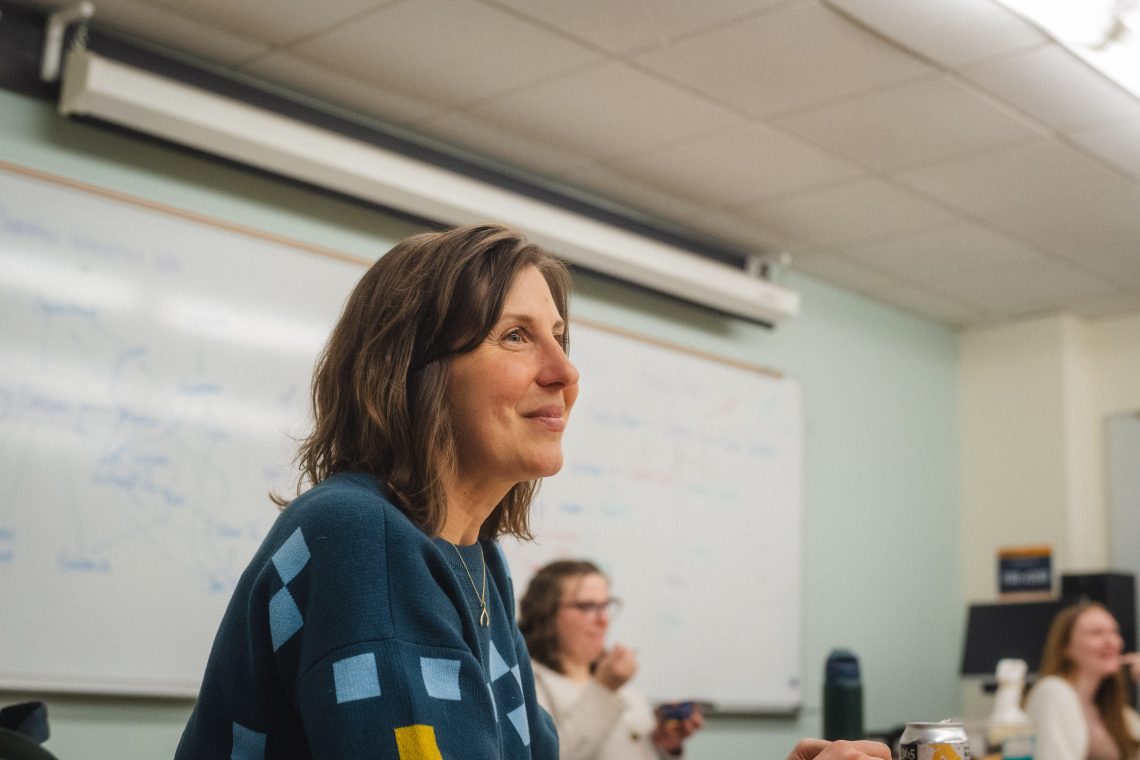
For faculty in the English and Marketing pathway, the pairing grows from a shared commitment to connecting creativity with data-driven decision-making.
“Most marketers can analyze data. Most writers can craft a story. Few can do both fluently and effectively,” said Dr. Eklou Amendah, assistant professor of marketing. “The USM Marketing and English Polymath Program trains you to do both.”
Other pathways follow a similar logic: History & Geography-Anthropology (GIS) connects human narratives with spatial data; Philosophy & Biology links scientific questions with ethical reasoning; and Art & Psychology explores creativity through the science of human behavior.
How it works for today’s students
Students drawn to more than one field but cautious about taking on too much will find the program’s structure works in their favor, Kuenz says.
“You won’t be spread too thin — you’ll be more focused,” she said. “Because Polymath students satisfy most of their general education requirements through major coursework, they begin work in their majors from the first year.”
The program’s multidisciplinary design also opens a wide range of internship and employment opportunities through the Career & Employment Hub’s network of more than 200 partner organizations across Southern Maine.
Affordability is built into the model: Students earn two full majors within a single Bachelor of Arts degree, gaining the value of a double major without additional time or expense.
For Kuenz, the program’s impact extends beyond career preparation.
“I believe the students who will graduate having spent four years learning completely different subjects and developing distinct skill sets will simply be better educated,” she said. “I want the people planning a healthcare career to learn about ideas, ethics, and values from an entire major in philosophy — not just a single class — and I want those who are skilled with language to do the same with numbers.”