

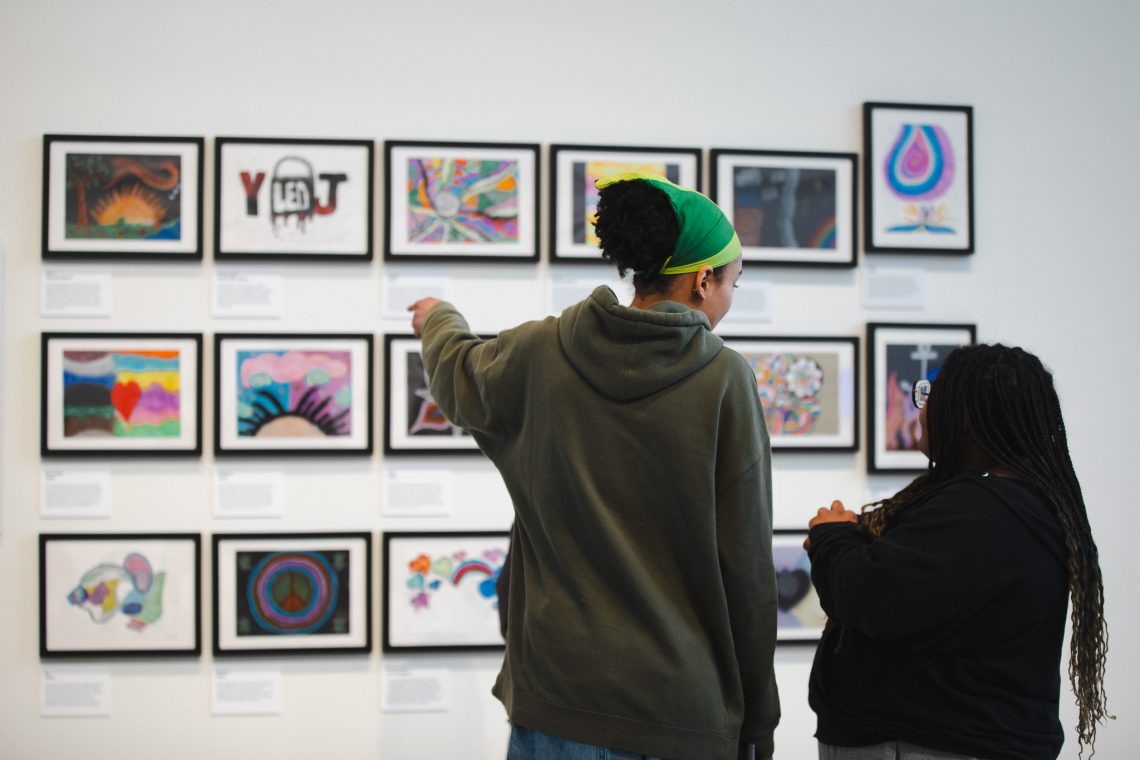
When 12-year-old Erica from Greater Portland Family Promise saw her drawing framed and hanging on the gallery walls of the Crewe Center for the Arts, her mouth dropped open and her eyes widened. When Amanda posed for a photo next to her own framed piece made in a Center for Grieving Children art workshop, she wiped a tear from her cheek.
A new exhibition, “Even As We Grieve,” brings together the University of Southern Maine and eight Greater Portland nonprofits around one shared conviction: art can be a powerful vehicle for community, healing, and connection.
How the exhibition — and the community behind it — came together
“Even As We Grieve” centers on the work of Peter Bruun, USM’s 2026 Artist-in-Residence, whose paintings and drawings explore grief, loss, and the human connections that help people navigate each. On view through July 31, the exhibition places a selection of Bruun’s work alongside 60 pieces created by community members from the eight partnering nonprofits, and 20 accompanying audio stories.
Bruun is a Maine-based artist, curator, and educator whose work draws on his own experience of grief to explore universal questions of loss, recovery, and the sustaining power of community. Much of his work began as a source of healing and expression after the 2014 overdose death of his daughter — but grew into something larger. He was selected through USM Art Gallery’s artist-in-residence program, an initiative launched in 2015 to connect the University to the broader community through temporary, community-focused projects.
“Art and exhibitions have a particular power: when you use them to hold people’s stories, those stories gain meaning and value they might not otherwise find,” said Bruun. “There is something fitting about a project on community, and actually building it. In honoring these individual villages, we find ourselves part of a larger one.”
For “Even As We Grieve,” Bruun partnered with eight Greater Portland nonprofits — EqualityMaine, Maine TransNet, Greater Portland Family Promise, Center for Grieving Children, Portland Recovery Community Center, Commonspace, Reentry Sisters, and Youth-LED Justice — each serving people navigating loss, crisis, and systemic inequity.
“The partners we worked with represent communities that are disproportionately exposed to traumatic events,” said Kat Zagaria Buckley, USM art exhibitions director. “We wanted to honor the work these people did and share their stories. While it deals with heavy topics, the exhibition is about how community guides us through difficult times.”
A closer look at the exhibition
The exhibition is organized around two bodies of work displayed in conversation with each other — Bruun’s paintings and drawings on one side, and the community work on the other, their voices woven throughout in 20 different audio stories.
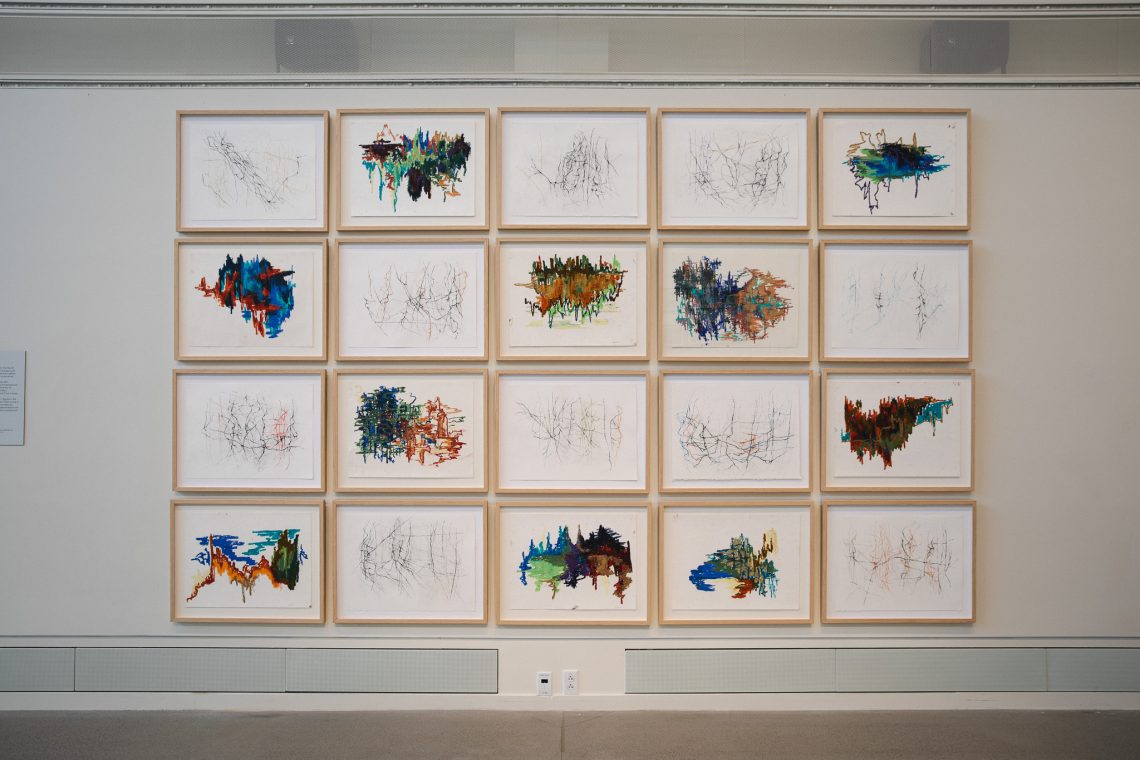
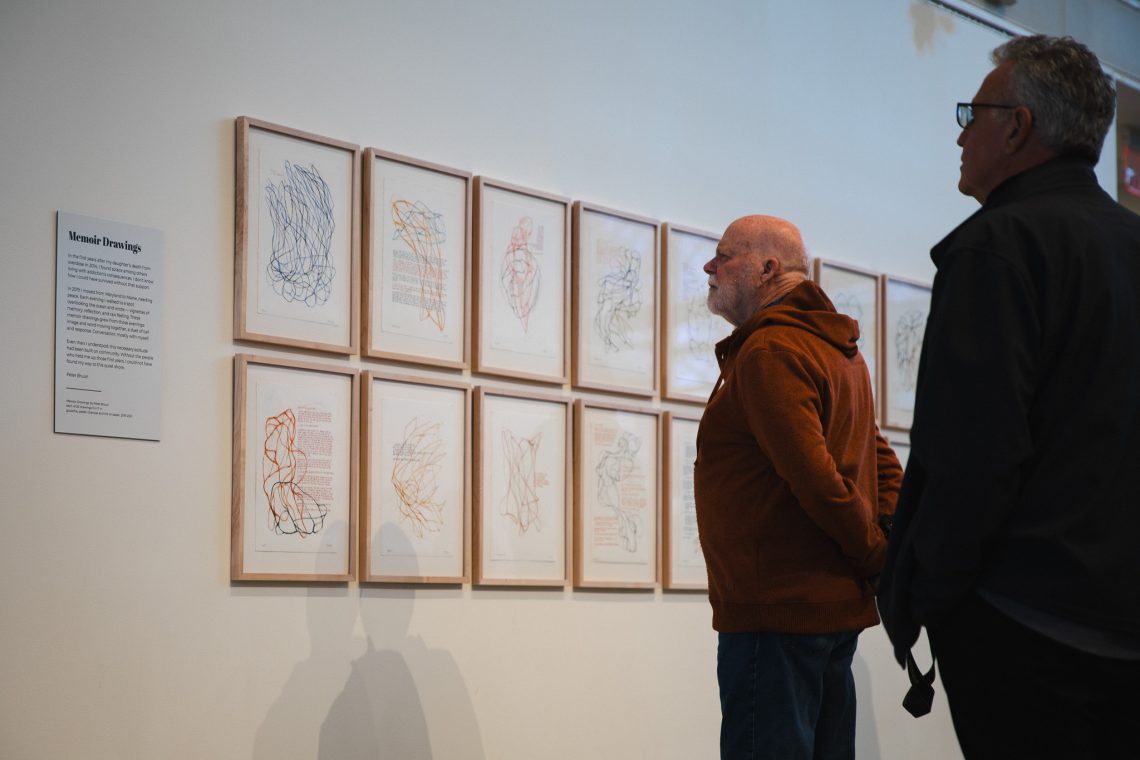
Bruun’s paintings, drawings, and text-based works trace his own grief journey, from loss through recovery.
“His linework mirrors the nonlinearity of grief journeys,” said Zagaria Buckley. “Placed alongside community artwork, it reminds us that we are always just scratching the surface of a journey that twists and changes, deepening each time we are able to be in community.”
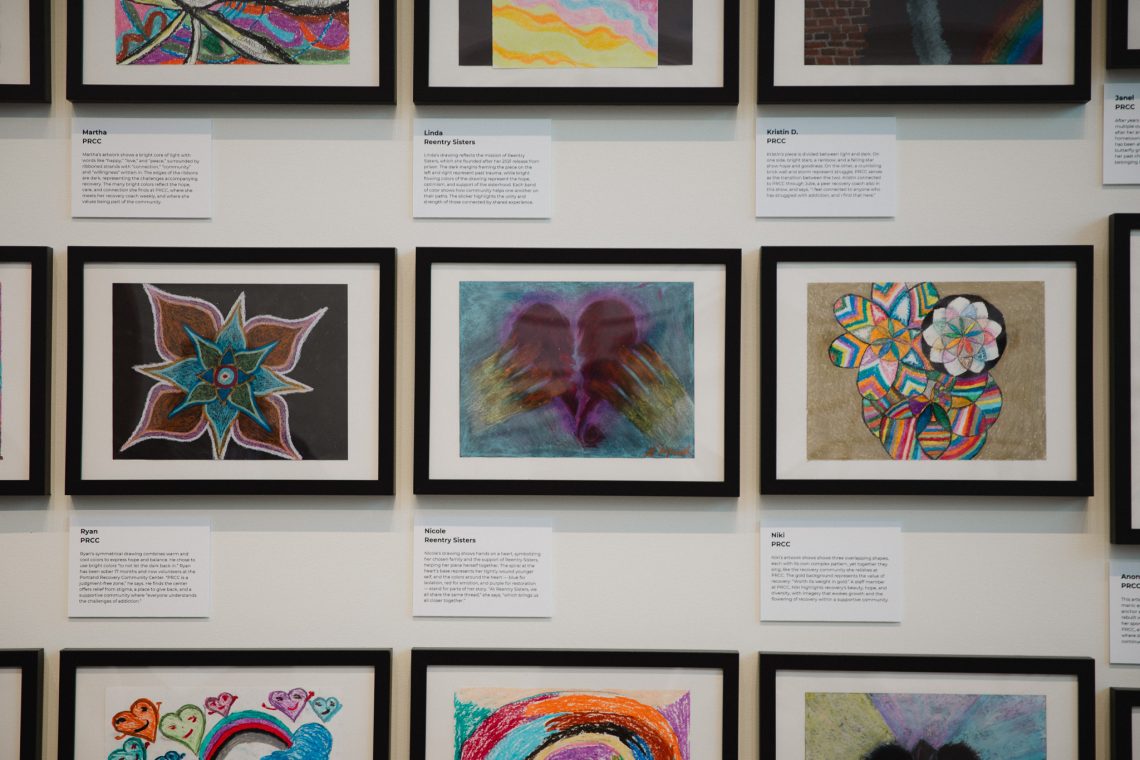
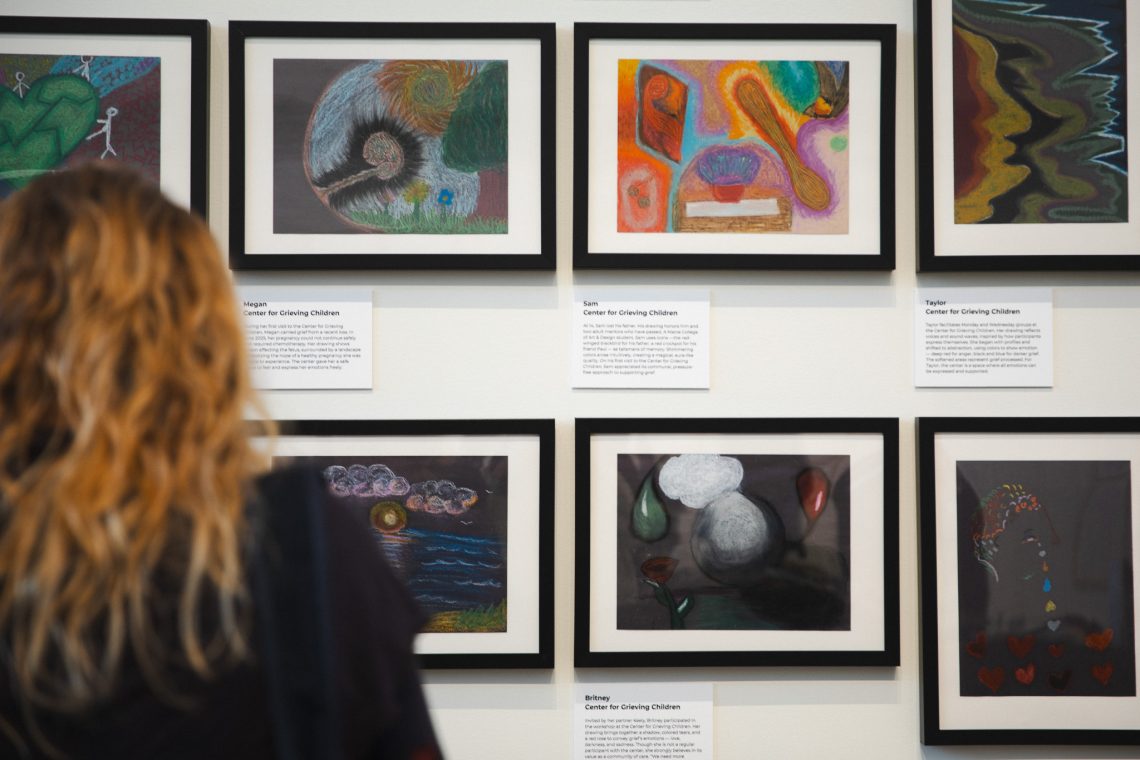
Across from Bruun’s work, the community pieces tell their own stories. To create them, Bruun led art workshops with each of the eight partnering organizations, inviting participants, volunteers, staff, and friends to make work rooted in their own experiences of grief and connection.
“There was a tenderness to the workshops that made it feel unique,” said Gretchen Johnson, executive director of the Center for Grieving Children. “Everyone brought different levels of experience and comfort in creating art, and at the end, everyone’s work was beautiful — so many mentioned how well they felt held and connected.”
Students, graduates, and a university showing up
For USM, the exhibition goes beyond a gallery show. The Crewe Center for the Arts, intentionally positioned as a bridge between the campus and the larger Portland community, was built to hold exactly this kind of collaboration.
“We are here as a community space, welcoming constituencies who typically might not interact with the University and whose artistic engagement is too often limited by systemic barriers,” said Zagaria Buckley. “The Crewe Center can hold all this and more — a space where we welcome and hold one another.”
USM students have played an active role from the start. Juliana Levesque, a Media Studies student, created an eight-minute video weaving together Bruun’s artwork, the community pieces, and audio vignettes. Other students contributed behind the scenes as well — helping with audio editing, exhibition organization, workshops, and more. At the April 16 opening event, USM students interning with the partnering organizations contributed poetry and music to the evening’s program.
“When I began my residency, I knew I wanted USM student involvement — I just didn’t know what form it would take,” said Bruun. “USM is a socially minded community, and this project seemed to attract people who share those values. In every instance, they enriched the whole.”
For Jennifer Kern, a USM graduate student pursuing a master’s in counseling, the exhibition’s location represents an opportunity.
“Having this here is really meaningful,” said Kern, who is currently studying expressive arts approaches in counseling. “Students who are grieving can see themselves reflected here — a reminder that they are not alone in what they’re carrying. The exhibition does a powerful job of showing how differently grief can look from person to person.”
The project continues
On May 21, Bruun’s second exhibition as USM’s Artist-in-Residence opens at the University Art Gallery in Gorham — a distinct body of work titled “You Once Had an Aunt,” comprising 100 small oil paintings inspired by the birth of his grandson and Bruun’s late daughter, the child’s aunt, whom he will never meet. Two more community events tied to “Even As We Grieve” — June 25 and July 23 — remain at the Crewe Center, both free and open to the public.
The work, and the community it has built, is still unfolding.
“An individual in pain finds harbor, and from that harbor finds their feet, restores hope, finds community. Over and over again. There is grace in that — in my story and in every story this show holds,” said Bruun. “Even as we grieve, we carry one another.”