
James Quinlan, assistant professor and chair of the Department of Computer Science, recently presented at the Joint Mathematics Meetings (JMM) in Washington, DC, contributing to an American Mathematical Society (AMS) Special Session titled Engaging Learners with AI. The presentation focused on leveraging large language models (LLMs) for course development, emphasizing how generative AI can support curriculum design, instructional planning, and assessment in mathematics education.
The AMS Special Session examined the expanding role of artificial intelligence in mathematics education, highlighting its influence on teaching, learning, and assessment across educational levels. Invited talks explored AI applications in calculus, data science, mathematical problem-solving, and K–12 instruction, and addressed theoretical, ethical, and practical challenges. The session brought together researchers and educators developing AI-integrated pedagogical approaches and aimed to foster sustained discussion about how AI is reshaping the landscape of mathematics education.
In the presentation, the professor discussed how LLMs can be used as pedagogical support tools rather than replacements for mathematical reasoning or instruction. The talk emphasized practical workflows for using LLMs to support course development, including drafting problem sets at varying levels of difficulty and aligning course materials with learning objectives. Particular attention was given to instructor oversight, the importance of mathematical correctness, and strategies for prompting LLMs to reinforce conceptual understanding rather than rote solution generation.
Overall, the AMS Special Session on Engaging Learners with AI highlighted both the promise and the complexity of integrating AI into mathematics education. The professor’s presentation on LLM-assisted course development contributed to an ongoing conversation about how educators can thoughtfully adopt emerging technologies while preserving the rigor, creativity, and human judgment that define mathematical practice.
The Joint Mathematics Meetings, jointly organized by the AMS and the Mathematical Association of America, is the largest mathematics conference in the world. The 2026 meeting in Washington, DC, drew approximately 5,400 attendees and featured 368 sessions with 634 presenters across a wide range of mathematical disciplines and educational topics. The conference hosted 55 exhibitors, offering participants opportunities to engage with publishers, software developers, and professional organizations. JMM also achieved an estimated 900,000 social media impressions, reflecting its broad reach within the global mathematics community, and distributed over $500,000 in travel funding to support participation from students, early-career researchers, and educators.
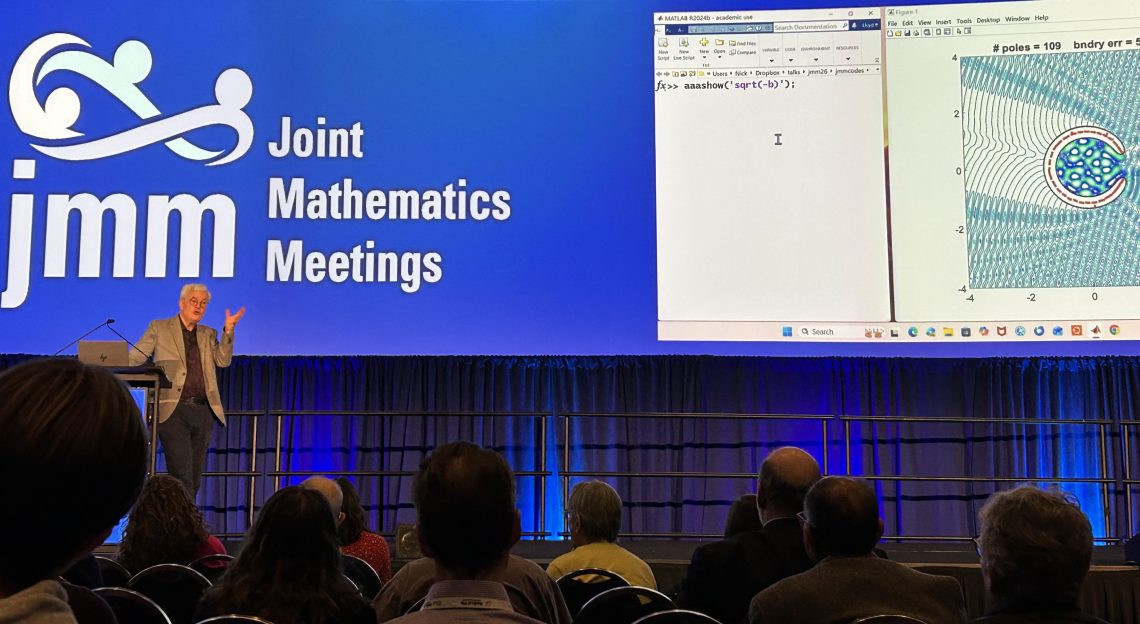
The meeting featured several high-profile speakers, including Gilbert Strang of the Massachusetts Institute of Technology, whose contributions to linear algebra and mathematics education have influenced generations of students. The 2026 Josiah Willard Gibbs Lecture was delivered by Nick Trefethen of Harvard University (pictured below), who addressed a broad audience on the polynomial approximations and the new AAA algorithm, continuing the Gibbs Lecture’s tradition of connecting advanced mathematical ideas to a general scientific audience.