

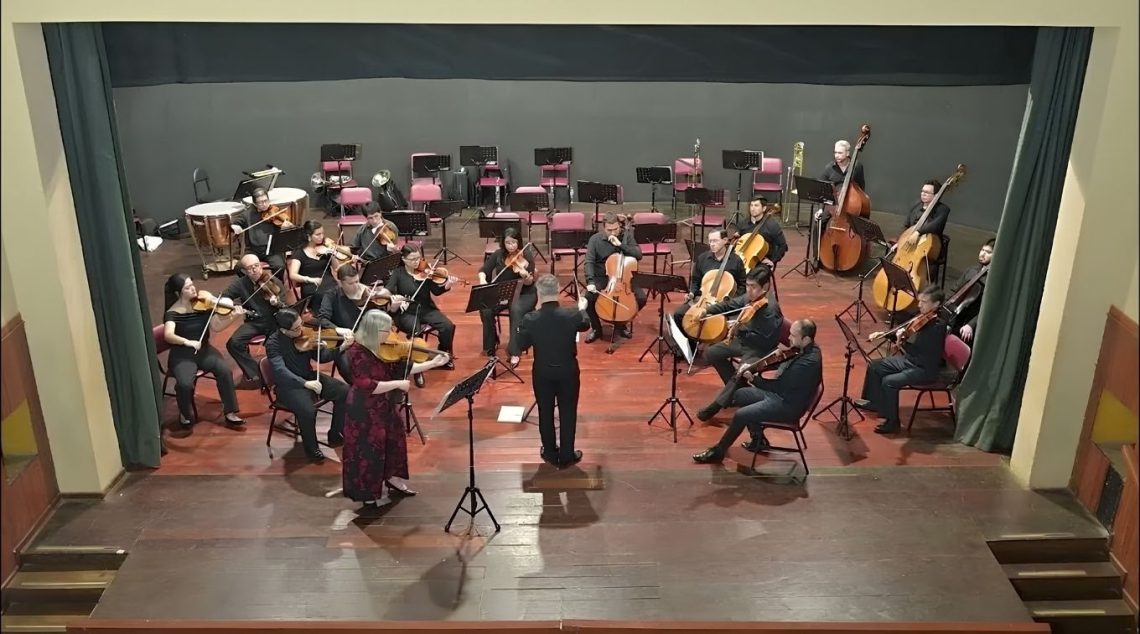
A friendship built over 30 years in the professional music world led a pair of University of Southern Maine faculty members to Peru last month, where they performed and conducted alongside the Orquesta Sinfónica de Trujillo in a week of concerts spanning classical repertoire and cross-cultural collaboration.
Robert Lehmann, professor of music and director of string studies and orchestral activities at USM’s Osher School of Music (OSOM), received the invitation through Wilson Pedrazas, a violinist from Trujillo and member of the Portland Symphony Orchestra (PSO). Pedrazas had been asked to return home to perform a demanding violin concerto with the Trujillo symphony but needed a Spanish-speaking conductor. The two had met as graduate students at Boston University and shared the PSO stage for years, but it took a colleague at dinner to connect the dots: Lehmann was raised in Mexico City.
From there, the program grew quickly. Pedrazas knew Kimberly Lehmann, artist faculty in viola at OSOM and Robert’s wife, through their shared work in the PSO and invited her to join for a series of chamber music concerts alongside the symphony program. With her presence confirmed, organizers added a concerto slot to feature her as a soloist with the full orchestra — a decision she learned about when the concert poster arrived.
“This is one of the beauties about music,” Robert said. “You make these lifelong friendships and acquaintanceships, you see people on and off over the years, and then you just never know when something will bear fruit.”
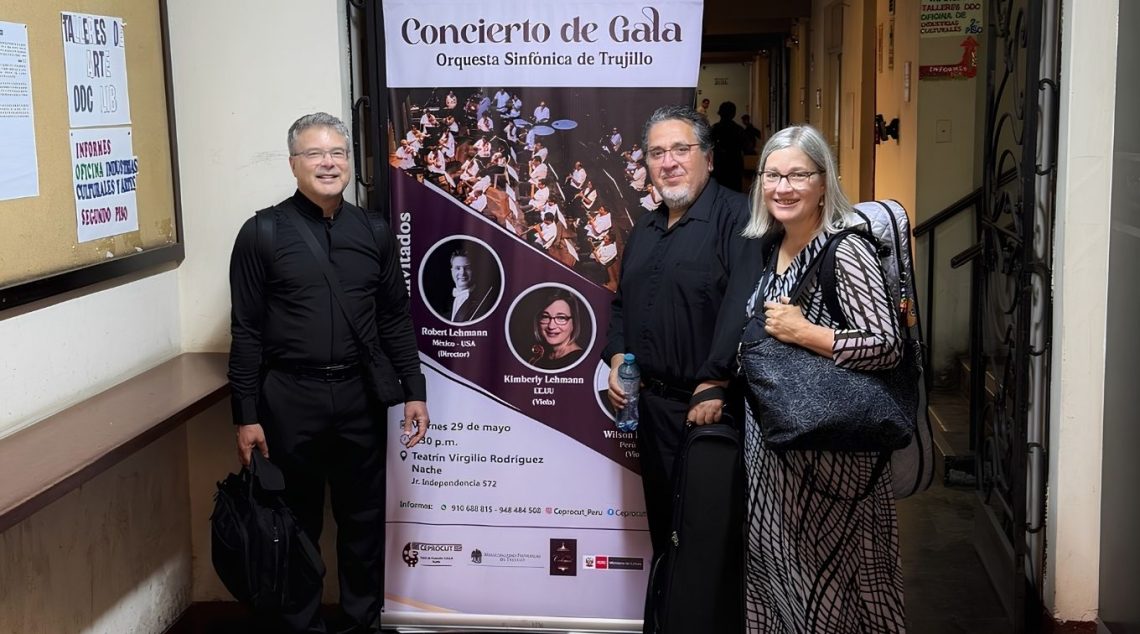
Over the course of one week, the Lehmanns participated in five orchestra rehearsals, three chamber music rehearsals and three concerts. The symphony program, performed May 29 at the Teatrín Virgilio Rodríguez Naché, featured Kimberly performing the Telemann Viola Concerto, Robert and Pedrazas performing Bach’s Double Violin Concerto, Pedrazas as a featured soloist on Wieniawski Violin Concerto #2 which was the main course and catalyst for the trip, and Robert conducting the orchestra in Schubert’s “Unfinished” Symphony. Two chamber music concerts preceded the symphony program, with the Lehmanns and Pedrazas joined by Francis Alarcon, principal cellist of the Trujillo Symphony, for programs that included Mozart’s “Hunt” Quartet, Dvořák’s “American” Quartet, and the Ponce Sonata for violin and viola.
Stepping in front of an unfamiliar orchestra in a foreign country required both preparation and patience. Robert described an early wariness from the ensemble that gave way by the second rehearsal.
“By the end of the first rehearsal I was starting to see smiles, and they were doing what I was asking them to do,” he said. “The second day they were very friendly. I think they trusted me. They knew I had their best interest at heart, that I wasn’t going to waste their time. I’m just here to roll up my sleeves and make good music. And I think that was what resonated.”
Moving between the roles of conductor and performing soloist within the same program added another layer of complexity. Robert said the two roles are inseparable.

“As a conductor, the sound you’re after is intangible — you work through the ensemble, never directly,” he said. “That’s why I can’t look the orchestra in the eye if I’m not holding myself to the same standards as a performer on my instrument. The two are interlinked.”
The trip also carried meaning beyond the concert stage. For Robert, whose formative years were spent in Mexico City, the visit offered a direct encounter with another Latin American culture. A stop at the Huaca de la Luna, a Moche archaeological site near Trujillo, brought to mind the Aztec and Mayan sites he had visited growing up, while the stark desert coastline of northern Peru stood in contrast to the tropical Pacific he knew from Mexico. Robert said the experience reinforced for him that approaching a new place without assumptions is as important in a rehearsal hall as it is anywhere else.
At OSOM, international engagements like the Trujillo visit reflect a broader pattern among the school’s faculty. Without a formal study abroad program, Robert said, student exposure to the wider professional music world depends largely on the networks faculty build and maintain over careers.
That exposure carries particular weight in Maine, where high school string programs are few and, by Robert’s account, shrinking. Students who arrive at USM having been the only string player in their school can find the transition to a conservatory environment jarring — and that gap, he said, is precisely where faculty perspective matters most.
“We know what it takes,” Robert said. “So if you come to study here, we have that 20,000-foot vision of what your life should be like — because we’ve been outside of Maine, we’ve been outside of the United States. We understand what it takes.”
A few selections from their concert are available below.