
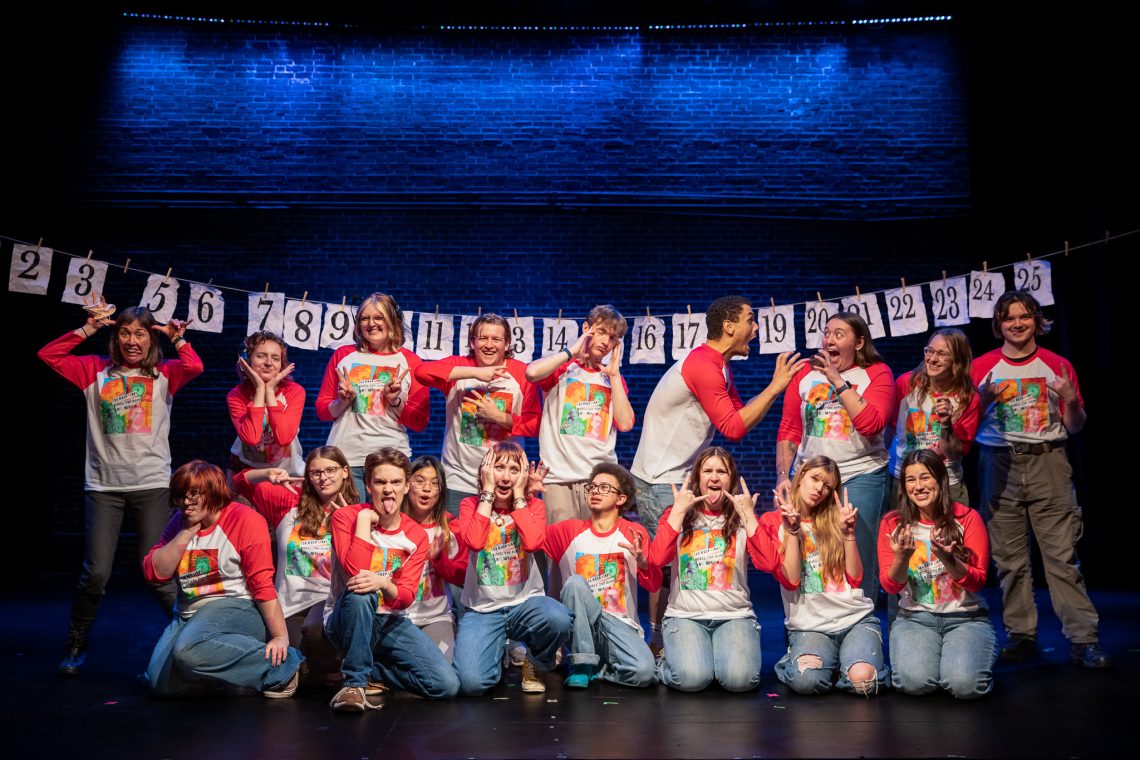
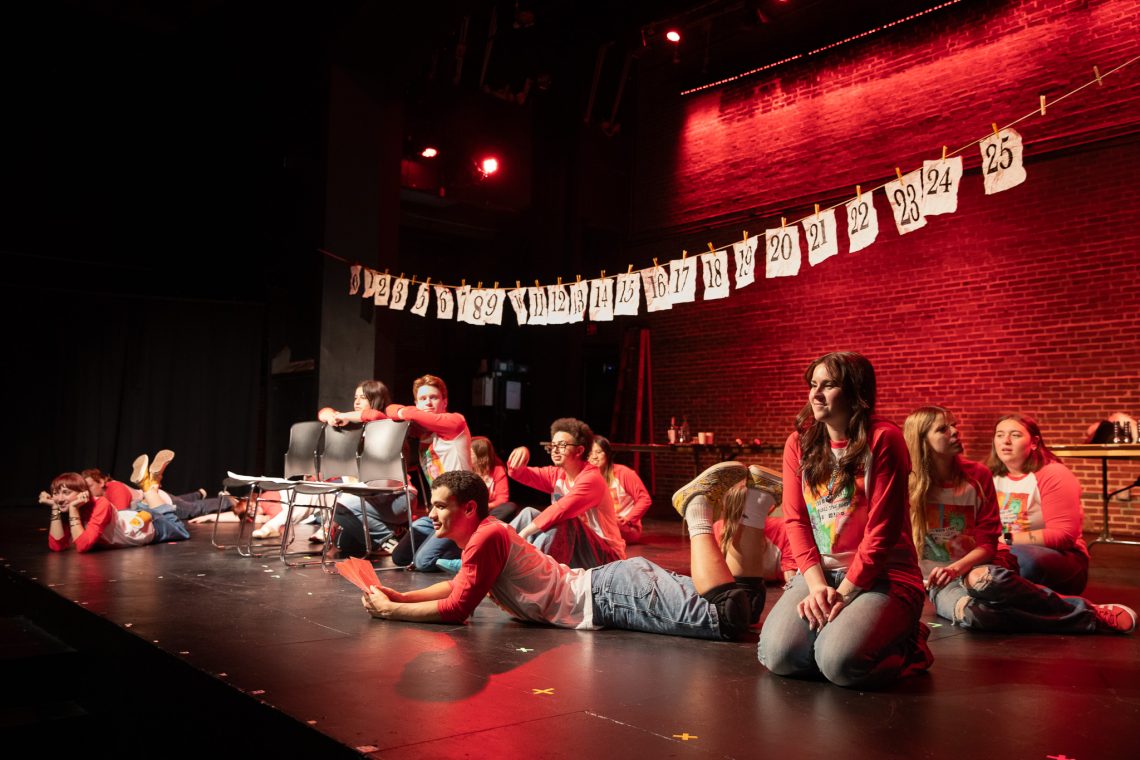
The clock starts at 60 minutes. A clothesline of numbered plays stretches across the stage, the audience shouts out numbers, and a cast of first-year theatre majors scrambles through all 30 before the buzzer. When the clock turns red, the pace goes from fast to frantic.
That’s “Too Much Light Makes the Baby Go Blind (30 Plays in 60 Minutes),” and at the University of Southern Maine (USM), it’s the first production each new cohort of theatre majors puts on together. Incoming students take a course built around the show, meet the classmates they’ll work alongside for the rest of college, and get their first taste of collegiate theatre side by side.
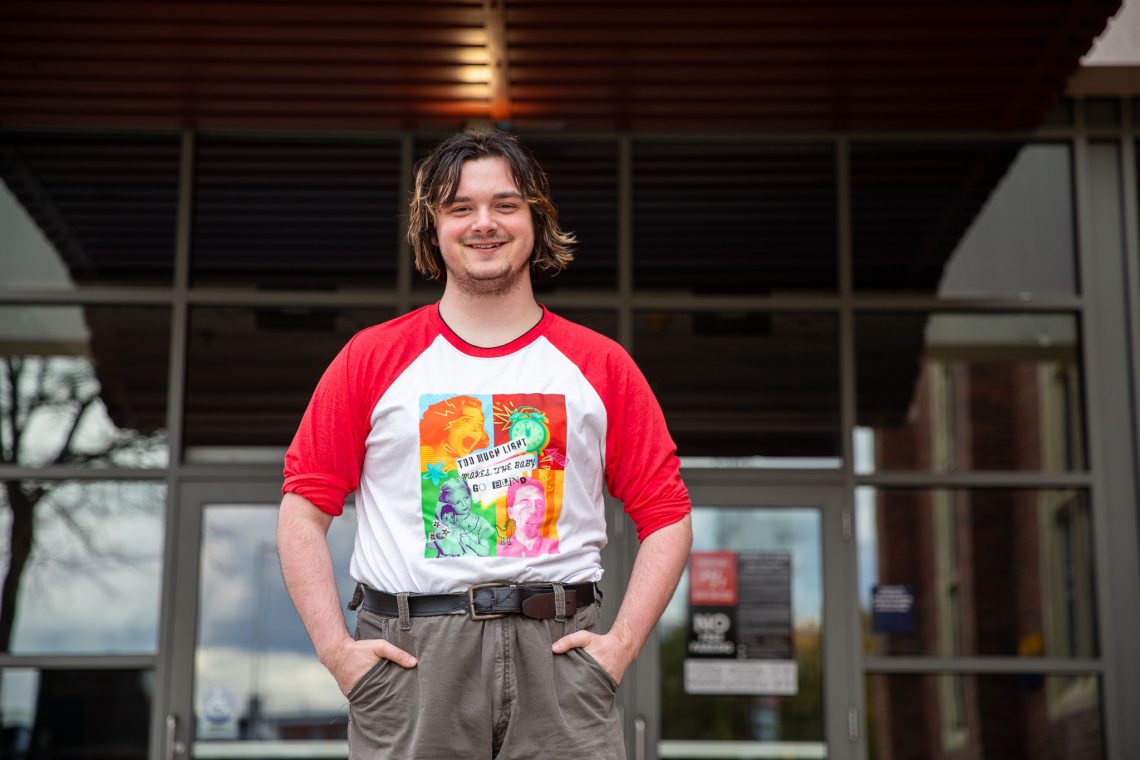
Over the show’s four years at USM, senior theatre major Trekk Skeate has seen it from every angle. He was onstage with the very first cohort, worked in the wings the following year, and this fall he’s back as assistant director.
A crash course in theatre
Trekk arrived at USM loving musicals and started in the musical theatre program through the Osher School of Music. After a semester there and another undeclared, he moved to theatre his second year, just as the department launched its first-year cohort. He and one other second-year student were invited to join.
The course gives every new major the same starting point, whether they’ve done years of productions or none at all. There’s no competitive audition. Students who want to perform are cast, and those who’d rather stay offstage find a place in stage management, design, or crew.
For Rachel Price Cooper, director of this year’s production, the goal reaches beyond the show itself.
“We started doing this as a cohort team-building, community-building exercise within the department,” Price Cooper said.
Skipping the competitive audition matters most for students who might otherwise talk themselves out of theatre altogether. Price Cooper remembers being one of them.
“When I was a freshman, I really wanted to major in theatre, but I was super intimidated. I didn’t end up doing it until my sophomore year, just because I thought, ‘All these people from big high school theatre programs, I couldn’t possibly compete.’ This is a really nice way in,” she said.
Spring auditions can draw 100 students for a single musical, and it’s anyone’s guess who ends up in the cast together. The cohort takes that uncertainty off the table.
“On the very first day of classes, we were basically told, ‘These are your friends for the next five months. Have fun,’” Trekk said.
As a second-year, he could have skipped the cohort and joined the upperclassmen instead.
“If I didn’t join the first-year cohort, I would have been thrust in with everybody else who had already spent a year in the department together. They had two or three shows under their belts. I felt like I would have had a hard time making friends,” he said.
Getting comfortable onstage
Many of the plays in “Too Much Light” poke fun at theatre itself, from overbearing directors to awkward rehearsals. Price Cooper said that makes them natural starting points for conversations about consent, boundaries, and what a healthy rehearsal room looks like.
In Trekk’s first production, one of those plays, “Hair Director,” had him rolling around on the stage floor.
“There was a piece in my ‘Too Much Light’ where I had to basically act like a fool onstage for maybe a minute and a half, and it felt really weird. I had never been in that position before, to make a fool of myself, and my peers, my friends around me, never made me feel like I was making bad choices or that I was actually a fool, because we had worked together for so long,” he said.
He’s confident that if he’d asked to skip the floor-rolling, Price Cooper would have found another way to stage it.
“This show is meant to push you, but it’s not meant to break you,” Trekk said.
This year, some of the performers he’s directing have asked to stage their pieces differently, and as assistant director, Trekk is now the one making room for that.
“It’s my job as their director in those pieces to say, ‘Yes, what can we do to make you feel good?’ Yes, it’s Rachel’s vision, but it’s your body,” he said.
The first real test
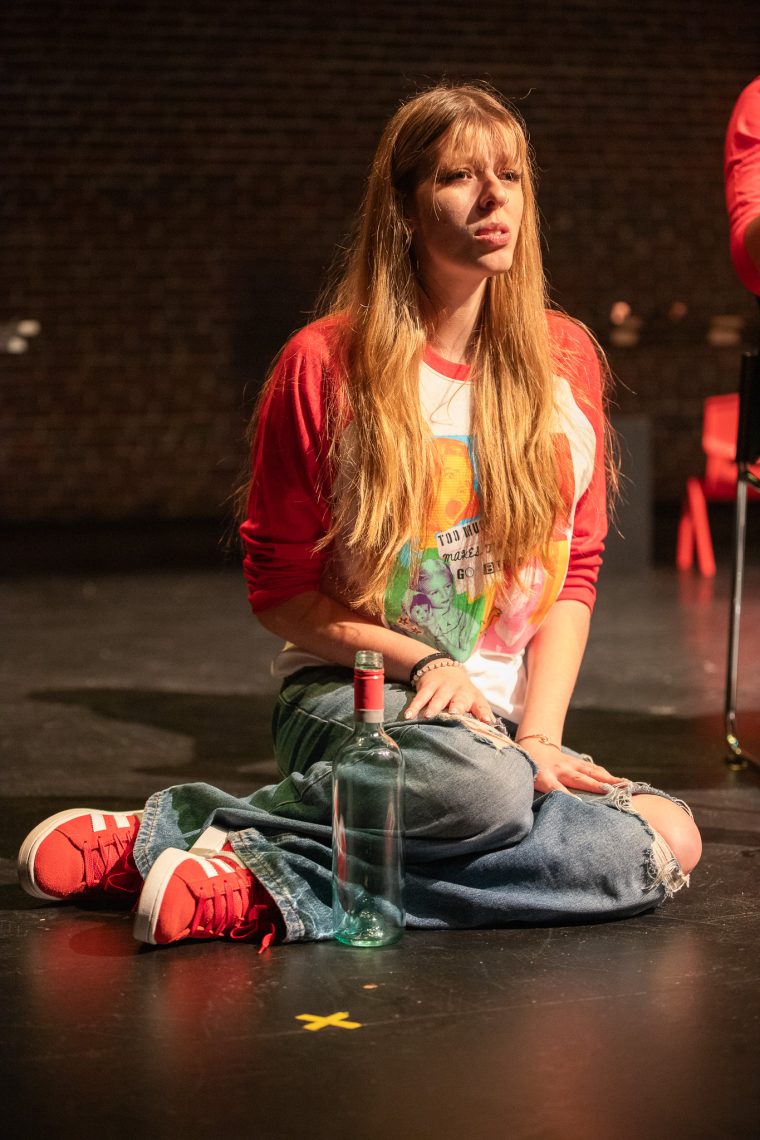
“Too Much Light” doesn’t ease anyone in. In Trekk’s year, the first few days were introductions and theatre games. Monologue auditions came next, and the cast list went up that same first week. From there, it was straight into blocking 30 plays, then tech, then opening night. It’s traditionally the second production of the department’s season, and for most of the cast, it’s both their first college show and a fast, honest look at whether this work is for them.
“It forces reflection: Can I do this? Should I do this? And if the answer is no, that’s not a bad thing. There are other avenues here and the support to help you navigate those questions. That’s why this is here. It’s designed to help you find what works for you,” Trekk said. “It’s a win-win.”
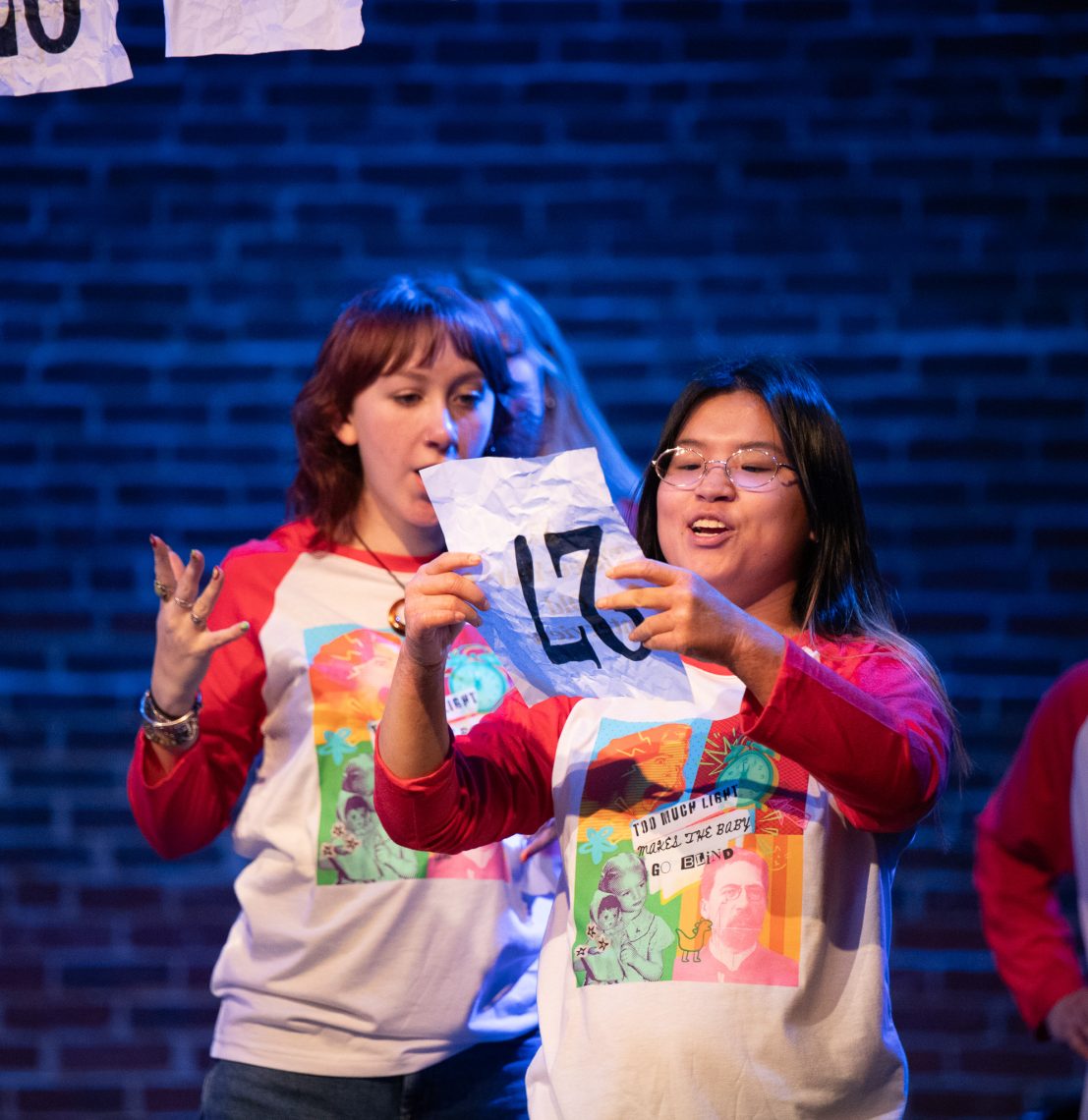
One performer in Trekk’s cohort realized she didn’t want to be onstage, so she designed the group’s T-shirts instead and went on to a work-study job in the costume shop.
Inside a night of ‘Too Much Light’
Trekk has now seen the show from the stage, the wings, and the director’s side of the room. If you’ve never been, here’s how a night works. Every audience member gets a menu listing all 30 plays by number and title. The titles are often part of the joke. One, called “Lawsuit,” is just performers running around with … well, you’ll just have to see the show. Others are genuinely poignant.
Someone in the crowd yells a number, the cast pulls it from the line, and everyone scrambles to set the props and rehearsal blocks the scene needs. They perform it, clear the stage, and ask for the next number. The order changes every night.
The clock adds the real pressure. Performers are expected to hold the pace they’ve rehearsed for two months until the final minutes, when the clock turns red.
“As soon as it turns red, it is off to the races,” Trekk said.
During one final dress rehearsal in Trekk’s year, a castmate hit the red with a nearly three-minute solo piece still to go, a play that tells a family’s story using chairs. To finish in time, he started sending chairs flying across the stage.
The year Trekk was on deck crew, working backstage, the show belonged entirely to the performers once it started. He spent it stage right, watching the clock along with everyone else.
“I was experiencing what the audience was experiencing, watching the numbers dwindle on the clock and thinking, ‘OK, they have five plays left. We have 15 minutes. Can they do it? I think they can do it. But wait, that one play is really long. Oh no.’ It was the same level of jitteriness that the audience experienced,” he said.
From first show to final year
Once “Too Much Light” closes, the cohort splits up to audition for the rest of the season, and Trekk said the show sends them in prepared.
“Having ‘Too Much Light’ as your own isolated production gives you an intro to what the standards are as a department. So when you leave the cohort for the spring shows, you’re already halfway there. You know what to prepare for,” he said.
Trekk’s cohort is the first to complete the full cycle, from that first fall production to senior year.
“With the structure of the cohort itself, since my year, they’ve really locked in a system. It kind of felt like our year was the experiment. The next year tested the structure. And then last year was, ‘We got it. We’re locked in,’” he said.
Now seniors, that first cohort is stepping into leadership roles. This year, the department brought back its student directing program, and Price Cooper said both student directors came from Trekk’s cohort. Even as their paths have split, Trekk said the group still shows up for each other’s work, something he expects to continue after graduation.
Along the way, Trekk found a second calling in stage management, including a summer on the house management team at Maine State Music Theatre. After taking Price Cooper’s directing class, he asked to be her assistant director for “Too Much Light.” She said yes almost immediately.
Exploring all options in theatre
With graduation this spring, Trekk is starting to think about life after USM. He’s looked into grad school but hasn’t settled on what he’d study, in part because his time here has opened up so many directions at once.
“My first two years were definitely performer-focused, and my last two years, definitely stage management-focused. That makes me more versatile than I expected. My original plan was to just graduate here with a BA in performance, but now I know more than that. It’s not what I planned, but it’s where we’ve ended up, and I am beyond excited to see where all of these opportunities lead,” he said.
For students considering the same path, Trekk’s advice is exactly what he’d give his 18-year-old self.
“Slow down. Take a breath. There are, and will be, many opportunities ahead,” he said.