
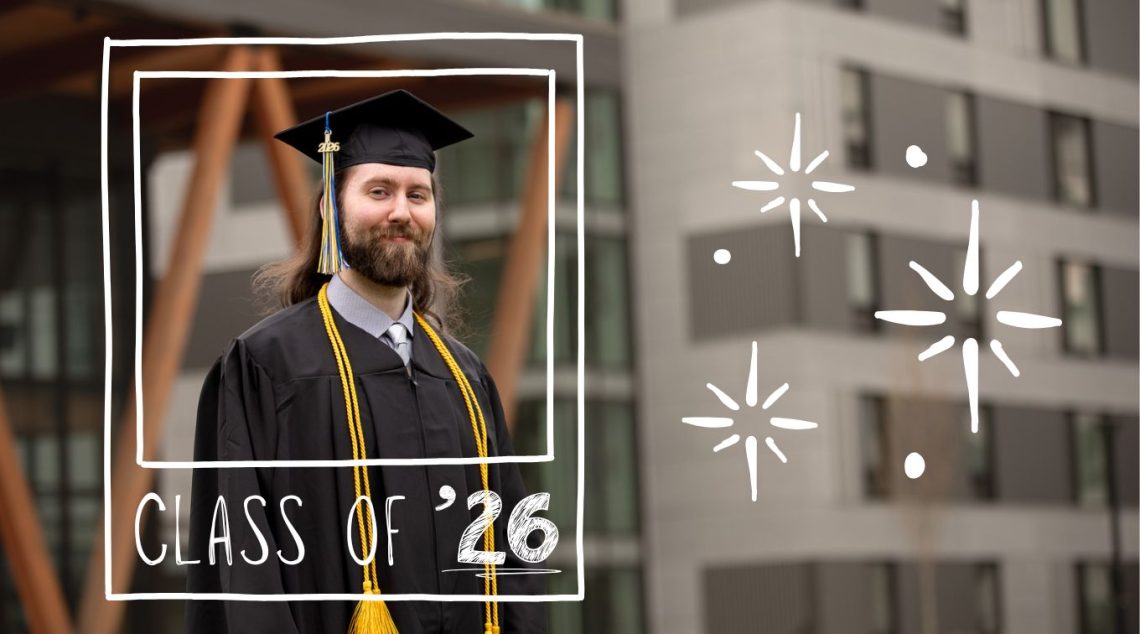
Tim Fogleman describes himself as a decently adventurous person. He loves new experiences, new places, and conversations with people who see the world differently than he does. When it came time to finish his bachelor’s degree, he chose the University of Southern Maine — in a state he’d visited exactly once, for a trip to Acadia National Park.
“I didn’t know much about Portland,” he said. “But I was like, yeah, let’s go see a different part of the country.”
That spirit took him far. This May, Fogleman will graduate with a degree in public health from USM’s Muskie School of Public Service. In just two years, he worked at the Glickman Family Library, wrote for The Free Press, showed up to everything he could, and built the kind of community most students spend four years searching for.
The NEBHE Tuition Break — and a leap of faith
Fogleman grew up in Gainesville, Florida, in a science-minded household — his father a health physicist, his mother a microbiologist turned teacher — and came of age with what he describes as a “ravenous appetite” for reading, writing, and learning. Before finishing high school, he was already taking college courses. After that came several years working in food service, caretaking, and the nonprofit world — but finishing his degree was always part of the plan.
“I love to have new experiences and talk to people who have a different perspective,” said Fogleman. “That’s how I view myself — becoming a more well-rounded person.”
A stint in New Hampshire gave him time to think, and what he kept coming back to was public health — systems, barriers, and the way small, fixable problems compound into big, harmful ones.
What made USM possible was a significant break in tuition for students like Tim who apply from within New England, known as the NEBHE Tuition Break. He didn’t know much about Maine, but he took the chance anyway.
The full USM experience in four semesters
Fogleman leaned into campus life from the start. Over four semesters at USM, he lived in the residence hall on the Portland campus, then in South Portland, then commuted from further away, and finally returned to live on campus in Gorham for his final semester. Each move gave him something different — a new set of neighbors and a new sense of what it meant to belong somewhere.
That last semester in Gorham — living in Philippi Hall, close to the rest of the residential community — turned out to be one of the most formative. The resident assistants there worked hard, he said, serving as connective tissue between students who might otherwise pass each other without a word. And as a queer student, Fogleman was particularly aware of how much intentional community-building can matter — for anyone who’s ever needed a safer, more welcoming place to land.
“The connections I was able to make, the community I was able to build — by the end of it, those friendships were the bedrock for everything else”
Tim Fogleman ’26
He’s candid about what it can take to find your footing at a university like USM, which serves commuters, online learners, and residential students across multiple campuses. But he’s equally clear that the footing is there to be found.
A public health major with a press badge
Fogleman came to USM already knowing that public health was where he needed to be. His years working in food service, childcare, and nonprofits had given him a systems-thinker’s eye for spotting where access breaks down — and what it takes to fix it.
“I’m a systems person,” he said. “Everything that happens, there’s a whole bunch of different little things floating around it that influence that outcome.”
At USM, he found a program with a framework for all of it. One of his earliest and most memorable courses was a philosophy of politics and work class with Jason Read — not a public health course, but one that expanded the way he thought about everything that followed. He also took a graduate-level health communication course through USM’s accelerated master’s program, weaving his interest in writing and storytelling into his public health work.
“Everybody cares about public health,” Fogleman said. “They just might not know it’s public health. It affects everybody.”
Along the way, his work as a writer and copy editor for The Free Press gave him a different kind of lens. Covering everything from cultural showcases to student food insecurity, he learned to ask questions, build sources, and tell the stories that weren’t being told.
Fogleman admits with a grin that his time at the student newspaper was partly a cover story.
“It was a little bit of a ruse,” he said. “Because what I really love is being involved in the community. I love going to events. I love helping out with events. And the Free Press was a really good excuse.”
The power of having someone in your corner
Fogleman had met Gina Capra, director of the Adult Student Success Center, before the center officially opened — through the campus library in Portland, where he worked his first two semesters.
When the center launched, he found something he hadn’t quite had before: a consistent community of adult learners all navigating what it means to return to school with years of life experience already under their belts.
“Having people to encourage me, having so many different people from so many different parts of campus all connected in one spot — it truly was the difference maker in my experience,” he said.
Capra, he said, was an “absolute legend” — deeply familiar with campus systems and people, always knowing who to connect him with and where to point him next.
“If you can get past the hang-ups of asking for help,” Fogleman said, “there are so many people ready and willing — often with the exact thing you need.”
What he’s leaving with
“Education for me has always been about building the tool belt that I take into the real world to try and make change happen,” said Fogleman.
His advice to students — incoming, current or graduating — keeps coming back to the same place: get to know your neighbors, show up even when you’re not sure why, and don’t be afraid to ask for help.
“There are usually people in existing communities that’ll be willing to help introduce you if you ask,” he said. “But you can also start from scratch and be that person for others.”
Plenty of barriers to community exist, he added. Running into them is how you learn to navigate them — for yourself, and eventually for the people coming after you.
“Get creative with solutions. Try new things. Talk to strangers. Trust and love yourself.”
Bonus: What song have you had on repeat lately?
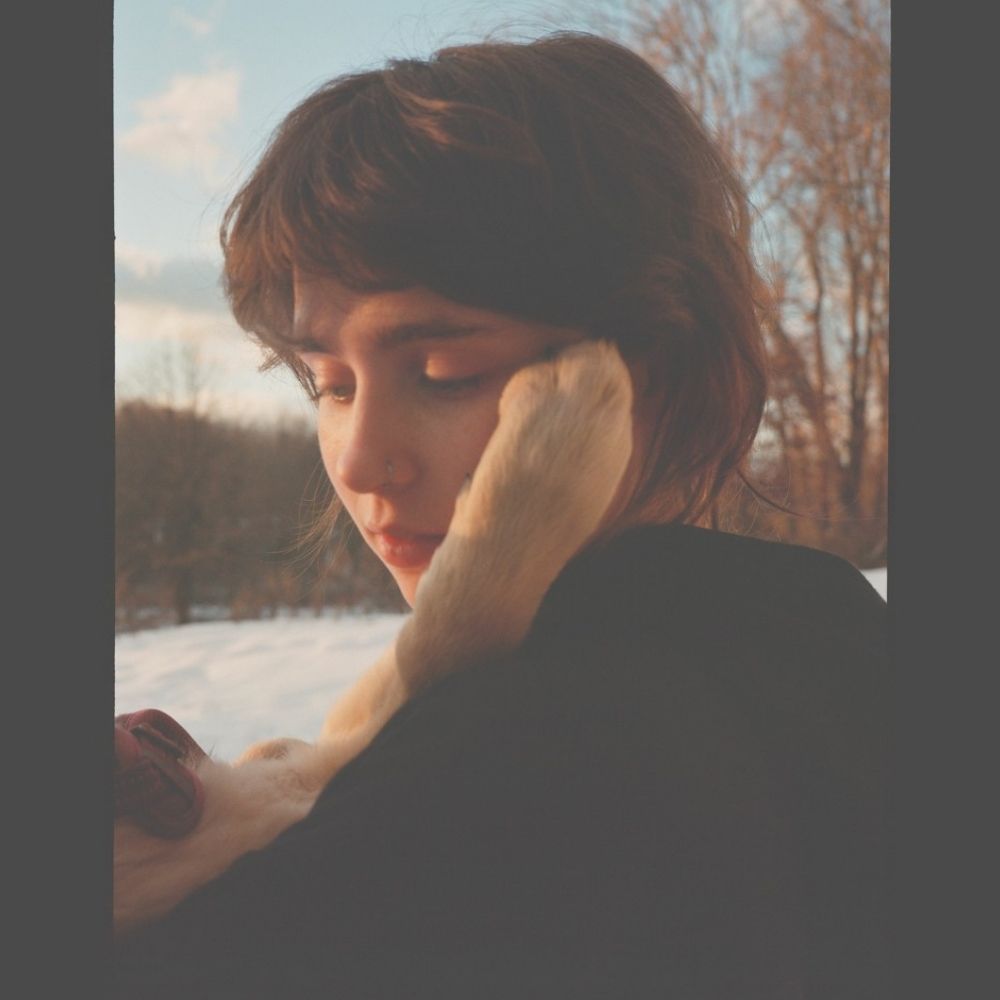
Amoeba
Clairo