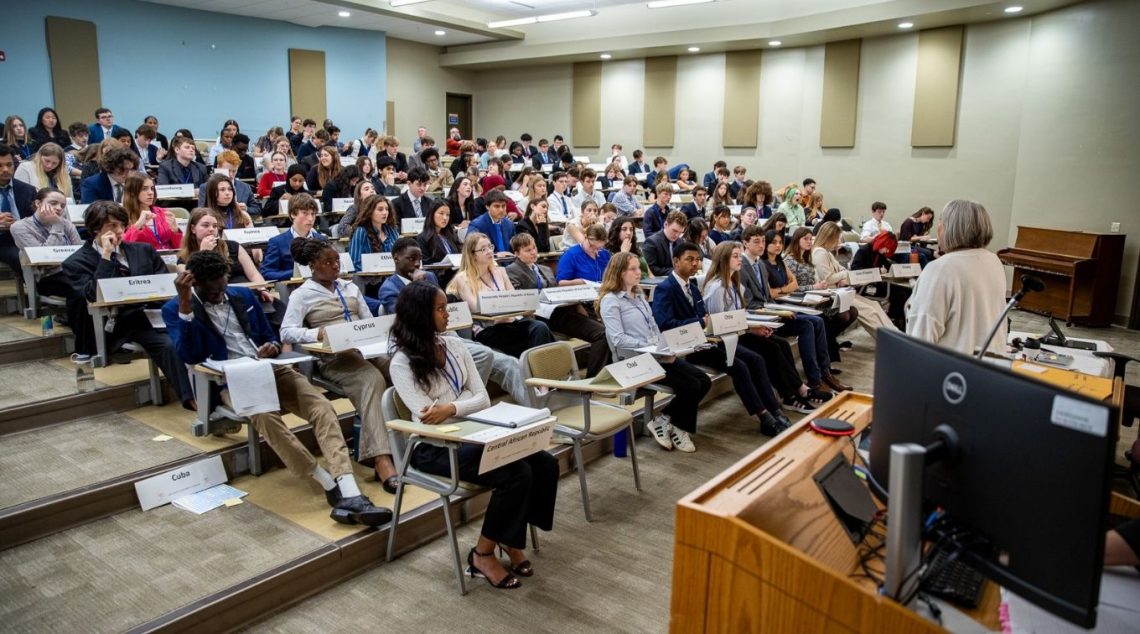
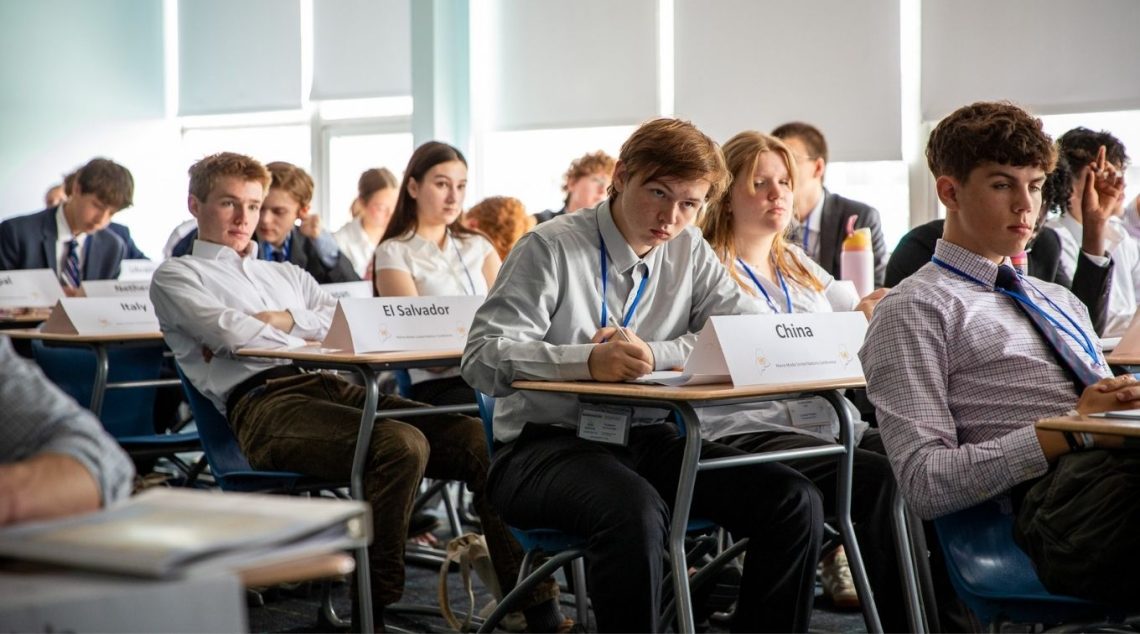
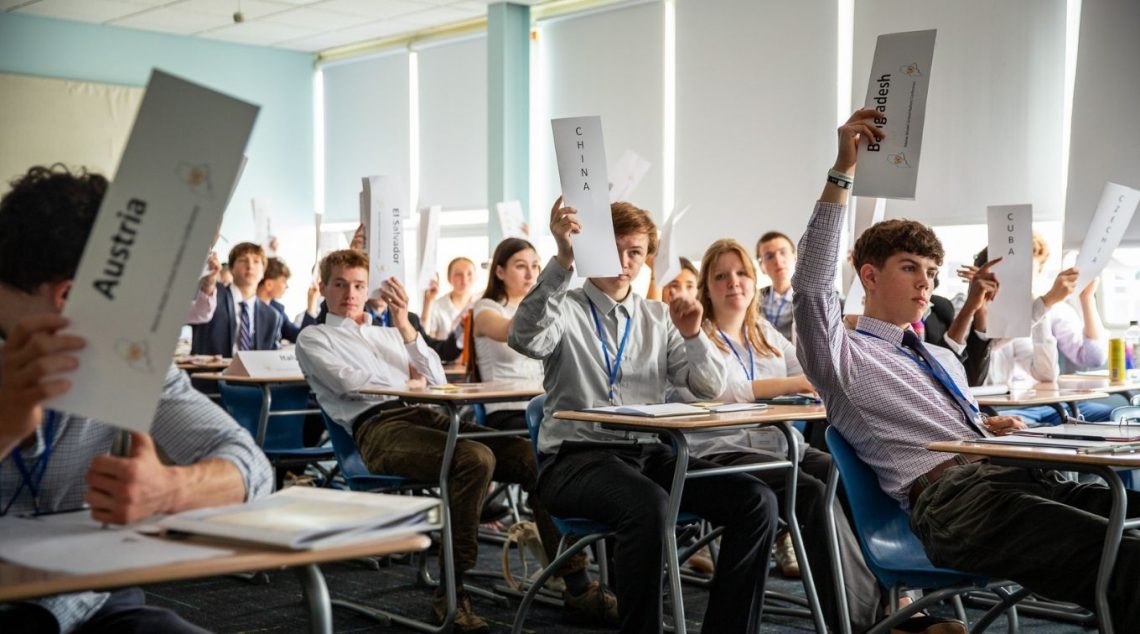
Samuel Genovese first walked into a Model UN conference as a nervous high school freshman. This May, he stood at a podium inside Costello Field House at the University of Southern Maine and opened one as secretary-general — the student in charge of the entire event.
“Giving the opening address as Sec-Gen really was a full-circle moment for me, the almost poetic end of a journey I started eight years ago as a high school delegate,” he said.
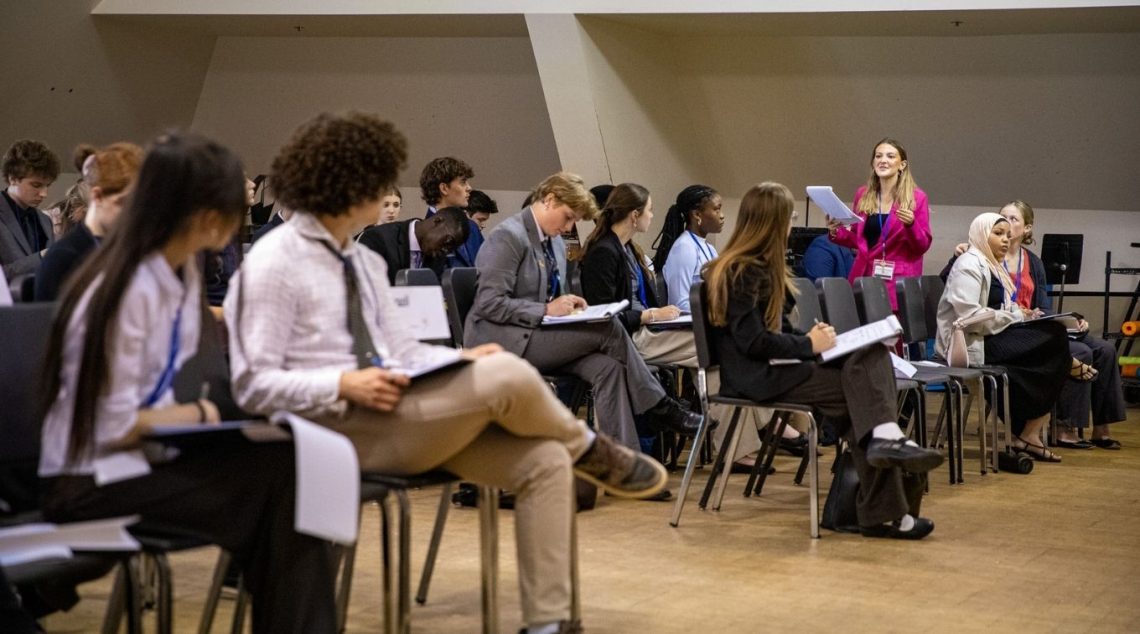
Between those two moments is a story most of the 450 high school students in the room never saw: months of preparation, a student-led leadership team, and all the behind-the-scenes work that makes the Maine Model United Nations Conference (MeMUNC).
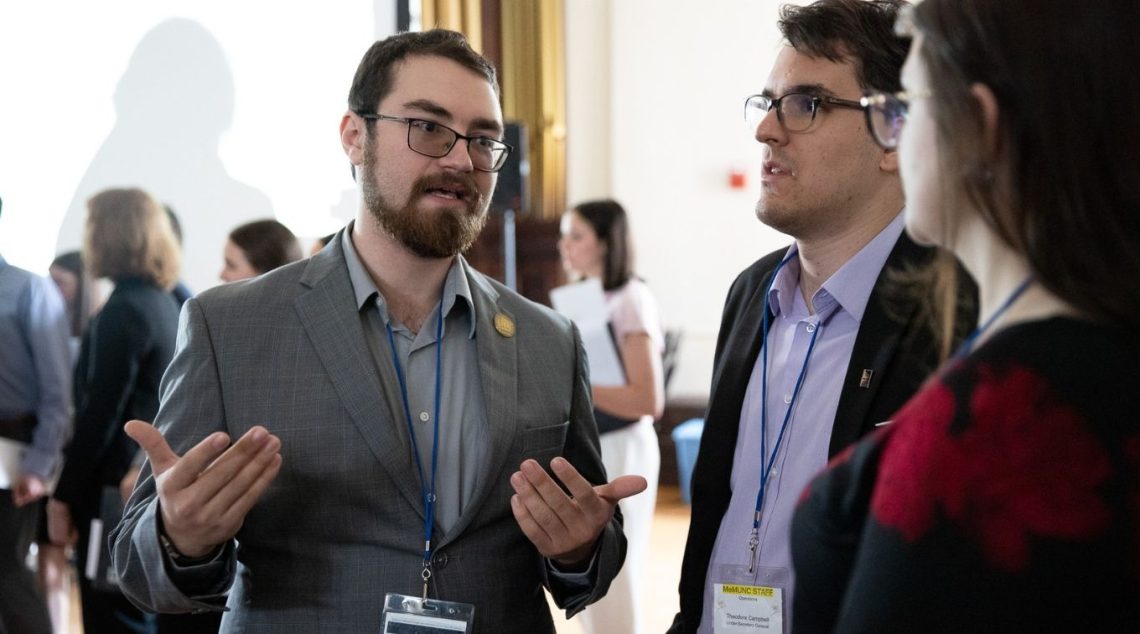
Eight years in the making
Genovese, a political science major who graduated this spring with minors in history and philosophy, has been part of MeMUNC in nearly every capacity.
“I was first involved with Model UN as a delegate in high school,” he said. “Then I took a political science capstone course as a freshman to help run the conference as a student, and since then, I have returned as Under-Secretary for Publications and, this year, as Secretary-General.”
Delegate, organizer, publications lead, and now the person holding it all together.
Before the first gavel
What looks like a three-day event is really a semester-long project. Long before the first delegate arrives, the student team is assigning countries to schools, confirming registrations, inviting speakers, and keeping a constant line of communication open with high school advisors across the state.
“The biggest part of the job as Sec-Gen is communication,” Genovese said, “talking with advisors for high school Model UN clubs and classes, working to invite speakers for the conference, and communicating with the rest of the team to ensure everything that needs to be done is on track. It is very much a team effort.”
That team is bigger than most delegates realize. Seven student leaders run the conference alongside 14 additional USM students earning course credit, each responsible for a piece of an operation that, once it starts, barely pauses to breathe. Committee sessions run back to back, meals are on a clock, and the days stretch from early breakfasts to late bed checks before starting again.
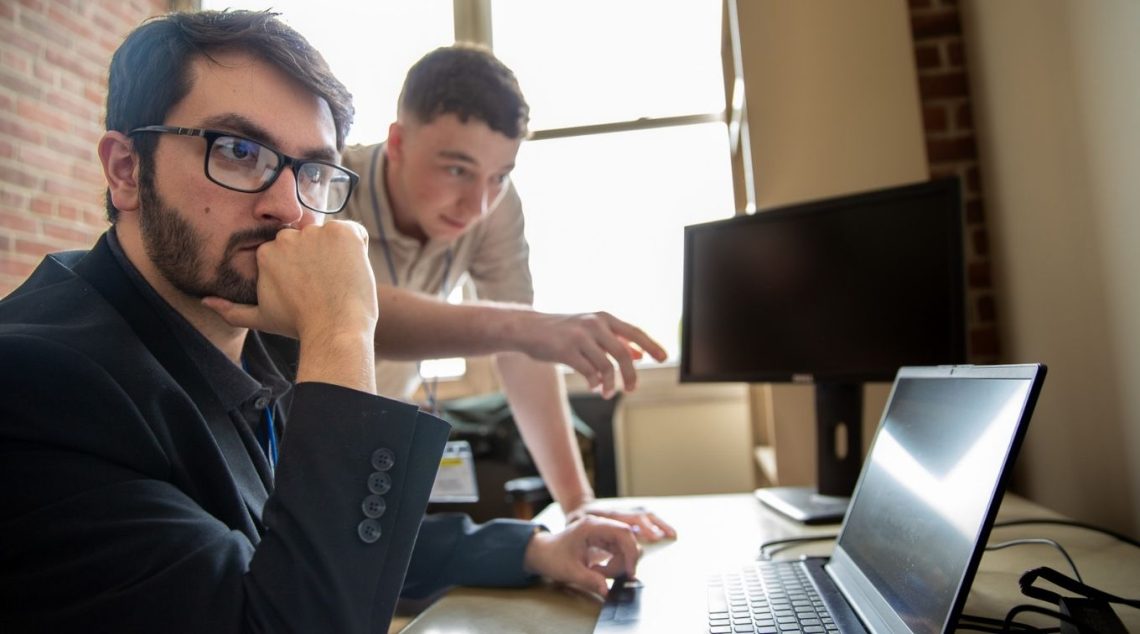
When things go sideways
For all the planning, Genovese learned a long time ago that the conference will always hand the team a few surprises.
“The biggest challenge is the things we can’t control,” he said. “Delegates misbehaving at the conference, people getting headaches, problems with the buildings we need to rely on facilities to fix. A lot of variables exist out of our control. So the key is to accept what you can’t control and focus on what you can.”
This year, that meant a printer breaking down mid-conference, sending students hustling paperwork over from other buildings, and a set of soundboards coming loose from the wall in Bailey Hall. Neither derailed anything.
“It was situations like these that required us to be light on our feet and adapt quickly to changing circumstances,” Genovese said. “In the end, everything went well, and none of these complications became major problems.”
The fix, he said, is rarely a solo act. It comes down to trusting the leaders around him to absorb whatever comes up, often all at once.
Back at the podium
By the time the opening ceremony arrived, that semester of work was sitting in one room. Genovese stood in front of hundreds of high school students, their advisors, and a row of his own professors and mentors. Faculty co-directors Tim Ruback and Rebecca Gibbons delivered remarks, along with guests from the World Affairs Council of Maine and the United Nations Association’s Maine Chapter.
Then Genovese spoke.
“Certainly, it was a mix of excitement at being given such an opportunity and yet also fear that I’d mess up,” he said. “Yet even the anxiety was effectively washed out by how happy I was, honestly.”
He could feel the same energy coming back at him from the room.
How students get involved
Genovese’s path into MeMUNC leadership started with a single political science capstone course, open to students looking to help run the conference rather than just attend it. From there, the roles scale up: USM students can join as one of the 14 team members earning course credit, move into one of the seven leadership positions, and eventually take on a role like secretary-general.
“The level of trust that the professors place in us to ensure the whole thing comes together as planned is quite high,” Genovese said. “Being selected for the leadership team is definitely a vote of confidence from Professors Ruback and Gibbons.”
For students wondering whether it’s worth the time, Genovese is direct about what it’s given him.
“It’s a really great program that’s allowed me to make lifelong friends, get some strong references for grad school, make my resume stand out in the job market, and, honestly, just make some really great memories,” he said.
Eight years after he first sat in a delegate’s chair, Genovese knows exactly where that experience can lead. He’s spent the last four years building it for the next generation of students who walk in nervous, not yet knowing how far it might take them, too.