

The Michael E. Dubyak Center for Digital Science and Innovation is a state-of-the-art facility designed to foster collaborative research, innovation, and interdisciplinary exchange. Following its mission, the center is a hub for advancing computer science through strategic partnerships, technology transfer initiatives, and cutting-edge research endeavors.
At its core, the Dubyak Center is committed to driving progress in computer science through collaborative, interdisciplinary efforts and innovation. The facility provides a conducive environment for fostering public-private partnerships and facilitating technology transfer initiatives to translate research into practical applications.
Upcoming Events
More upcoming event coming soon!
Past Events
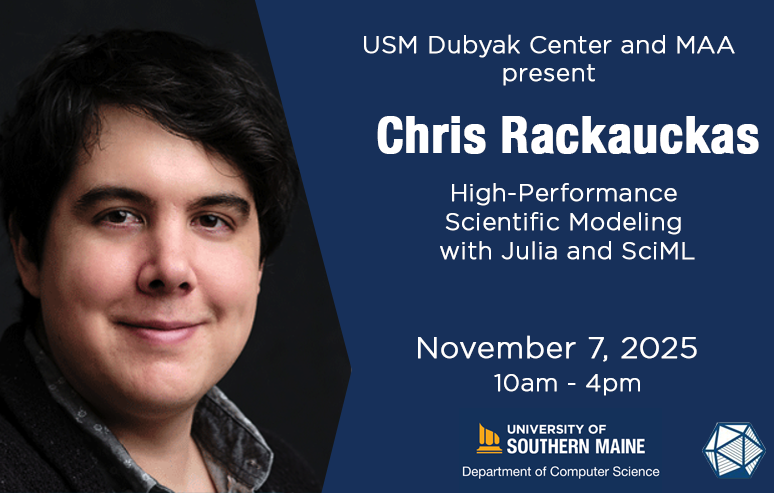
Workshop: High-Performance Scientific Modeling with Julia and SciML
Overview: This workshop provides comprehensive training in high-performance scientific computing using the Julia programming language and the SciML (Scientific Machine Learning) ecosystem. Designed for researchers and computational modelers, this material covers everything from Julia basics to advanced techniques in scientific modeling, including differential equation solving, parameter estimation, and the integration of machine learning with mechanistic models.
The workshop emphasizes practical, hands-on learning through interactive Pluto notebooks, progressing from fundamental Julia concepts through sophisticated modeling techniques. You’ll learn to build performant scientific models, solve large-scale stiff systems, perform inverse problem solving, and leverage automatic differentiation for machine learning integration. Whether you’re modeling chemical kinetics, biological systems, or physical processes, these materials provide the tools and knowledge needed to deploy advanced computational models on high-performance computing systems.
This workshop will give you the tools to build and solve real-world, large-scale models on high-performance computing (HPC) clusters. It will start with the basics of Julia, then showcase how to use standard packages, and finally demonstrate how to translate these methods to large distributed clusters and GPUs. You will leave with an understanding of how to use and modify the Julia package ecosystem to fit your needs for scalable modeling.
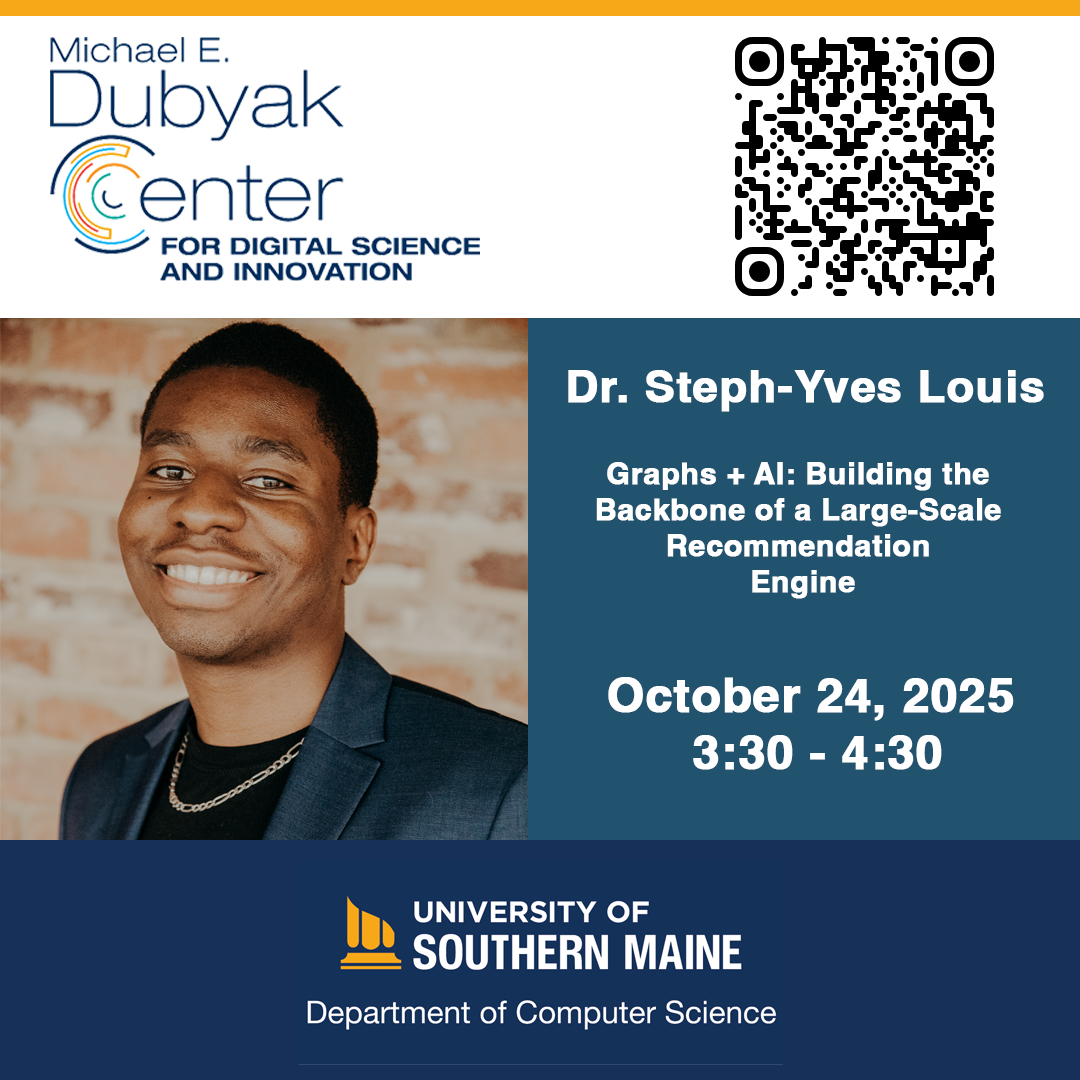
Title Graphs + AI: Building the Backbone of a Large-Scale Recommendation Engine.
Abstract: What if we could model the world not as isolated data points, but as a dynamic network of relationships? That’s the power of graph theory. When combined with Graph Neural Networks (GNNs), it becomes one of the most potent tools in modern AI. We’ll dive into how graphs model the hidden structure of real-world data, and how GNNs leverage those connections to generate intelligent predictions. Our focus will shift from concepts to commercial reality, revealing how graph databases and GNNs collaborate in massive production systems to deliver the high-speed, personalized recommendations that fuel the success of platforms like Amazon, Pinterest, Netflix, and SHI International. Join us to learn how thinking in graphs can turn massive data into meaningful connections and smarter decisions.
Bio: Dr. Steph-Yves Louis is the AI Technical Lead for the AIML Group at SHI International, where he oversees the design, development, and deployment of large-scale, enterprise AI products. Before his role at SHI, he served as a Lead Machine Learning Engineer at Apple, advancing major conversational and predictive AI technologies for the CoachingAI Team. His background also includes leading AI efforts at a nuclear fusion startup, applying cutting-edge machine learning to accelerate complex scientific discovery. Dr. Louis holds a Master’s in Biostatistics and a Ph.D. in Computer Science from the University of South Carolina, where his research focused on Graph Neural Networks (GNNs) and their use in large-scale learning systems.