April 9 – May 1, 2026
Gorham Gallery
Join us for Open Studios at the University of Southern Maine Art Department on Friday, May 1 from 4 – 7 PM.
The annual Bachelor of Fine Arts exhibition showcases a thesis prepared by graduating seniors from the Art Department. The show is the culmination of their artistic studies at the University, showcasing student work before they enter the world as practicing creative professionals. Dedicated to conceptual investigation in the artists’ media of choice, works in this show see the artists using all they have learned to tackle an artistic investigation, adroitly navigating technical prowess and conceptual investigation with aplomb.
2026 Artists:
|
Adalei Brooks |
BA in Art & Entrepreneurial Studies with a Concentration in Photography and Digital Art & Design |
|
Abby Lemieux |
BFA in Studio Art with a Concentration in Photography and Digital Art & Design |
|
Crystal Reynolds |
BFA in Studio Art with a Concentration in Ceramics |
|
Jacob Singelais |
BFA in Studio Art with a Concentration in Photography and Digital Art & Design |
|
Cyrus Smith |
BFA in Studio Art with Double Concentrations in Painting and Drawing and Photography and Digital Art & Design |
|
Oscar Stephan |
BA in Studio Art with a Concentration in Painting and Drawing |
|
Hailey Stover |
BFA in Studio Art with a Concentration in Painting and Drawing |
|
Trevor Taylor |
BFA in Studio Art with a Concentration in Photography and Digital Art & Design |
|
Kate Upham |
BFA in Studio Art with a Concentration in Painting and Drawing |
Adalei Brooks
BA in Art & Entrepreneurial Studies with a Concentration in Photography and Digital Art & Design
Adalei Brooks is a Maine-based artist working towards their BA in Art and Entrepreneurial Studies with a concentration in digital art and photography at the University of Southern Maine. Their work focuses on themes of mental health, social justice, and political topics. As a digital artist, they do primarily digital photography and use a mix of physical and digital media to display their work. Adalei will be receiving their Bachelor’s this upcoming May and plans to continue this kind of work.
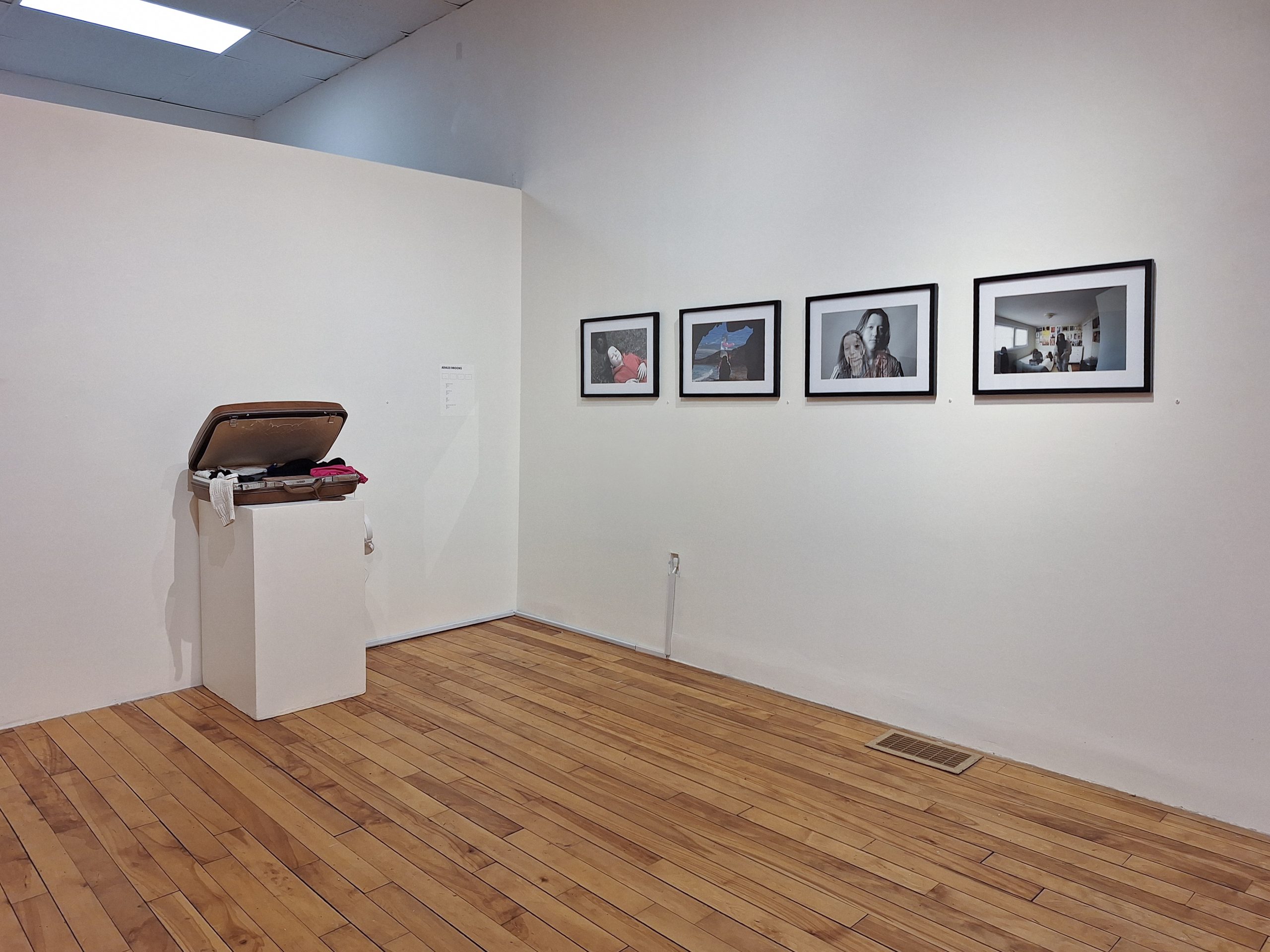
Carry On is a multimedia installation piece that explores themes of mental health. Drawing on personal experience this body of work examines how it feels and sounds to live in the mind of someone struggling with mental health.
I use a combination of videos from my childhood, the present, and ’90s television to create the video element of the work. The foundational footage of the project is a time-lapse of my bedroom, which quickly became a sinking pit or prison for me when I was struggling. The videos from my childhood are memories that show what’s supposed to be a happy kid who grows up to be a perfect adult.
The soundscape experienced through headphones immerses the viewer. It is a combination of ’90s television clips and original audio from my childhood home videos. I chose to use ’90s television clips because many people consumed the same entertainment media during the decade.
These shows normalize bad habits and create taboos around mental health. Many of the clips come from sitcoms that are supposed to be a funny escape from reality. The influence that the ’90s has on contemporary thoughts on mental illness is interesting due to its forward thinking at the time, as many saw these shows as progressive representations of mental health. It provided a basis for many people’s thoughts on mental health that are still being used today. The combined audio creates a chaotic sensation by using layered audio clips and headphones.
The suitcase is a carry-on that displays a video, a pill bottle, a knife, a lighter, and a brick to show examples of what people carry with them that you do not see. The objects represent a piece of trauma someone can carry with them, and the weight of the brick is a weight that is not inherently shown to others.
The four images displayed alongside the suitcase are all images of me at different points in my life. From lying in the grass as a kid to my current-day bedroom, there have been so many different twists and turns. It feels as though I am a Russian nesting doll with all of these versions inside me. Although colors have faded or I am looking from a dark cave, they are always there. The images are all composites, spanning from the past to the present.
The video, images, soundscape, and objects allow viewers to gain a new perspective on this large topic.
To younger me, you carried on.
Abby Lemieux
BFA in Studio Art with a Concentration in Photography and Digital Art & Design
Abby Lemieux is a multimedia artist working in Southern Maine. She is currently a senior at the University of Southern Maine, pursuing a BFA in Studio Arts with a concentration in Photography & Digital Art and a minor in Environmental Science. She works with many media, including photography, drawing, painting, fiber arts, wood, and metal. Her interests include environmental ecology, 80s metal music, and animals (both wild and domesticated).
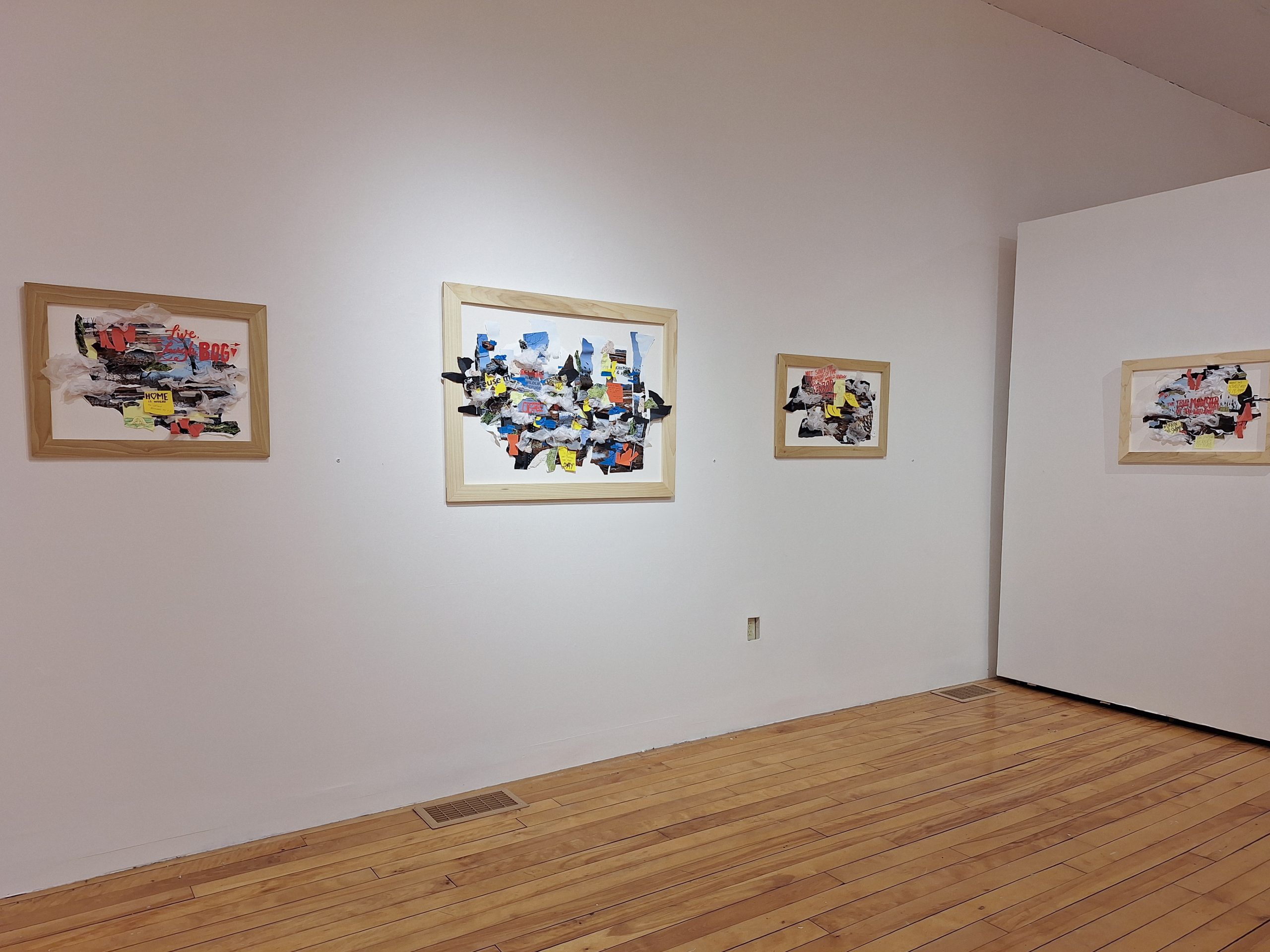
This series, Swamped, investigates misguided perceptions of wetlands through the lens of pop culture and folklore. Common turns of phrases, “bogged down,” or “swamped,” have distinctly negative connotations. Worldwide, many cultures have concocted their own swamp monsters;* Jenny Greenhorn (United Kingdom folklore), a nasty lady who pulls unsuspecting passersby into bogs on foggy nights, “Creature from the Black Lagoon” (American film released in 1954), a monster who resembles some combination of a derpy fish and a human, and even “Shrek” (2001 DreamWorks film), the grumpy, swamp-dwelling ogre. Subliminally, we are convinced that wetlands are awful places to be.
In actuality, wetlands are enigmatic ecosystems with numerous untold benefits (allow me to tell them). They prevent damage from floods, manage water levels to limit erosion, filter pollutants, and more. These are irreplaceable, ecologically and financially beneficial ecosystems. Nonetheless, filling or draining wetlands was a common practice historically (portions of our very own Portland, Maine, were built on a filled wetland). Reflecting on history, folklore, and pop culture, it is clear that public opinion on wetlands does not reflect their ecological understanding. By projecting fear, ignorance, and indifference onto wetlands, we minimize their ecological significance and ignore opportunities to protect and reestablish them.
Swamped uses satire to challenge humanity’s preconceived notions about wetlands. Through references from folklore, American politics, pop culture, and common turns of phrase, I point out the implicit ridiculousness of these narratives. The mythos and reality represented simultaneously in these collages compete for the viewer’s attention, confusing scientific understanding with society’s dialogue. These images (all of York County, Maine wetlands) are ripped and stitched back together with drawings, tape, paper, sticky notes, notecards, crumpled vellum, and printed textures, mounted in handmade poplar frames. These artificial materials demonstrate the flimsiness, irony, and above all, the intrinsically human nature of public (mis)understanding of wetlands.
* My personal favorite: the Japanese Kappa, a farting pervert turtle. ¯\_(ツ)_/¯
Crystal Reynolds
BFA in Studio Art with a Concentration in Ceramics
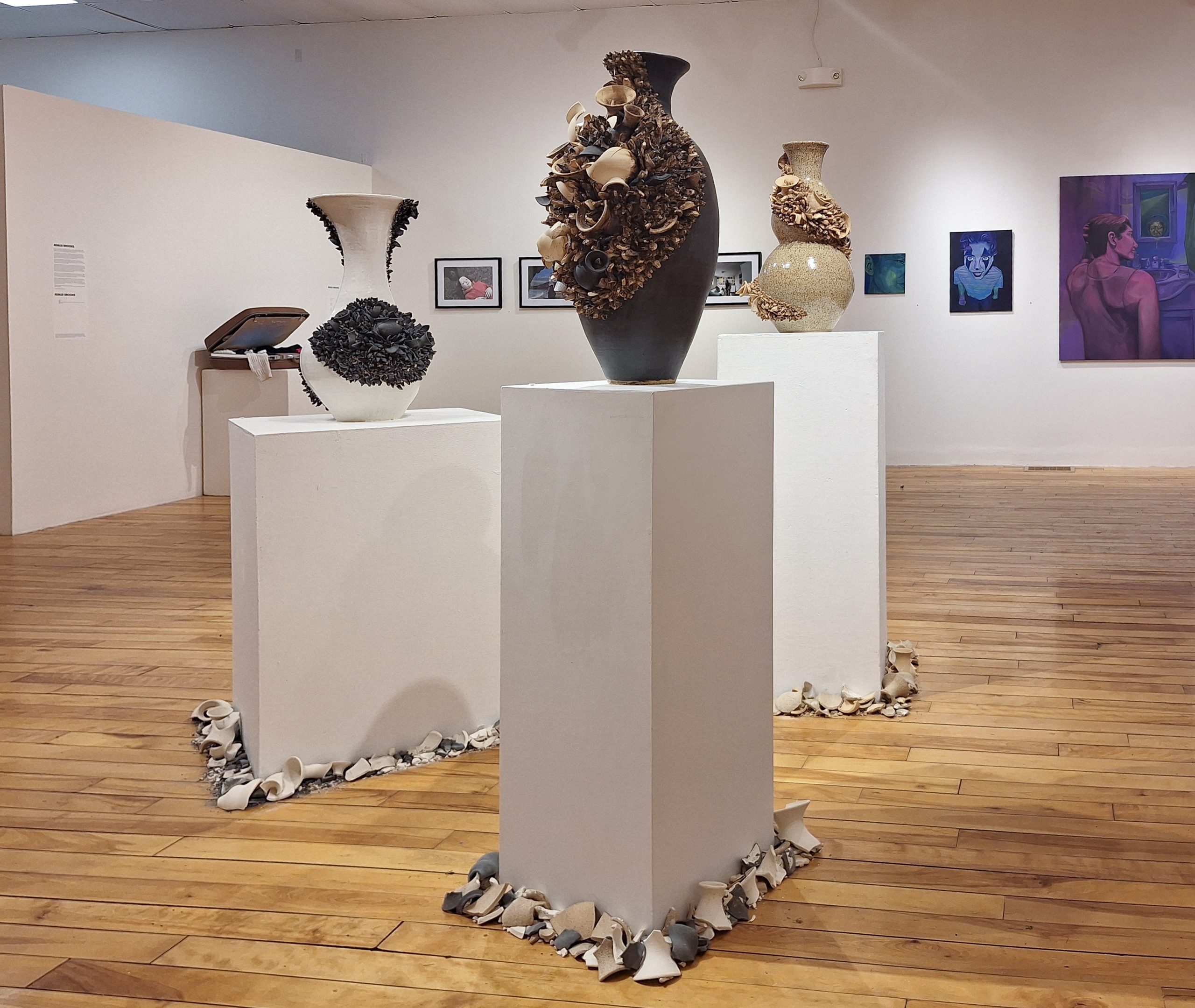
Crystal Reynolds is a Maine-based artist who works with ceramic materials and the traditional pottery form in a nontraditional way. Her practice explores the meaning of failure and what it takes to become a potter, challenging expectations of craft, process, and outcome.
She is currently pursuing a Bachelor of Fine Arts in Ceramics at the University of Southern Maine, where her work has been exhibited in the Juried Student Exhibition from 2024 to 2026. In recognition of her work, she received the Presidential Award at the 2025 Juried Student Show and the Fundamental Disciplinary Award at the 2023 exhibition.
In addition to her academic work, Reynolds participated in the 2024 Monson Arts Summer Residency in Maine, further developing her conceptual approach to ceramics.
My work explores the grief that accompanies failure. As a ceramicist, I have failed more times than I can count. Failure in ceramics takes many forms: a pot collapsing on the wheel, a glaze running, or a piece crumbling in my hands. Each of these moments carries emotional weight—anger, grief, self-doubt, and even hatred—which I confront and examine through my work.
One of the clearest ways to demonstrate skill as a potter is by creating a large vessel, as it requires a deep understanding of the throwing process. For this reason, I create large vases that showcase my technical ability while also revealing what it takes to achieve them by incorporating broken pots into their surfaces. I work with large quantities of pots—throwing them repeatedly, then breaking them and reattaching the fragments onto my large forms. These fragments are placed with precision, creating a dense, jagged surface. This process reveals the duality of failure and success in ceramics, highlighting how every successful piece carries countless failures in its shadow.
My work is rooted in the sense of loss I feel when a piece does not survive, representing the countless hours, objects, and efforts I have lost over time. Every failed piece becomes a record of time, labor, and emotion; rather than discarding them, I reclaim these moments as material.
I believe that being a potter requires persistence, the ability to fall flat on your face and still get up again and again. It is the willingness to repeat the same action, learning through failure until something finally sticks. These artworks represent constant failure transformed into perseverance; each fragment contributes to a larger whole, just as each attempt contributes to growth.
Cyrus Smith
BFA in Studio Art with Double Concentrations in Painting and Drawing and Photography and Digital Art & Design
Cyrus Smith (b. 2003) is a multi-disciplinary artist from Maine who will be graduating with a BFA in Studio Art with a double concentration in photography and digital art and painting and drawing in May 2026. Cyrus’ work is integrated with his love and collection of physical media, and they have been focusing on the interconnection between the analog and digital with humans in specific. He previously had a show with Kate Upham entitled Who Up Transing They Gender? in the Kidder Gallery on the USM Gorham campus in 2025.
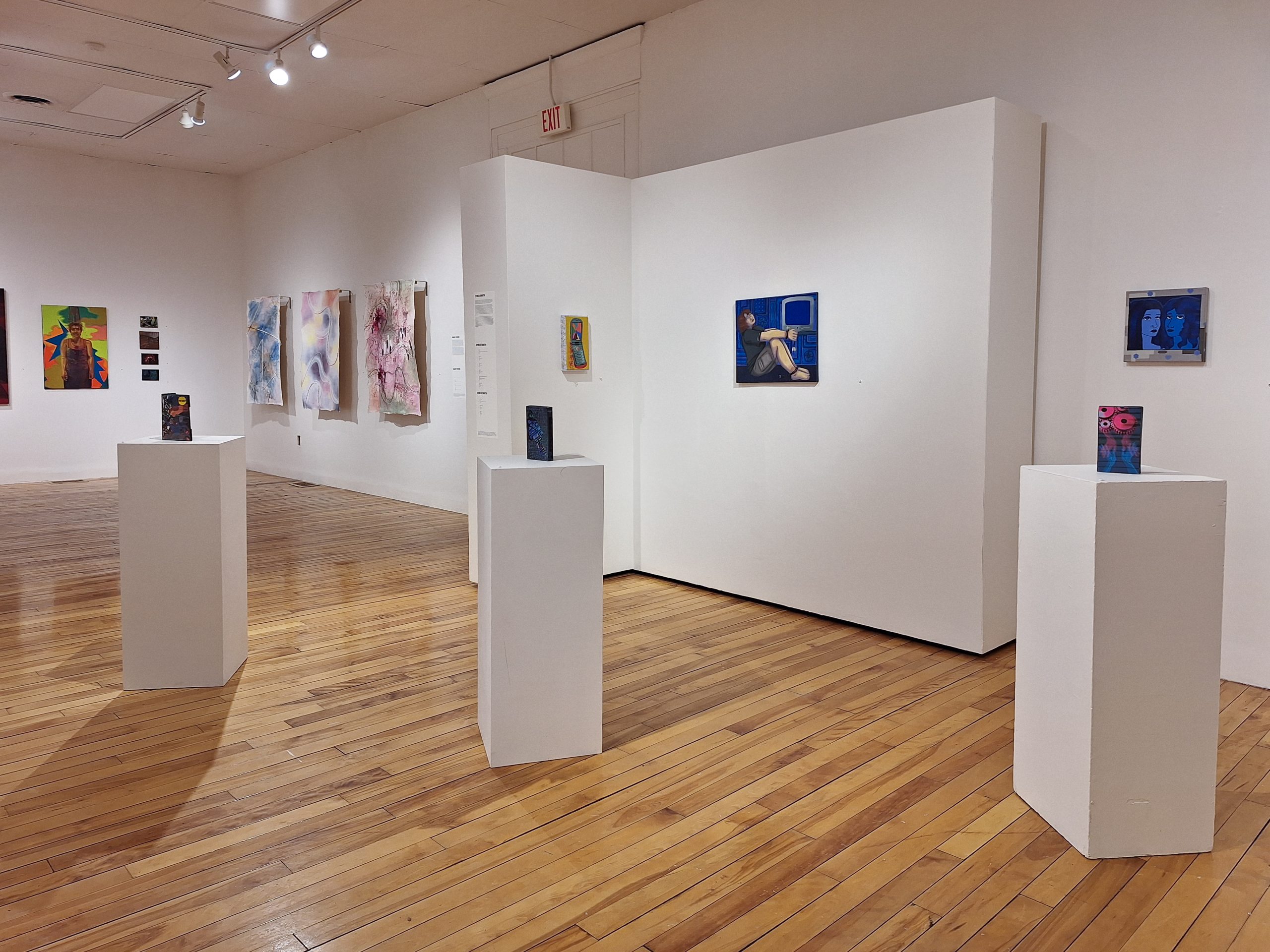
In Bio-Mechanical, I explore the human connection between the digital world and analog media. In particular, I investigate how people interact with technology and how it affects our perception of reality. Through this body of work, I show viewers how merging the analog and digital will change our experience with them.
I am particularly interested in electronics during the transition period of analog technology to the digital age, from the 1990s through the 2000s. As these things still exist and will continue to exist in the physical world, I am interested in the sense of timelessness that comes from putting iconography together from different periods. Although being an analog collector is a big part of my life, I am in between these two worlds, as I engage too much with digital media every day. Analog media is something from our past that continues to live and intermingle with our digital lives. With this series, I explore how we interact with our physical media and content during the transition from analog to digital, and how we continue to be affected by this shift.
This series is a multidisciplinary exploration of this topic, and to further this connection between material and concept, I utilize both digital and physical means of making. This series includes work in oil paint and collage, alongside analog representations of digital work. I explore how the materiality of the work changes interpretation with regard to the images produced by analog and digital technologies. The imagery in this series focuses on human bodies while utilizing the infrastructure that underpins contemporary digital technology, exploring motifs such as pixelation, cords, screens, and hardware. I use these motifs to explore how technology can be used to express the human experience and extend the human body.
Jacob Singelais
BFA in Studio Art with a Concentration in Photography and Digital Art & Design
Oscar Stephan
BA in Studio Art with a Concentration in Painting and Drawing
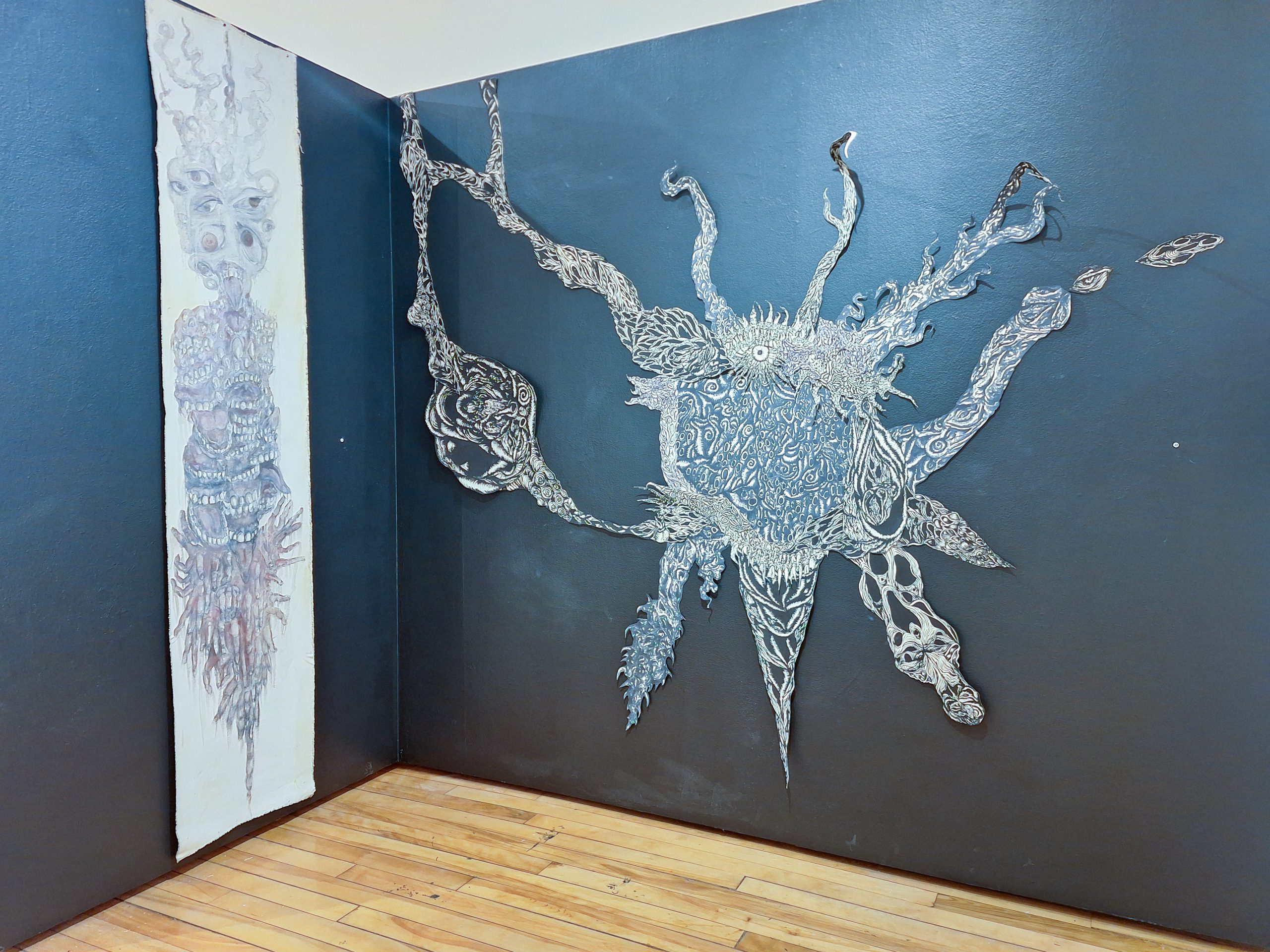
Oscar Stephan is an artist currently based in Westford, Massachusetts. His practice, drawing heavily from his background as a biology major, as well as his fascination with manga and horror, to explore organic forms using a complex and twisted visual language in various ink media. Much of his work is improvisational and chaotic. Receiving his Bachelor of Arts in Studio Art with a concentration in Drawing and Painting, Oscar is expected to graduate in May 2026, having received a Discipline Award for Drawing and Painting during his time at USM.
My work explores themes of transformation through large pieces. These depict amorphous masses of body parts and ambiguous organic forms in unconventional shapes. I have lovingly referred to this as SOUP, representing both the everflowing, everchanging fluidity of my ideas and themes and the mixing-together of various influences, styles, and emotions. The process heavily influences the context of my work. The large, immersive scale of my drawings interacts with the viewer, creating an immersive experience.
Body horror and organic forms make up the “meat” of the SOUP. My drawings are composed of writhing tentacles, tubes, and various body parts such as eyes, teeth, and sexual organs. These are constructed using intricate ink line work in media such as ballpoint pen and liquid ink. I draw on inspiration from metal music and its corresponding album art, cosmic horror and fantasy fiction, Japanese manga, and my own personal feelings and experiences, such as my relationship with gender identity, sexuality, and my own body. My graphic mark-making seems as if it has a mind of its own, and I naturally gravitate towards organic shapes. I have always had a vivid imagination, and Surrealist-inspired automatic drawing plays a role in reflecting my true thoughts as opposed to confining myself to pure representation and illustration. Although SOUP is made up of over 30 different pieces, I view it as a large mass of work forming together into one. These small pieces, much like cells in a larger organism, all play their part in forming something much larger than themselves.
Letting chance play a part in my work has allowed my visual language to develop on its own. Because of this, a large portion of SOUP was unplanned and left up to chance, allowing the exhibition to birth itself and hatch out of my imagination. Viewers are encouraged to immerse themselves in the world of SOUP, and to feel whatever emotions come to them first, whether that be disgust, a morbid fascination, or a deeper understanding. In my future work, I want to continue to explore the state of being amorphous and escaping the traditional, rectangular confines of a frame.
Hailey Stover
BFA in Studio Art with a Concentration in Painting and Drawing
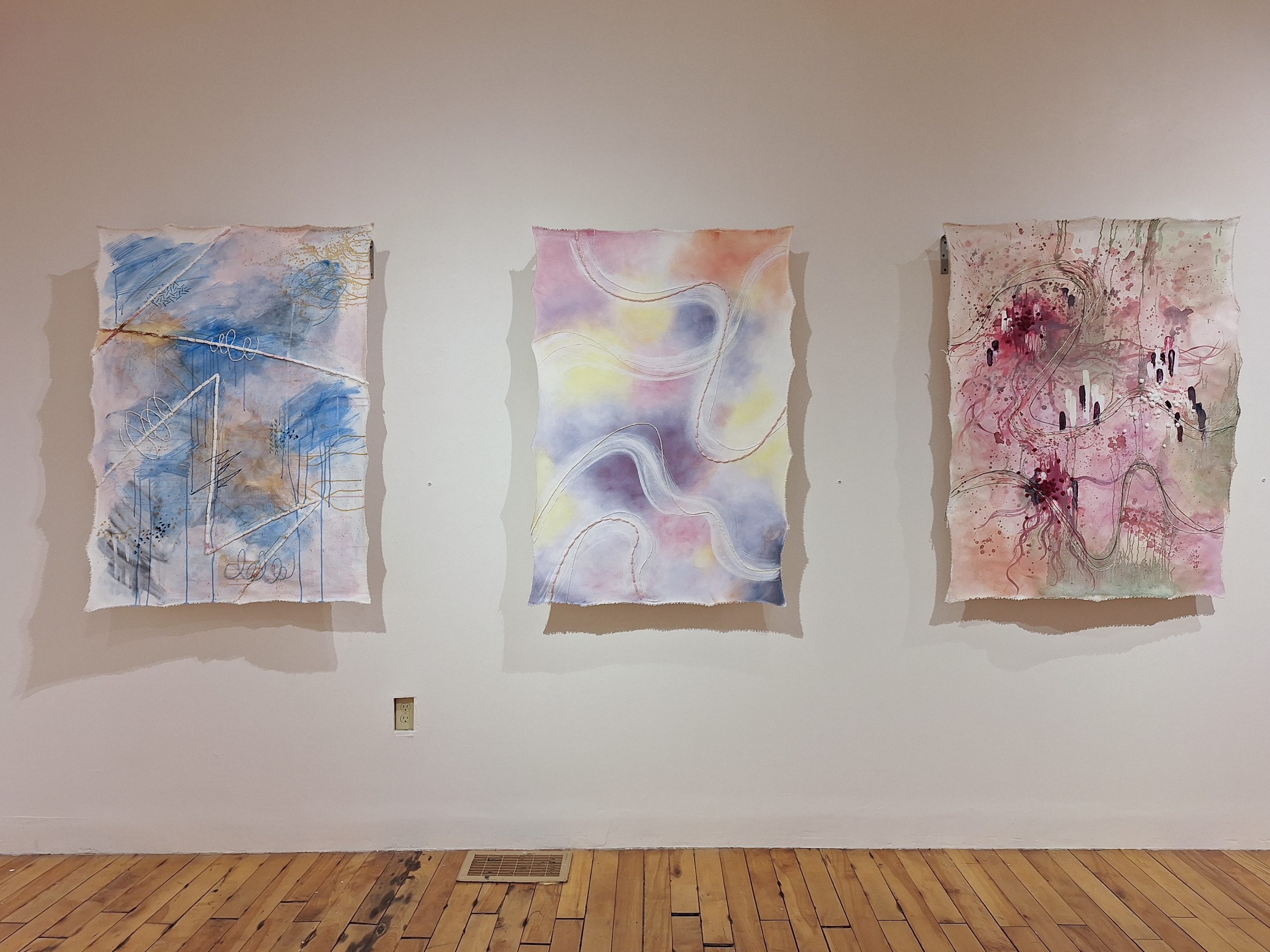
Hailey Stover is an artist based in Upstate, New York. Working across painting, drawing, and textiles, she experiments with a range of media to create layered, tactile works that explore grief, nostalgia, and memory through abstraction. Stover is currently a senior at the University of Southern Maine, pursuing a BFA in Studio Art with a concentration in painting and drawing. Her work has been exhibited in several student juried shows, including the Hyde Museum in Glens Falls, NY, during her freshman and senior years of high school, and at Cazenovia College during her freshman year.
My work explores memory and nostalgia as fragmented, emotional spaces rather than established narratives. I am interested in how memories blur, intensify, and shift over time. Instead of depicting specific moments or recognizable imagery, I use abstraction to translate what memory feels like, not what it looks like. Abstraction allows me to work intuitively and emotionally, without the limitations of representation. The marks, colors, and textures function as traces, similar to how memories leave impressions that are incomplete, layered, and sometimes inconsistent. Each piece does not portray a specific memory, but embodies the familiar, personal sensation that lingers when a memory resurfaces. Memory is not linear or complete, and nostalgia is not purely comforting.
Material choice plays an important role in this exploration. I work on primed, unstretched canvas, allowing the wash of diluted acrylic to pool, seep, and stain the surface before building layers of oil on top. This process reflects accumulation, where early layers remain partially visible, underneath newer marks, like older memories beneath present experiences. Texture is a part of my work through embroidery and heavy mediums. The reverse side of the embroidered canvas exposes knots, loose threads, and raw canvas that represent the unseen side of memory, what is felt but not always articulated or remembered clearly. The soft, muted colors suggest distance and fading, while layers of bright color interrupt the surface to signal emotional tension. Through this body of work, I invite viewers to sit with ambiguity and acknowledge their own experiences within abstraction. My work exists in that in-between space where feeling dominates clarity, and what remains is the trace.
Trevor Taylor
BFA in Studio Art with a Concentration in Photography and Digital Art & Design
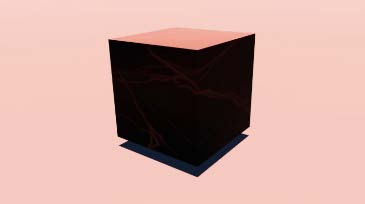
Trevor Taylor is a student at University of Southern Maine studying Digital Art and Photography and currently puts his practice into the arts. His biggest passion is wanting to make animations and bringing his creations to life through drawings and digital animation that he’s been practicing for years now to improve his skills and what he made for this exhibit is a small compilation of 3-5 second animations that are from the 12 Steps of Animation such as Appeal, Slow-In and Slow-Out, Exaggeration, Squash and Stretch, and Anticipation. Previously, his work was showcased to the Westbrook Community as his mural titled Flow Together was presented to the public along with other classmates from a class taken with teacher Michael Shaughnessy during the Fall 2025 semester.
For my artist statement, I want to focus on animations that I have done over the semester. While I’ve been majoring in Digital Art and Photography with a minor in Game Design, my true passion is to do animation and work for major studios helping bring characters to life through storytelling. Ever since I was little, I’ve always been fascinated by cartoons old and new from watching cartoons like Tom and Jerry and Spongebob Squarepants on TV being mesmerized by the characters moving and always making me laugh with the visuals. Not only that but there were also animated movies and from there I tried my hand at my own characters and worlds making them go on mischievous adventures that further expanded the story. When I got older and got access to digital media, I found there were programs that let you make animations and practice with them. So I went and used a program called Blender and I started making small animations testing out the new mechanics. Lately for my ART471/472 class, I’ve been focusing on using the Twelve Principles of Animation for my project which covers Appeal, Squash, Anticipation, and a few others. I really love making videos and creating stories.
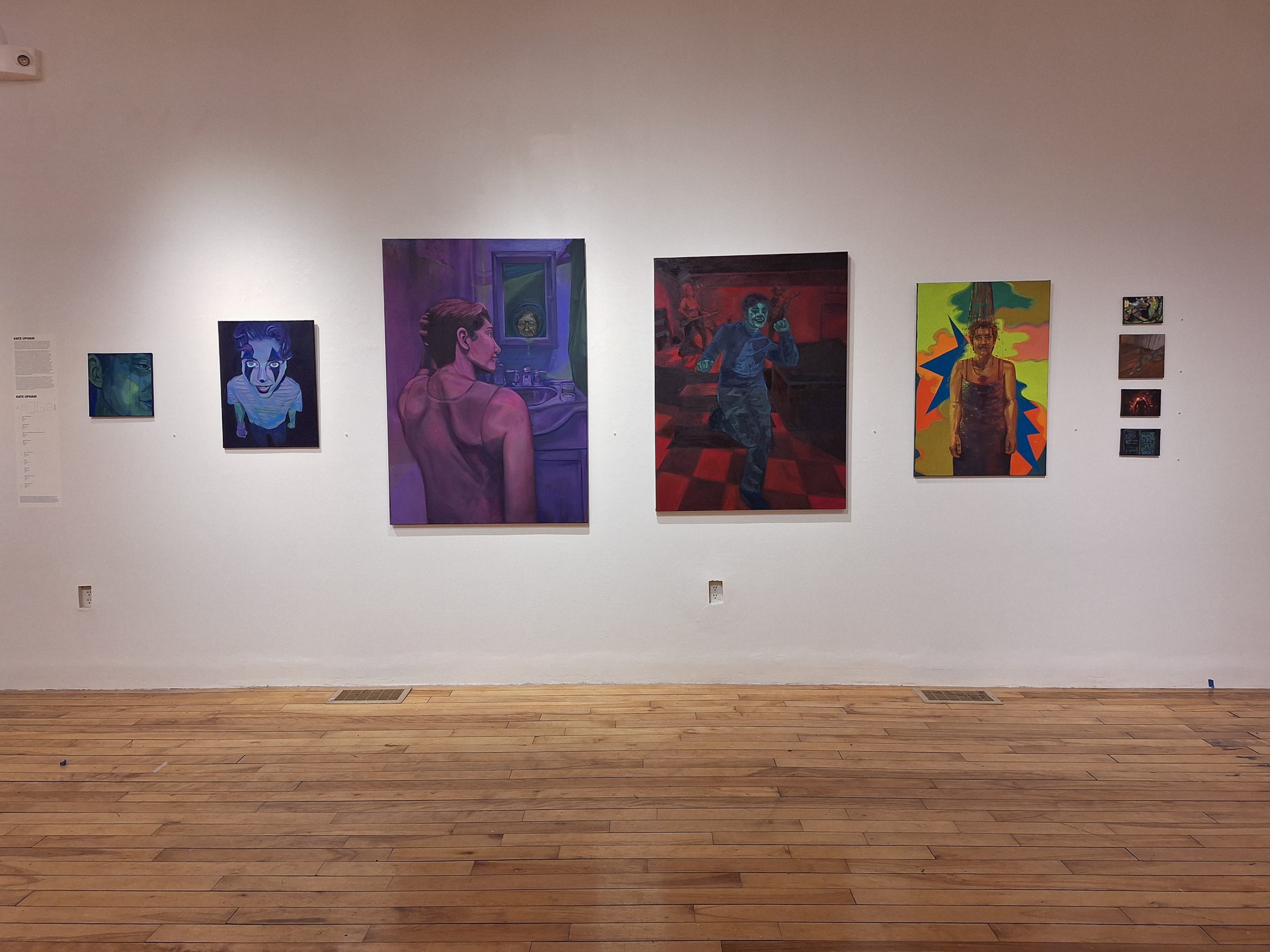
Kate Upham
BFA in Studio Art with a Concentration in Painting and Drawing
Kate Upham is a Maine-based artist currently working towards a BFA at the University of Southern Maine with a concentration in painting and drawing. He has shown works in the Juried Student Show in the University Art Gallery in 2023, 2024, and 2025. He and fellow artist, Cyrus Smith have also exhibited works in a joint show entitled Who Up Transing They Gender? this past fall (2025) in the Kidder Gallery, also on the Gorham University campus. Upham focuses on his oil painting concentration with a heavy emphasis on self portraiture, utilizing bold colors, and telling personal stories through small captured moments in his work. He will be graduating from the University of Southern Maine with a Bachelor of Fine Arts in May 2026.
My work explores coming to terms with transmasculinity as a young adult and my personal investigation into that reality. I create paintings exploring themes of transitional periods, interpersonal relationships, the contrasting discomfort and comfort of traditionally feminine roles, and the unique ways in which I express, experience, and navigate masculinity. This body of work utilizes recurring shower/water themes, reflections, bold color stories, and unique perspectives; closely examining pieces of my life, and dissecting their relationships to my identity.
My body of work consists of several oil paintings on canvas, and relays a complex internal struggle between gender identity, growing older, and the confusion, excitement, and anxiety that comes along with personal acceptance. The shower theme in some of my work is a play on the traditional idea of a ‘shower thought’. Most of my compositional ideas come from moments of deep, sometimes intrusive, thought. Standing in solitude in the shower is where many of these images are conjured; the pictures in my mind are often framed or clouded by large swaths of intense color correlating to the emotions felt as scenes from my memory and imagination play through. Some colors are sour, dirty, muddled, or downright uncomfortable when placed together. Others are joyous, whimsical, and bring about a euphoric glow. The figures and their poses, actions, and scenes they exist in are pulled from captured moments of my life; most being depicted in a life or larger than life size, demonstrating the close examination of the trans experience in the public eye. The self-portraiture demonstrates literally and figuratively the extensive self investigation that comes with my gender exploration and expression. Some images are melancholy and nostalgic, staring through a former self, and recognizing his repressed discomfort, whilst others are energetic, unapologetically loud, and authentic. Some works have multiple layered images in a single composition; mirroring, comparing, and contrasting each other. Other compositions allow a singular moment or subject to speak for itself.
My body of work gives viewers a glimpse into my personal struggles, but also (and in a way more importantly) into my personal pockets of joy: The seemingly small moments that make me feel secure in myself, the odd activities I partake in that allow me to feel like me, and the community spaces and people I have surrounded myself with that support and uplift. I believe focusing on euphoria to contrast the dysphoric imagery is important. The doom and gloom of the trans experience is very real, but even moreso there is so much joy and relief found in freely expressing oneself. With the current political climate and society’s shift in view of trans people I find it important to highlight more than just how exhausting it has felt to masquerade as something I’m not, but also the confidence and euphoria I have gained from accepting myself proudly as a trans person.