

September 24 – December 5, 2026
Crewe Center for the Arts Great Hall Gallery
Don’t miss the September 24 opening from 5 – 7 pm.
The University of Southern Maine is thrilled to announce the opening of OverUnder, an exhibition featuring work by artists Rachel Gloria Adams and Rachel Sperry. The show features work rooted in familial representation created via fiber-derived techniques. There is something inherent in the act of weaving and stitching that helps process memory. In the context of their respective practices, the artists examine themes of domesticity, loss, childhood, and parenthood.
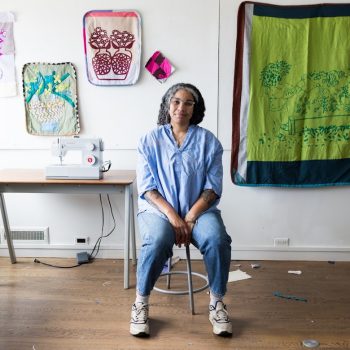
Rachel Gloria Adams is a multidisciplinary artist living in Portland, Maine. Adams has developed a vibrant, graphic pattern-based visual language filled with references to the natural world that possesses an heirloom quality. Her work takes form by way of quilting, painting, design, and murals. Adams moved to Maine in 2005 to pursue her Bachelor of Fine Arts from the Maine College of Art and Design. She has gone on to exhibit artwork at the Portland Museum of Art, Center for Maine Contemporary Art, Notch8 Gallery, and Dowling Walsh. Her work has been acquired by the Portland Museum of Art, Farnsworth Museum, as well as private collections. She has attended residencies at Surfpoint, Speedwell, Pace House, and is an Indigo Arts Alliance David C Driscoll Fellow. In addition to her studio practice, Adams has been commissioned to create murals for businesses as well as institutions, including the Children’s Museum of Portland, Worcester Art Museum, and Farnsworth Museum.
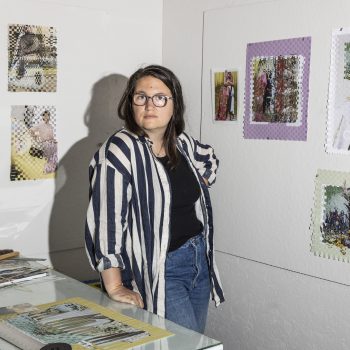
Rachel Sperry was born in New York City in 1989 and grew up throughout New England before settling in Portland, Maine, where she lives with two Karls (one her son, the other her husband) and a dog named Jenny. She earned a Bachelor of Fine Arts in Printmaking from Washington University in St. Louis in 2013. In 2014, Sperry founded her creative studio, NUUFORM, which has evolved over the years to encompass a wide-ranging practice including knitwear, editorial commissions, photography, and studio-based work. Her work has been exhibited internationally in Italy and across the United States, and has been featured in publications such as Mother Tongue, The New York Times Opinion, Cake Zine and Out of Eden’s.
Learn more about the artists and their work at the artist conversation.
Curatorial Essay
by Director of Art Exhibitions and Outreach, Kat Zagaria Buckley
In 2024, Vietnamese Thiền Buddhist monk Thích Nhất Hạnh implored readers to imagine, as we hug our loved ones, that they are gone.1 This exercise ensures that embracers fully experience an embodied moment by meditating on its impermanence. Nhất Hanh’s “hugging meditation” is meant for public displays of affection, though its applicability is not limited. Nevertheless, it is strikingly difficult to employ in private contexts, especially with the immediate family. Ubiquitous contemporary distractions of mundanity encroach upon would-be practitioners in the domestic setting. Phones ping and to-do lists loom, threatening our ability to appreciate fleeting connection even when solidified through touch.
Giving form to that which is otherwise ephemeral — moments, feelings, memories — is, similarly, one of art’s roles. The intangible draws us in, its existence as undeniable as its resistance to concretization. Lending actuality to impermanence is a kind of conjuring, an alchemy in which artists engage. OverUnder, which features the work of artists Rachel Gloria Adams and Rachel Sperry, takes manifesting the ephemeral as its basis. Both artists interrogate moments of familial intimacy as their source material, examining the role of impermanence, memory, and periphery in our relationships.
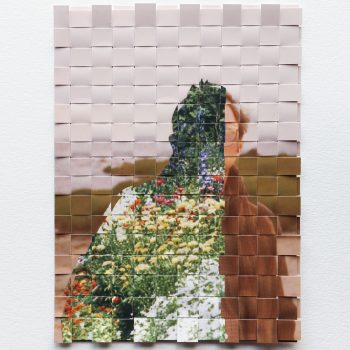
Sperry’s work draws from a personal archive of family photos. Often, the artist works with portraits of her late father, taken before Sperry knew him. She combines images that foreground her father with superimposed background elements, cutting her collage pieces into strips that are then woven together. The resulting works replace the particularities of the artist’s father; the contours of his presence fill instead with out-of-focus foliage. Sperry’s weaving technique adds texture to a previously smooth surface; the labor of producing these works is an embodied repetition, echoing the rumination and reëxamination that often accompany loss.
Photographs of loved ones from a time before we knew them, before the forging of personal relationships, are laden with contextual absence. Memories not known to the viewer are further obscured as those who experienced the shutter’s blink disappear. The result is a picture whose solidity enters a liminal, intangible state because its subject no longer speaks. By replacing the photographic subject with background elements, the artist renders visible this loss of knowledge.
Simultaneously, Sperry’s work alludes to the confusion that arises when a loved one exits the frame of our present perspective. The departed’s presence was integral to our own identity formation; their sudden removal from our lived experience unmoors a previously stable sense of self. When loss occurs, our identities, rooted in memories, can only be woven together from the fragments that remain. Foreground elements warp over time on an unstable foundation, tainted by the act of recall itself. Absence persists, permeating the present by muddying that which we once saw clearly.
Rachel Gloria Adams also takes the family as her primary subject. Her practice focuses on harnessing the momentary to create heirlooms. Across quilting, painting, and appliqué techniques, Adams utilizes patterns, symbols, and occasionally portraiture, infused with personal resonance. Of particular importance is capturing the manifestation of Black joy inherent in the artist’s experience of motherhood and daughterhood.
Adams hails from a lineage of quilters. The interruptibility of fiber arts as a medium — the practitioner’s ability to put the work down, tend to a task, and resume — has long made it an ideal technique in the context of caregiving. Theorist and psychotherapist Lisa Baraister argues that interruption particularly structures the experience of motherhood. She writes: “[t]hough thought is arrested by the constant interruptions that a child performs on the maternal psyche, a more ‘organic apprehension of the present moment’ is made available — those intense moments of pleasure or connectedness that mothers report, moments that may paradoxically allow access to a somatic or sensory mode of experiencing which may have been unavailable previously, and may constitute a new mode of self-experiencing.”2
Indeed, Adams’s works revel in caregiving’s interruption to process and open new avenues for its contemplation. In the gap of interruption — origin: Latin, inter, between/among, and rupt from rumpere, to break —a different kind of creative labor flourishes. Adams captures the moments that were perhaps distractions during her object’s very creation. These instances become part of the piece. In facilitating and acquiescing to interruption, the same techniques that undergird fiber art allow it to celebrate caregiving as a joyful act.
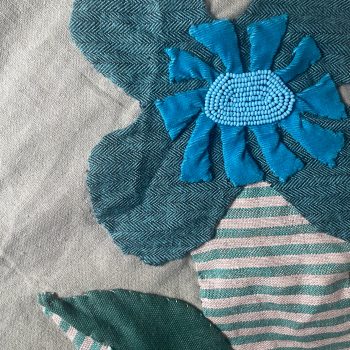
Adams’s recent appliqué works contain recognizable elements made strange: a flower with a beaded anther, a mix of silk and herringbone-patterned petals and striped stem on a grey ground; a vase with a patterned border; a tent, shaped like a house. While the specific references and their meanings are private to the artist and her family, the resulting objects are laden with domestic touchpoints that ease the viewer into the work. Adams’s objects encourage subjective interpolation, welcoming the audience’s respective experiences of domesticity, childhood, and parenthood onto the stitched-together forms. The result is an interrogation of that which is quiet: the home and its objects. Adams’s work embodies what hovers on the periphery, the backdrop against which our lives unfold. She coaxes joy forth through a careful observation of the objects that bear witness to its presence.
While weaving creates a picture, the alternating status of warp and weft can also blur what is foreground and what constitutes background. Both Sperry and Adams employ a similar subject/object confusion in their work, utilizing its potential across technique and concept to foster a strategic collapse of binary frameworks. In doing so, they expose simple delineations as illusions, demonstrating how the blurry boundaries of experience disappear when we directly gaze at them. Sperry’s work presents absence as part of life; Adams sees the domestic trappings that surround us as beholders to our joy. When viewed together, the artists’ work implores audiences to attend to a textural present. OverUnder is an argument to hold both loss and joy at once, weaving together a plane of connective, relational meaning. The work in this show captures the tension of temporality in our most important relationships; the outlines of which, too often, recede into the background of experience. Sperry and Adams create objects that escape the internal realm of ineffability, ricocheting outwards into manifestation, into tangible perception. Through their works, OverUnder invites audiences to consider impermanence while holding fast to the present moment.
1 Thich Nhat Hanh. “Thich Nhat Hanh’s Hugging Meditation.” Lion’s Roar, June 27, 2024. https://www.lionsroar.com/how-to-practice-hugging-meditation.
2 Baraitser, Lisa. Maternal Encounters: The Ethics of Interruption. Routledge, 2009. 68.