

Ella Hawkins, a junior studying computer science at the University of Southern Maine, has received a highly competitive $10,000 National Science Foundation (NSF) CISE Research Experiences for Undergraduates (REU) grant through the Computing Research Association. The award recognizes promising undergraduate researchers and supports students pursuing advanced work in computing and artificial intelligence.
Since joining the Artificial Intelligence and Information Retrieval Lab in Fall 2025, Ella has been actively involved in several ongoing research projects, including MathMex and SimpleText. Through the MathMex project, which focuses on the development of next-generation mathematical search engines, Ella has explored innovative query suggestion techniques using large language models. Her work has investigated how AI systems can better interpret and predict mathematical search intent, helping make technical information more accessible and discoverable.
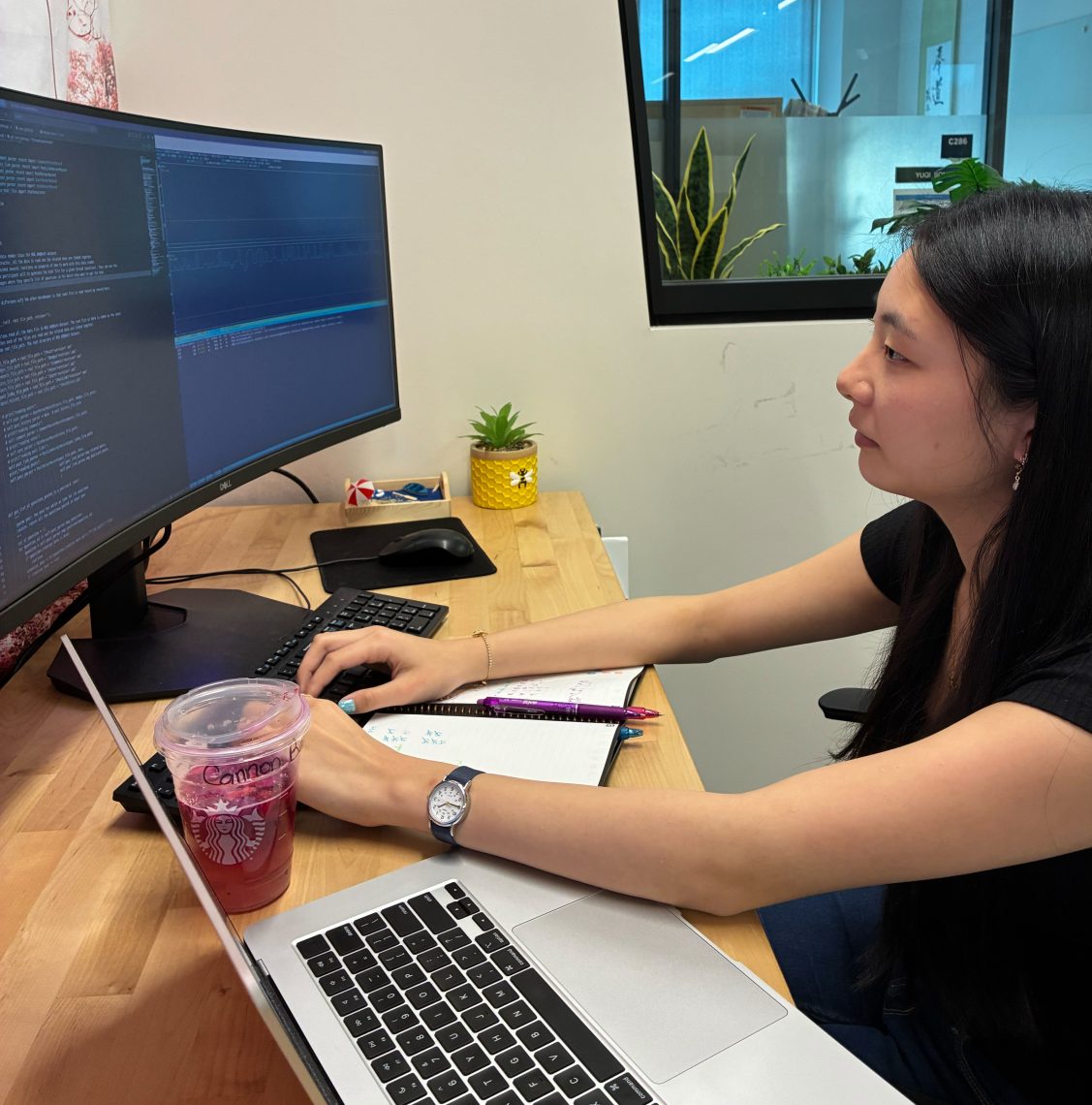
In the SimpleText project, Ella has focused on scientific document simplification and the challenges associated with large language model generation errors. Her research examines how AI-generated summaries and explanations can introduce inaccuracies or misleading interpretations, an increasingly important topic as generative AI tools become more widely used in education and research environments.
Beyond research, Ella has also been an active contributor within the Department of Computer Science. As a teaching assistant for courses such as Data Structures and Algorithms in Programming, she has supported students both inside and outside the classroom, helping explain complex concepts, assisting with programming assignments, and contributing creative ideas for course projects and activities. Faculty members have noted her enthusiasm, leadership, and willingness to help fellow students succeed.
Through her new NSF-supported research experience, Ella plans to further explore Retrieval-Augmented Generation (RAG) and agentic AI systems within the mathematics domain. Her future work will investigate how modern AI systems can combine reasoning, retrieval, and autonomous decision-making to improve mathematical problem solving and information retrieval.
“I am happy to be exploring modern AI techniques and learning about their applications,” said Ella. “I am glad my time at the University of Southern Maine has prepared me with the most up-to-date technology that is required in industry.”
Ella’s accomplishments reflect the growing opportunities for undergraduate students to engage in impactful research at the intersection of artificial intelligence, information retrieval, and computer science education.