

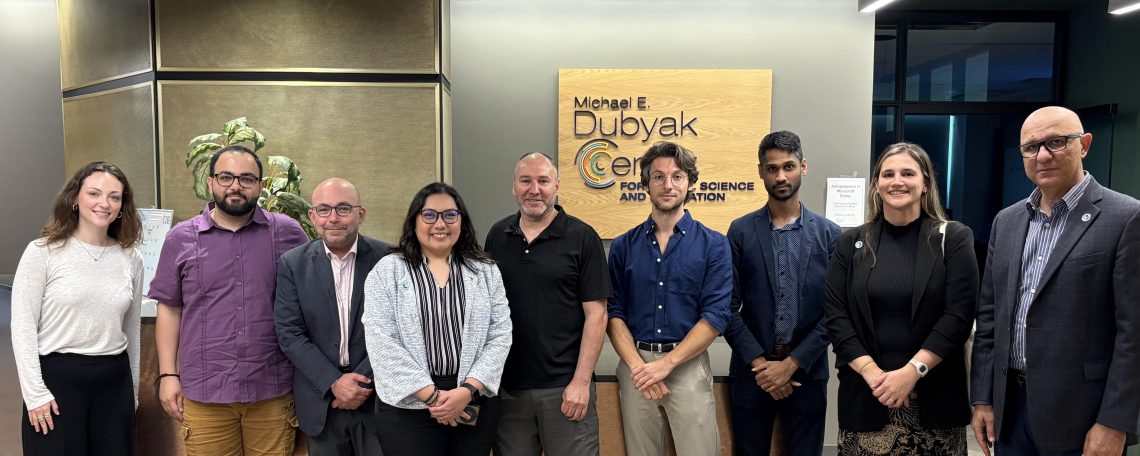
The University of Southern Maine’s Department of Computer Science recently welcomed an international delegation of artificial intelligence leaders to campus as part of the AI Innovation and Security – Freedom250 International Visitor Leadership Program (IVLP). The visit was coordinated in partnership with the World Affairs Council and the U.S. Department of State.
The delegation included experts from France, the Philippines, Trinidad and Tobago, Egypt, and Uruguay, representing universities, government agencies, research institutes, and innovation organizations. During their visit to USM, participants met with faculty and staff to discuss artificial intelligence research, education, innovation, and workforce development while learning about the University’s growing initiatives in computer science and data science.
The visiting delegation included representatives from:
- University of the Philippines
- International Research Institute for Innovation and Growth
- CEIBAL ANEP (Uruguay)
- The University of the West Indies
- The Arab League
The International Visitor Leadership Program is the U.S. Department of State’s premier professional exchange program, bringing together current and emerging international leaders to engage with institutions across the United States. The AI Innovation and Security initiative focuses on fostering international dialogue surrounding the responsible development and application of artificial intelligence.
During the visit, the delegation explored several themes identified by the U.S. Department of State, including:
- U.S. technology policy and AI research
- Public-private-academic partnerships that promote responsible AI development
- The role of artificial intelligence in economic growth and workforce development
- Emerging applications of predictive AI systems
Hosted in the Dubyak Center for Digital Science and Innovation, the discussions highlighted the Department of Computer Science‘s commitment to advancing education, research, and innovation in artificial intelligence and data science. Faculty shared ongoing initiatives, discussed emerging trends in AI education, and explored opportunities for future international collaboration.
“This visit provided an outstanding opportunity to exchange ideas with leaders from around the world,” said Dr. James Quinlan, Chair of the Department of Computer Science. “Artificial intelligence is transforming every sector of society, and addressing its opportunities and challenges requires collaboration that extends across disciplines, institutions, and national borders. We were honored to showcase the work being done at USM while learning from the experiences of our international guests.”
The Department of Computer Science appreciates the partnership with the World Affairs Council and the U.S. Department of State in making this visit possible. The conversations and connections established during the visit underscore the importance of global cooperation in shaping the future of artificial intelligence and preparing the next generation of innovators.