
Every spring, dozens of Maine middle and high school students send something they built with their own hands to the edge of space — it’s called the CubeSat Design Challenge. For the past six years it’s been led by Scott Eaton, assistant professor of mechanical engineering at the University of Southern Maine, who has shaped it into one of the most distinctive K-12 space programs in the country. This year’s challenge drew 28 teams from 18 schools and 163 students, sending student research roughly 21 miles above the Earth on high-altitude balloons.
We sat down with Eaton to talk about this unique program, plus crickets, and recovery missions in the Maine woods.
1.
How did the CubeSat Design Challenge get started at USM?
I didn’t know much about space when I came to USM. It was actually our prior dean who was pretty engaged in the space industry and got me involved. In the engineering program, part of our job is to reach out to high schoolers and get them interested in engineering and get them enrolled at the university. So we came up with the idea that we should start some kind of K-12 program: really target the kids, get them involved with the space industry, get them excited about space, and then ultimately get them on campus and provide resources and tutelage.
2.
How has the challenge evolved over the years?
We initially used what we call a greenfield approach — let them come up with their own mission, but we set certain constraints: your mission must weigh less than a kilogram, must conform to this form factor and do these other things. As long as they could articulate what their mission was and set measurements of success, it gives students time to build a team and think about what their mission should be really critically.
We would organize Zoom sessions with folks from NASA, make school visits to help with problem solving, and invite students to campus to test their devices in a vacuum chamber. Actually, this year we changed our format. Instead of the competition, we call it the challenge, and the only difference is that now we’re setting what the mission is for the students instead of letting them choose their own.
3.
Tell us about the cricket habitat mission. Where did that idea come from?
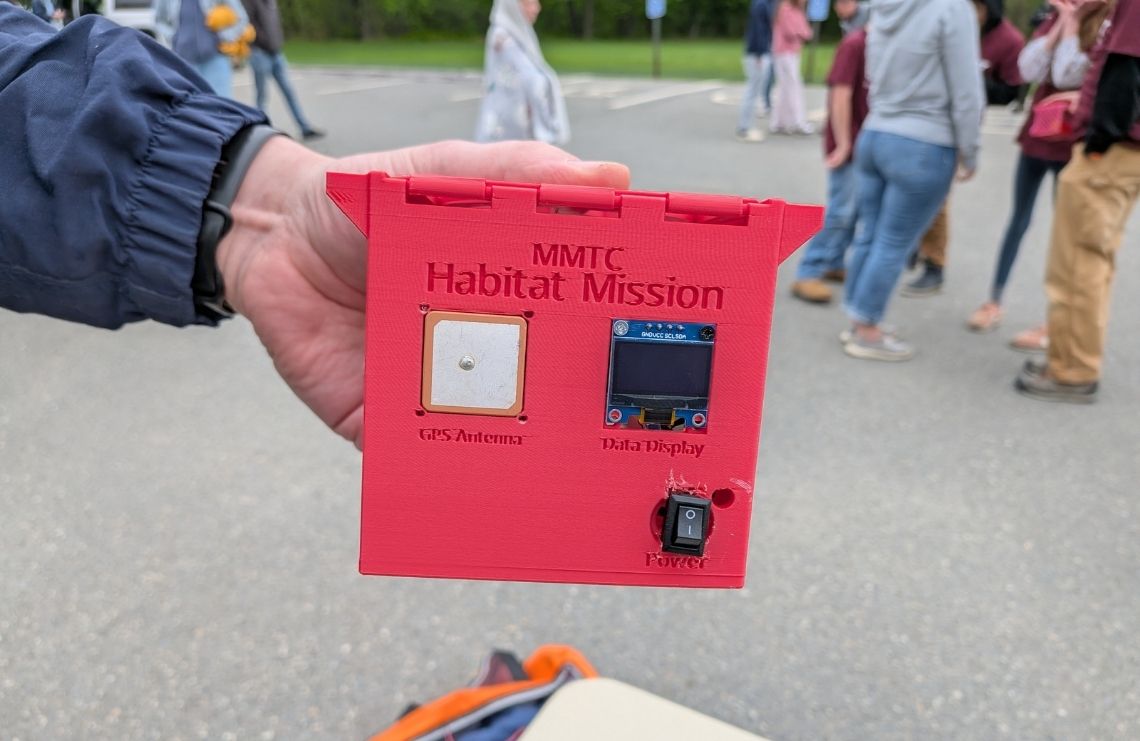
It was amazing the number of teams that were trying to make terrariums or little grow farms. We’ve had people put plants into space, all around the idea that astronauts need to eat on their way to Mars, and they’re going to have to grow their own food. So this year we set a challenge of keeping cricket astronauts alive, and we had a lot of teams choose that mission category. I think it’s just really accessible for students. A lot of them have basic biology knowledge. It doesn’t involve a whole lot of math, electronics, wiring or programming. It’s just: can you build an enclosure and keep a cricket alive?
You have to put three crickets inside your environmental chamber, and to be considered successful, two of them have to survive.
They are surprisingly robust animals, but the coldness of space is a big problem, so you have to figure out how to keep them warm.
Some teams come up with little electric blankets, some put hand warmers in there, some use water as a thermal mass to try to keep them at the right temperature.
We also had a radiation shielding challenge, where students used Geiger counters to measure radiation exposure and tried different shielding strategies, like wrapping their payload in aluminum, to see if they could reduce that exposure.
4.
What actually happens on launch day?
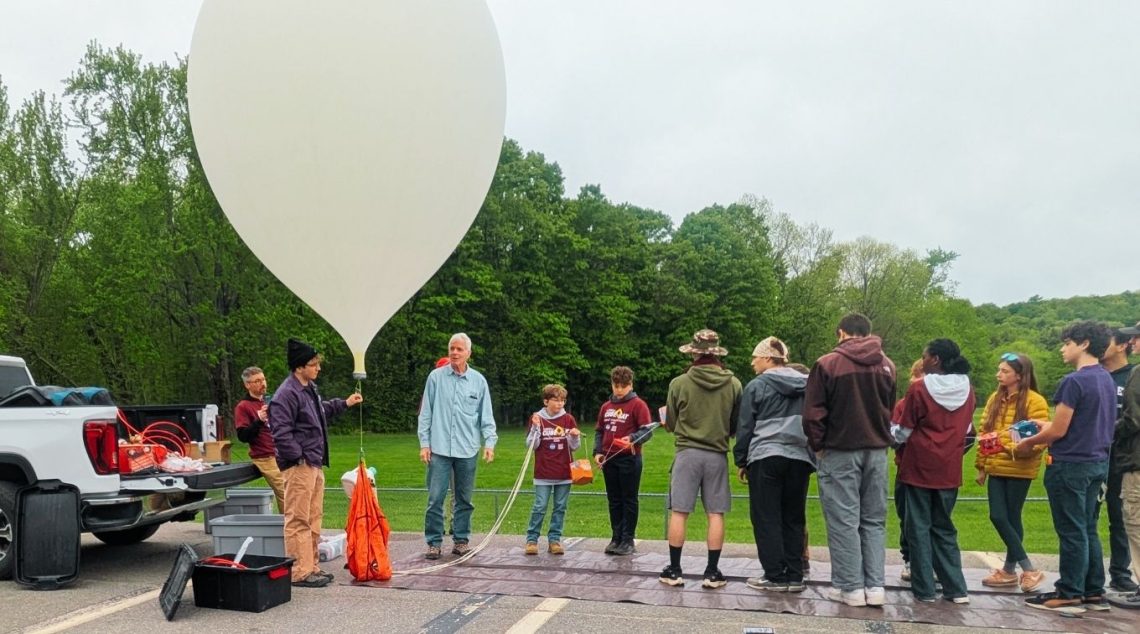
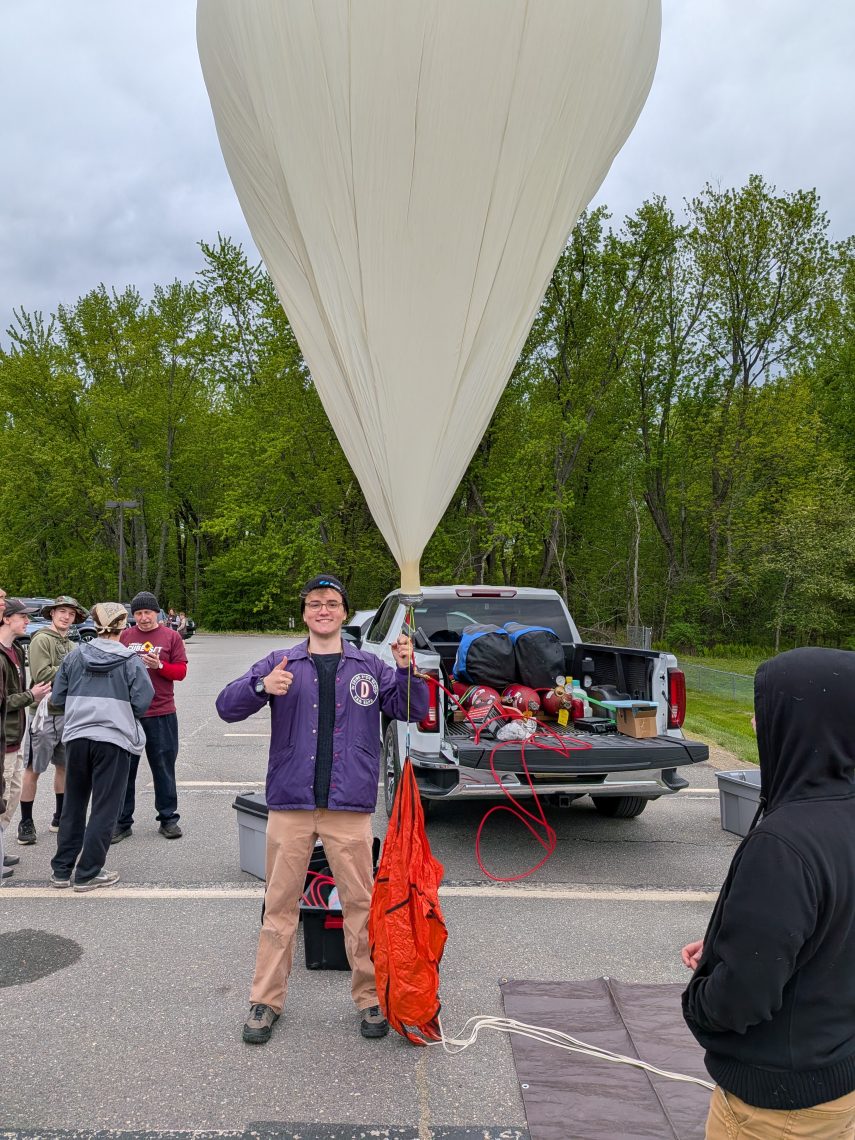
We’ll start typically around 7 or 8 a.m. Teams begin showing up at the launch site, and we lay out these big tarps and string everything up. It’s a great event. All the kids are there, and there’s a lot to do: some are tying up the balloons, some are filling them with hydrogen, others are taking pictures. Once both balloons are up, we tell everybody thanks for coming, but now we have to go. And then the chase is on to recover the balloons from wherever they landed.
5.
How do you track the balloon and recover it once it lands?
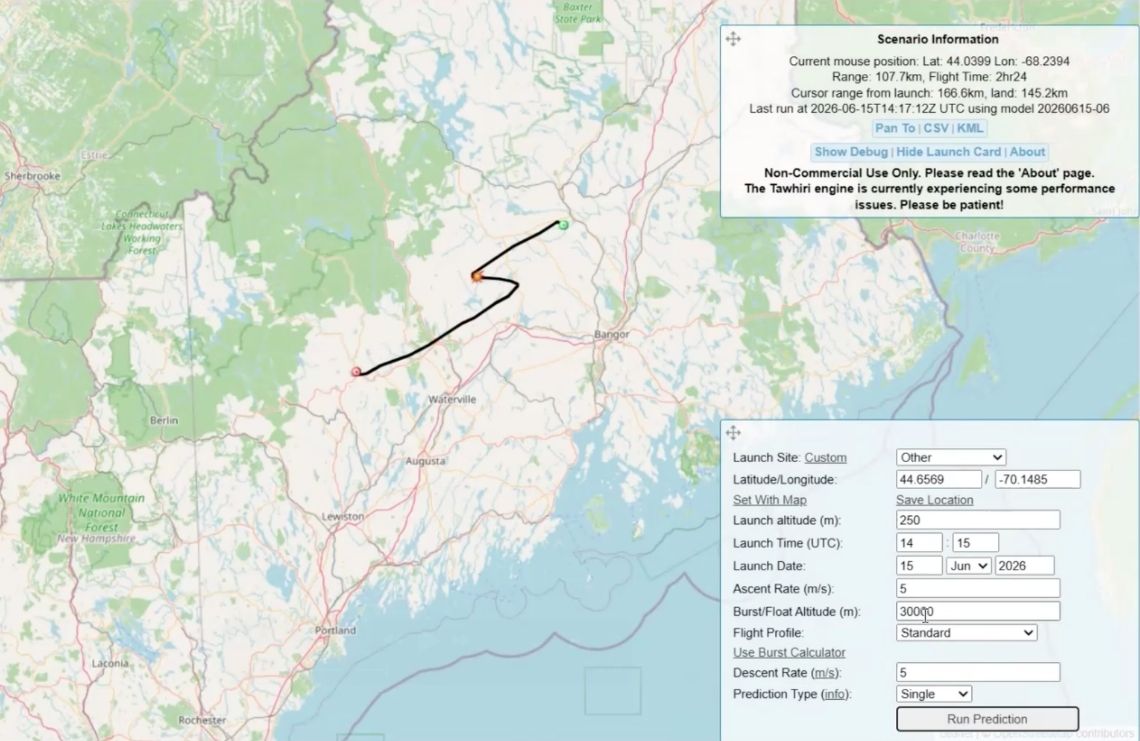
We use a website called the SondeHub Predictor. It takes all the jet stream wind speeds at different altitudes and allows us to run a prediction: if we launch our balloon this day, we’ll reach this height at this speed, here’s the trajectory. It’ll even show you peak altitude, where you expect it to pop, and then fall down to the ground. This turns out to be wildly accurate, within a couple of miles of where we think we will go. But we do have to watch it. On launch day last year, we were launching from Farmington and the predictor put us way out into the ocean. We actually had to wait a day, and then the weather changed, and we were able to hit a different trajectory.
I have to give all the credit for CubeSat recovery to Rick Eason. He was a long time director of the UMaine High Altitude Ballooning program, and he’s now a retired professor from UMaine Orono, but still continues to do balloon launches, completely free of charge, which is amazing. He has three different radio transponders, GPS trackers, GoPro cameras. He’s had over 175 different balloon launches, and I think we’ve done a total of almost ten with him at this point. He’s also an Eagle Scout, so chances are we’re going to land in the middle of a forest, and he’s the kind of guy who just loves to get out there and climb trees.
6.
Who supports this program, and what does that support look like?
The Maine Space Grant Consortium is our primary sponsor. In the past we secured a five-year grant with them to do the K-12 programming. They also helped us install our CubeSat Design Laboratory in the John Mitchell Center. But we reach out to private individuals and companies, and we have gotten some generous donations along the way, too.
7.
Is USM’s program unique, or are other schools doing this too?
This is very unique. We wrote a publication a couple of years ago based on some of the work we did, and we published that with the American Society for Engineering Education, which was well received. It was basically survey data from our students showing the quality of skill development we do through the program. I have heard of a couple others across the nation, but they’re pretty few and far between. I would say the scale of the program that we have, and the number of students that we onboard each year, we are very unique nationally.
8.
What do you want students who are curious about this to know?
I’m always looking for new entries, and I’d put a big shout-out for those who find it interesting but are too scared to join. There’s always this barrier because it’s new, and people don’t know if they’re good enough for this. Apply. We’re here to help. That’s our whole goal: we want to get people who don’t have skills and help them develop skills.
We do see a lot of the high-achieving high schools currently coming in, like Maine School of Science and Math, Falmouth, and Portland. They have a robust pre-engineering program. I want to get more of the schools in rural Maine who have eight kids who are just super excited about space but have no idea how to get started. Those are the people I would love to talk to.