
Thinking about an Occupational Therapy Assistant Career? 5 Questions Answered
June 9, 2026
|
by Benjamin Joseph
Students considering careers in healthcare often want a clearer picture of what the work looks like beyond the classroom. Occupational therapy assistants (OTAs) work directly with individuals facing physical, cognitive, or environmental challenges to help them adapt and participate more fully in daily life. They collaborate closely with occupational therapists (OTs) as part of the care team.
John Krasnavage, an occupational therapy assistant and faculty member in the Occupational Therapy Assistant–Bachelor (OTA-B) program at the University of Southern Maine, offers a closer look at the profession. In this Q&A, he shares how he entered the field, what the work involves, and what students should know when exploring OT as a career.
Q:
What first made occupational therapy feel like the right career for you?
A:
I knew occupational therapy was the right path when I experienced a fieldwork placement in a mental health setting. The mixing of evidence-based research, philosophy, psychology, and creativity to help individuals overcome barriers to live a more meaningful life made me immediately realize that I had chosen the right profession.
Q:
What qualities help someone thrive as an occupational therapy assistant?
A:
The great thing about OT is that previous life experience is part of what makes every practitioner special.
Some qualities that make a practitioner effective include empathy, creativity, authenticity, a sense of humor, curiosity, integrity, and dependability, to name a few.
Q:
What do occupational therapy assistants actually do?
A:
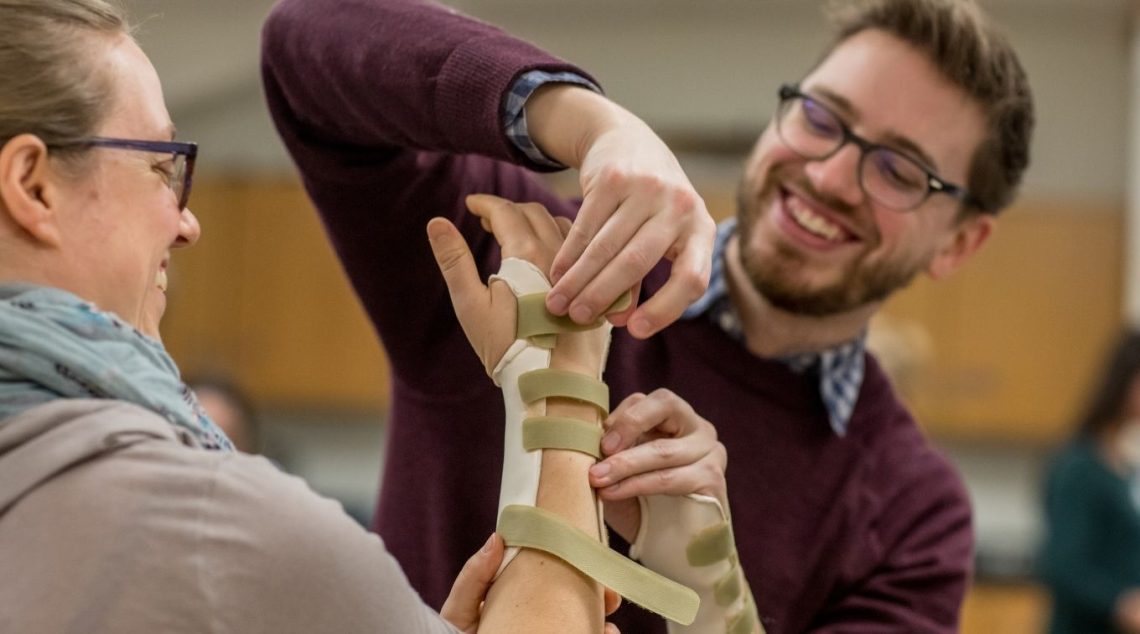
A common misconception of an OTA is that they assist the OT. In reality, OTAs assist the therapy process and collaborate with the OT to create meaningful and unique interventions to meet client goals.
Another common misconception is that our profession ‘gets people back to work.’ While this may be the case sometimes, OTAs also assist people with barriers and deficits, adapt how they perform a task, modify their environment, and/or rehabilitate their body and mind based on what is most meaningful to them.
I like to say that the profession focuses on ‘the job of life.’
Q:
Is there a moment in your career that reminds you why this work matters?
A:
It’s tough to pick just one! My favorite moments are when I witness a client make progress in their recovery by using the skills offered by the OT groups and they realize that they have accomplished something that they were unable to do a week prior.
I call this an ‘ah-ha’ moment. Whether it is a client or a student, when the process starts to make sense, it always reminds me how much our work matters.

Q:
What advice would you give students thinking about this career path?
A:
My advice would be to research what OT looks like in different practice environments, do a job shadow or two, and ALWAYS trust the process.
Bonus: What advice would you give students thinking about this career path?
I am most excited about the OT Compact, which allows practitioners to practice in any state that is a member. This will continue to open up the possibilities for OT practice and provide care to even more people across the United States who may not otherwise have access to OT services!
Occupational therapy continues to grow as healthcare providers look for ways to support people in living fuller and more independent lives. For students who enjoy problem solving, working closely with others, and adapting creative solutions to real challenges, the field offers a wide range of possibilities.