
Making Play Possible: How USM Students Build Adaptive Cars for Go Baby Go
July 16, 2026
|
by Benjamin Joseph
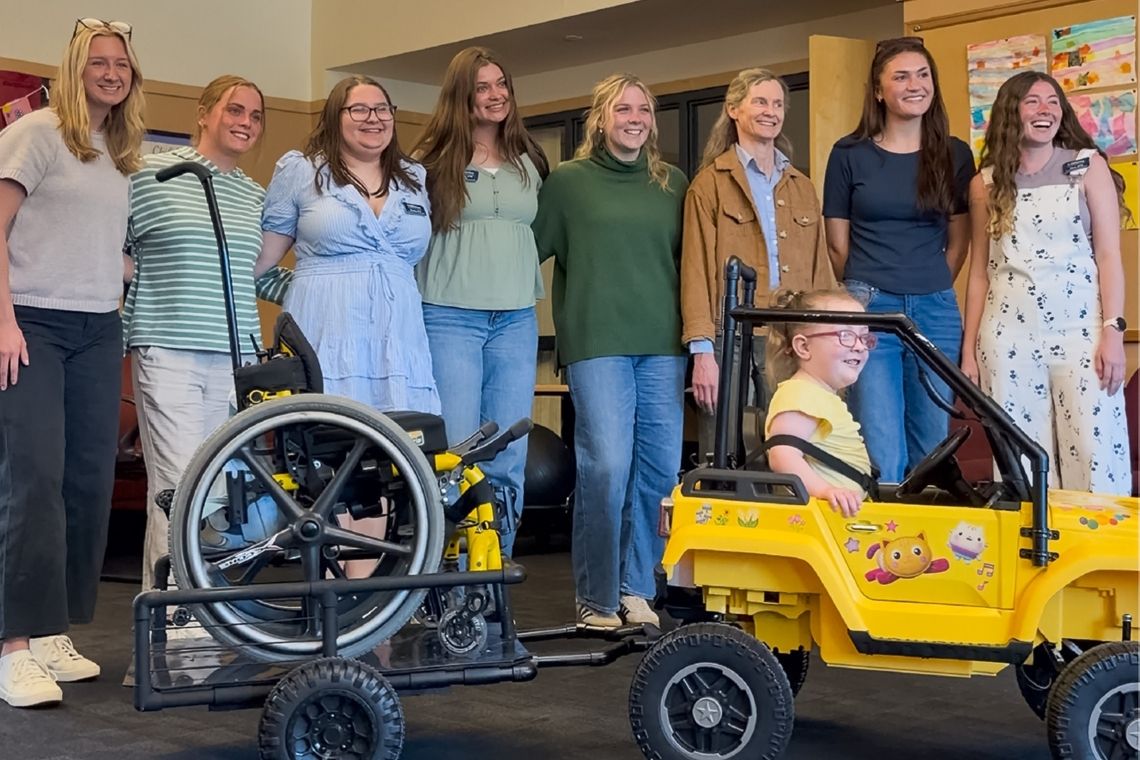
From the seat of her wheelchair, 3-year-old Claire has always watched her 8-year-old sister pull ahead, pedaling a bike she could never quite keep pace with. That all changed when engineering and occupational therapy students at the University of Southern Maine teamed up on a solution: a toy car built just for Claire, giving her the chance to keep up all on her own.
Claire has spina bifida, a condition that affects her lower back and limits movement in her legs. Her mom, Samantha Fortier Steward, said the diagnosis was presented with limitations rather than possibilities.
“The doctors tell you a lot about what can’t be done,” Fortier Steward said. “But there isn’t a whole lot they talk about when it comes to what can be done.”
The ride-on toy cars sold in stores are built around foot pedals, so getting Claire behind the wheel would take a redesign, not a shopping trip. Searching online for inclusive activities, Fortier Steward found her answer at USM.
Building mobility through Go Baby Go
The project is part of Go Baby Go, a national community-based outreach program with a much larger mission.
“Go Baby Go is a nationwide initiative to modify toy ride-on cars for kids with disabilities and make them into mobility devices,” said Daylin Soule ‘26, a mechanical engineering major from Lyman and who served as the project’s student lead.
This marks the project’s second donation to a Maine family — the first was in January.
The work runs on a simple rhythm. Occupational therapy students evaluated how Claire actually uses the car, and engineering students translated that into the next version of the design.
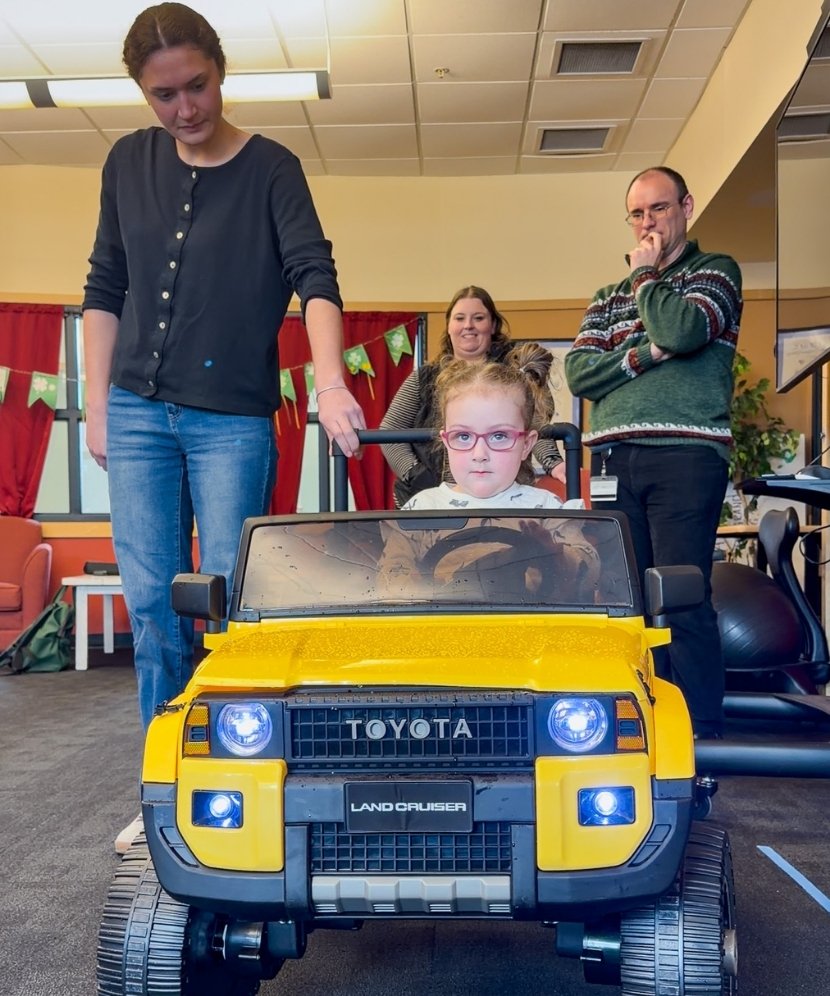
“Our role is making sure that this is adapted to her, being able to get in and out of the car, making sure that it is safe while she does that,” said Paris Howes, an occupational therapy student. “Pretty much making sure she can do this as independently as possible.”
Customized for Claire
Every detail of the finished car reflects the collaboration between OT and engineering students.
When the team watched Claire work to pull herself from her wheelchair into the driver’s seat, the seat moved back to give her room to board on her own. And when the OT students kept seeing her reach for something to hold onto that the car didn’t have, the lightbulb went on: custom handles, mounted right on the roll cage.
“From my perspective, just looking at the car, it was structurally sound,” Soule said. “However, adding those couple of handles really made an improvement and made Claire feel safer driving the car.”
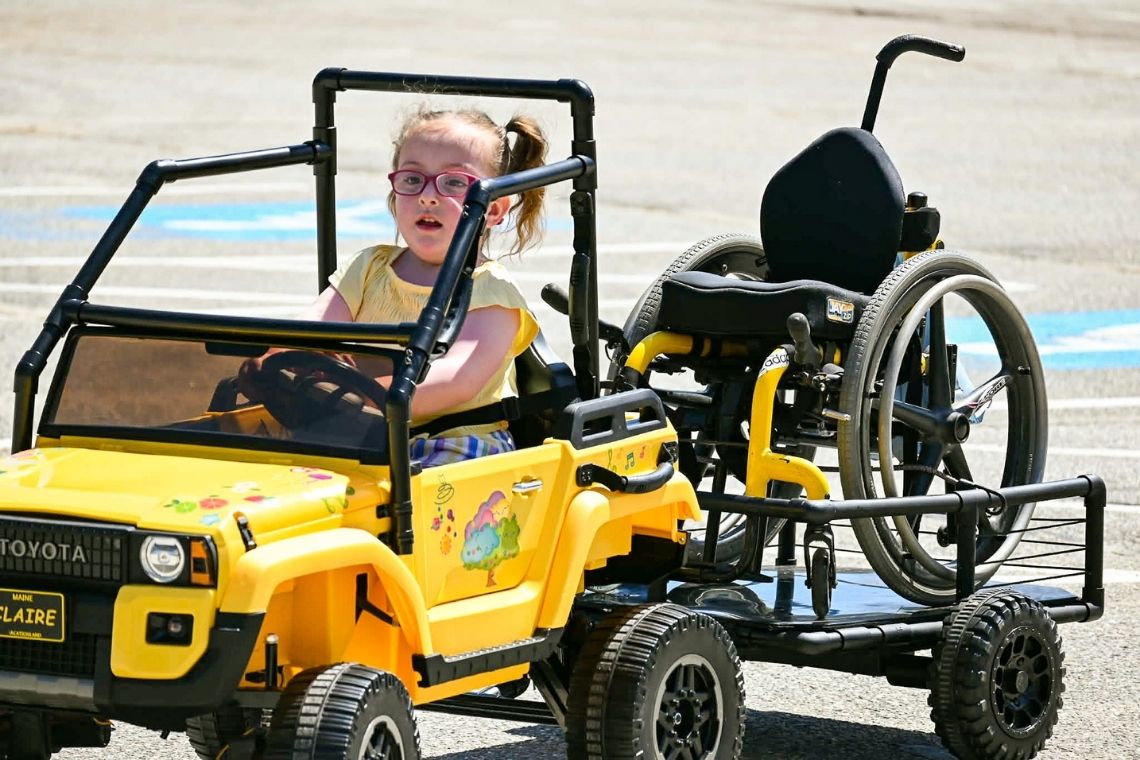
Piece by piece, the rest followed: a foot accelerator rewired into hand controls, a five-point harness, and a detachable trailer that can haul her wheelchair or her toys — each addition designed around Claire’s independence.
“As mechanical engineering students, we’re able to bring the functionality and the safety and the structure,” Soule said. “But without the OT students, we wouldn’t have the comfort or the interaction that the child really needs for a custom vehicle.”
Designing with people in mind
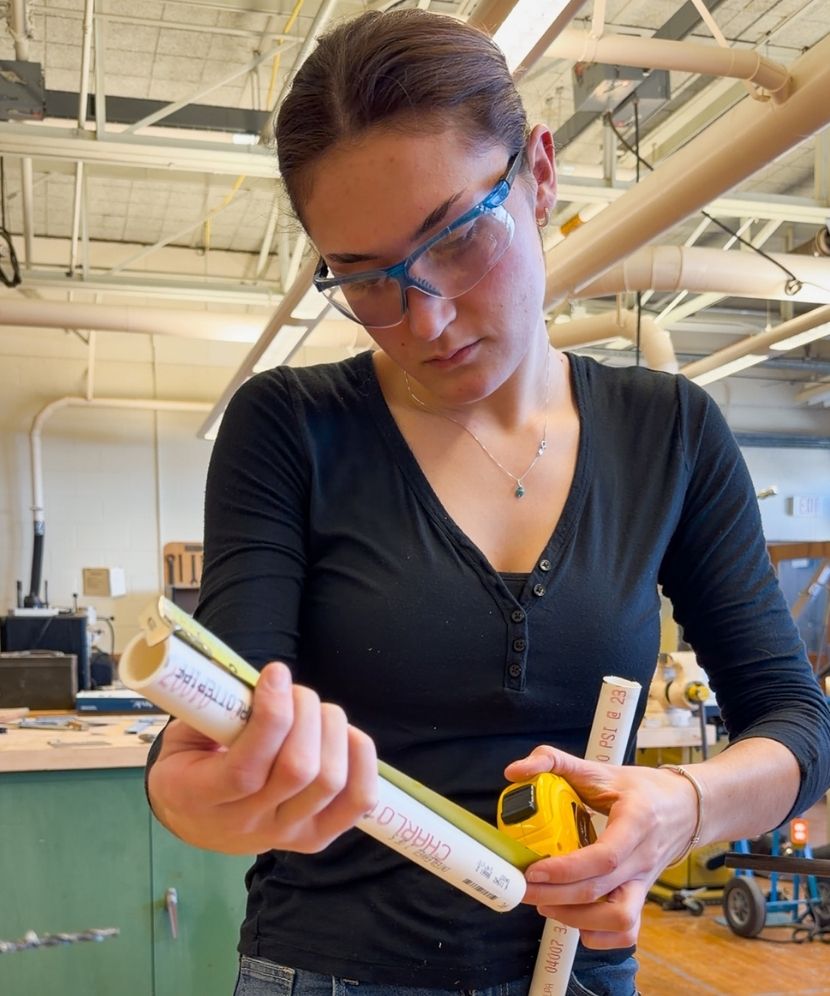
Scott Eaton, chair of the Department of Engineering, sees that collaboration as the type of hands-on, interdisciplinary learning that prepares students to solve real-world problems..
“They really bring a new perspective into our engineering design process,” Eaton said of the occupational therapy team. “We’re taking the technical engineering requirements and matching it to the human experience.”
This project takes students beyond the classroom and into the community.
“This is an opportunity for students to really be able to take their skills, meet some of the community and actually use it to benefit the society around them,” Eaton said.
Go Baby Go is just getting started at USM, and the upcoming move of occupational therapy to the Gorham campus will create even more opportunities for collaboration.
“We’re really excited to be able to partner with them in sustaining this program into the future,” Eaton said.
More than just a car
For Claire’s mom, the small, yellow car represents something much bigger: independence.
And for Soule, the project’s impact was found in those personal touches, like the trailer and cup holder — rebuilt after Claire’s second fitting to fit the cup she loves. The experience reinforced for Soule that engineering was the right path.
“Working with Claire and getting to see her actually use the mobility device was really a full circle moment,” Soule said. “Really seeing that be put into use and feel like I could make a difference and help somebody out, it really makes it feel like this was a really good degree for me.”